Yolanda Schaerli

68 Followers
17 Following
6 Posts
Associate Professor, Bacterial Synthetic Biology, Department of Fundamental Microbiology, University of Lausanne

Congratulations to our UNIL iGEM team !
๐Ÿ… Gold medal
๐Ÿ† Nominated for conservation project
๐Ÿ† Nominated for best wiki
๐Ÿ† Nominated for best presentation

We are very proud of you!
Learn more about their cool project about invasive Asian hornets: https://2024.igem.wiki/unilausanne/

| UNILausanne - iGEM 2024

Very happy to share our latest preprint: Amazing @astri engineered inducible phagemid transfer for CRISPR-based gene regulation and computation in multicellular E. coli consortia.
Engineering Intercellular Communication using M13 Phagemid and CRISPR-based Gene Regulation for Multicellular Computing in Escherichia coli https://www.biorxiv.org/content/10.1101/2024.08.28.610043v1?med=mas

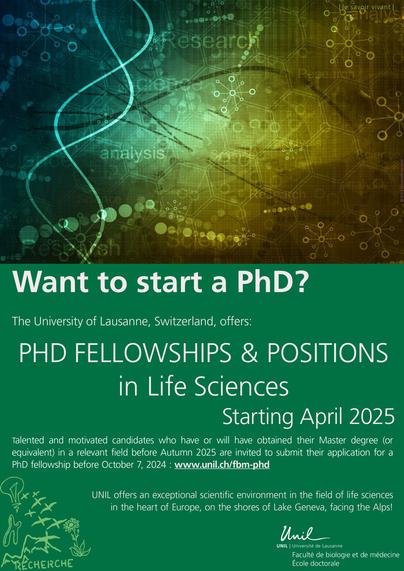
Interested in applying for a fellowship to do a PhD @unil with my lab (bacterial synthetic biology) as a host? Send me a CV and a motivation letter till September 6th!

https://www.unil.ch/ecoledoctoralefbm/en/home/menuinst/doctorate/phd-in-life-sciences/fellowships.html

Fellowships

Page Fellowships of site Doctoral School of the Faculty of Biology and Medicine hosted by the University of Lausanne

Very happy to see the โ€œoptoscillatorโ€ - a synthetic optogenetic oscillator - published! By applying light pulses on growing E. coli colonies and analysing the ring patterns, we observed synchronisation, (subharmonic) resonance, period doubling and chaos!

https://www.nature.com/articles/s41467-024-51626-w

From resonance to chaos by modulating spatiotemporal patterns through a synthetic optogenetic oscillator - Nature Communications

Oscillations are a recurrent phenomenon in biological systems across scales, but deciphering their fundamental principles is very challenging. Here the authors construct a synthetic oscillator in bacteria that can be controlled by light and show that different light conditions can generate complex dynamics that are transformed into distinct spatial ring patterns in bacterial colonies.

Nature