| Events | |
| Research | |
| Learning | |
| Collaborations |
| Events | |
| Research | |
| Learning | |
| Collaborations |
When asked to indicate support or lack of support for a variety of political statements, ChatGPT's responses tend to replicate a liberal point of view, albeit with logical inconsistencies, emblematizing the issue of bias embedded in AI systems through their datasets and human trainers.
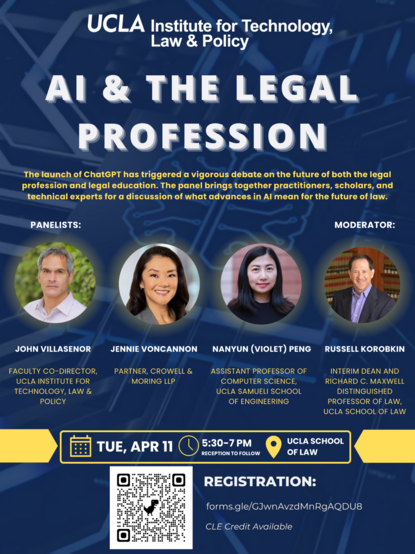
On April 11, ITLP will be hosting a panel at UCLA Law on the impact of AI on the legal profession:
We'll also be offering CLE credit, and the event is free and open to all.
You can register at: https://docs.google.com/forms/d/1pWQPnbAEhSP_9MWvTOHQfx4Ya10IZtIJDaCd6XVHYOU/viewform?edit_requested=true
When: Tuesday, April 11 | 5:30 PM - 7:30 PM Where: UCLA School of Law, Room 1347 The launch of ChatGPT has triggered a vigorous debate on the future of both the legal profession and legal education, as well as the evolving role of lawyers and technology in the practice of law. The panel event, which is hosted by the UCLA Institute for Technology, Law & Policy, brings together practitioners, scholars, and technical experts for a discussion of what advances in Al mean for the future of law. Panelists: John Villasenor, Faculty Co-Director, UCLA Institute for Technology, Law & Policy Jennie VonCannon, Partner, Crowell & Moring LLP Nanyun (Violet) Peng, Assistant Professor of Computer Science, UCLA Samueli School of Engineering Moderator: • Russell Korobkin, Interim Dean and Richard C. Maxwell Distinguished Professor of Law, UCLA School of Law
The 4th and 5th articles in our @cjr series on platforms & the press are live!
Alvin Ntibinyane of INK Centre for Investigative Journalism introduces citizen digitalization in Africa, and Wesley Gibbings of the Caribbean Investigative Journalism Network discusses challenges to viability facing Caribbean media:
<p>This is part of a series on platforms and the press published jointly by CJR and the UCLA Institute for Technology, Law & Policy. Chronically vulnerable to small market size, narrow advertising bases, brittle economies, and high susceptibility to natural disasters, the Caribbean media sector was initially keen, in the 1990s, to embrace digital technologies—with […]</p>