

Tony Vladusich

@TonyVladusich
0 Followers
45 Following
362 Posts
I'm a computational neuroscientist & software engineer. Colors, photos, brains, nature, science, software & chess, preferably all at the same time!
@troy_s I reposted but seriously doubt I was the source

I’ve lost follower acquaintances for saying this, so I’m saying it again: If you think that Statistical Nonsense Machines (wrong terms “AI” or “ML”) make art, you don’t have a clue what art is.

No, really. Go study it.

Art is sociological artifact. Remove the cognition to create interpreted intent in relation to the sign and signified, and the concept of “art” is removed.

Literally *not* art.

@Riedl jfc
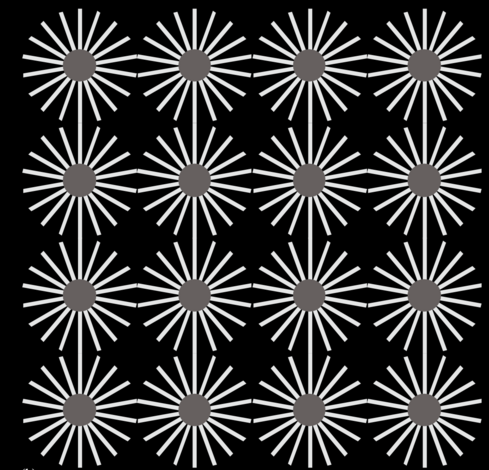
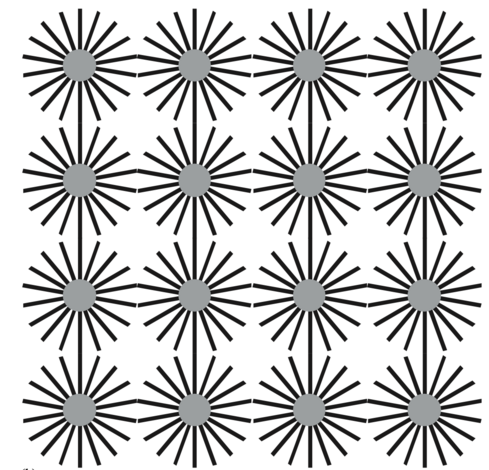
looking at these you can really get a gut feel for the idea that grey shades do NOT form a 1-D continuum: one simply cannot conceive of the disks on the black background with white spokes as "living in the same space" as the disks surrounded by white background and black spokes. indeed, adjusting the luminance of one set of disks will never lead to a match with the other set. yet the classical 1-D conception predicts that there should be a match (see https://journals.plos.org/ploscompbiol/article?id=10.1371/journal.pcbi.0030179)
Brightness and Darkness as Perceptual Dimensions

Author SummaryVision scientists have long adhered to the classic opponent-coding theory of vision, which states that bright–dark, red–green, and blue–yellow form mutually exclusive color pairs. According to this theory, it is not possible to see both brightness and darkness at a single spatial location, or an extended set of locations, such as a uniform surface. One corollary of this statement is that all perceivable grey shades vary along a continuum from bright to dark. At first glance, the notion that brightness and darkness cannot coexist on a single surface accords with our common-sense notion that a given grey shade cannot be simultaneously both brighter and darker than any other grey shade. The results presented here suggest that this common-sense notion is not supported by experimental data. Our results imply that a given grey shade can indeed be simultaneously brighter and darker than another grey shade. This seemingly paradoxical conclusion arises naturally if one assumes that brightness and darkness constitute the dimensions of a two-dimensional perceptual space in which points represent grey shades. Our results may encourage scientists working in related fields to question the assumption that perceptual variables, rather than sensory variables, are encoded in opponent pairs.

Lustre, original and inverted, after Pinna et al
@ekmiller @bwyble @kendmiller @strangetruther @achristensen56 @NicoleCRust @DrYohanJohn natural corollary to all this is that at some point we are all forced to ignore the elephant in the room 😂
@ekmiller @bwyble @kendmiller @strangetruther @achristensen56 @NicoleCRust @DrYohanJohn yeah, maybe it's a bit harsh to say it's not "new". that's just the way these things go sometimes. somebody touches the tail, but can't feel the trunk. somebody else comes along and feels tail and trunk. soon enough an elephant emerges. ideas sometimes just have the "right" time to ripen!
@ekmiller @bwyble @kendmiller @strangetruther @achristensen56 @NicoleCRust @DrYohanJohn I think there may be a canonical example already available of the idea of a "representational field"that is identical to the mathematical formulation of an electrostatic field -> see https://mastodon.social/@TonyVladusich/109672820236070121. btw, none of this is actually new. Kohler posited an electric field representation to account for perceptual grouping phenomena in the Gestaltist mould -> see https://www.ncbi.nlm.nih.gov/pmc/articles/PMC3482144/
A Century of Gestalt Psychology in Visual Perception I. Perceptual Grouping and Figure-Ground Organization

In 1912, Max Wertheimer published his paper on phi motion, widely recognized as the start of Gestalt psychology. Because of its continued relevance in modern psychology, this centennial anniversary is an excellent opportunity to take stock of what Gestalt ...

PubMed Central (PMC)
It’s very funny to me that the dominant Twentieth Century conception of AI was a slightly awkward nerd with an inhuman mastery of facts and logic, when what we actually got is smooth-talking bullshit artists who can’t do eighth-grade math.
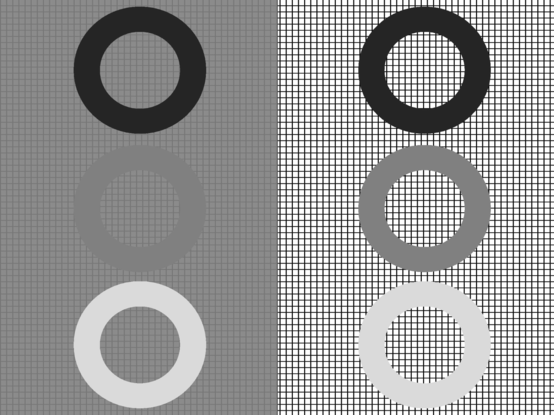
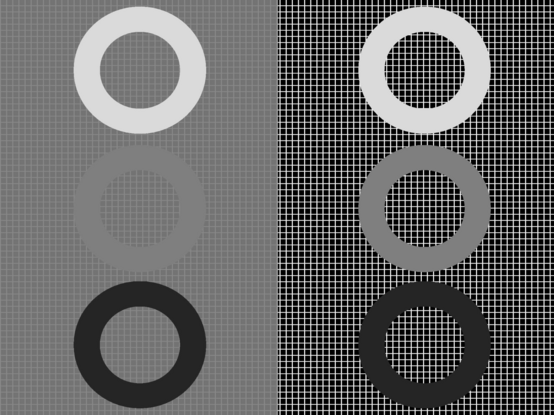
Achromatic rings & inverted rings