
Tony Vladusich

@TonyVladusich
0 Followers
45 Following
362 Posts
I'm a computational neuroscientist & software engineer. Colors, photos, brains, nature, science, software & chess, preferably all at the same time!

I’ve lost follower acquaintances for saying this, so I’m saying it again: If you think that Statistical Nonsense Machines (wrong terms “AI” or “ML”) make art, you don’t have a clue what art is.

No, really. Go study it.

Art is sociological artifact. Remove the cognition to create interpreted intent in relation to the sign and signified, and the concept of “art” is removed.

Literally *not* art.

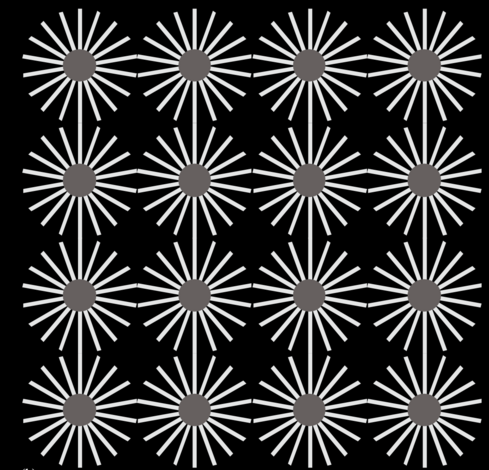
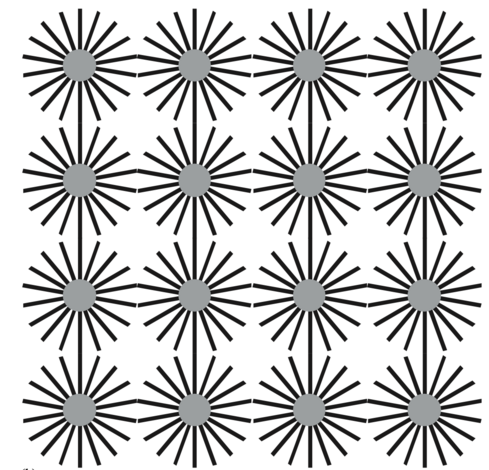
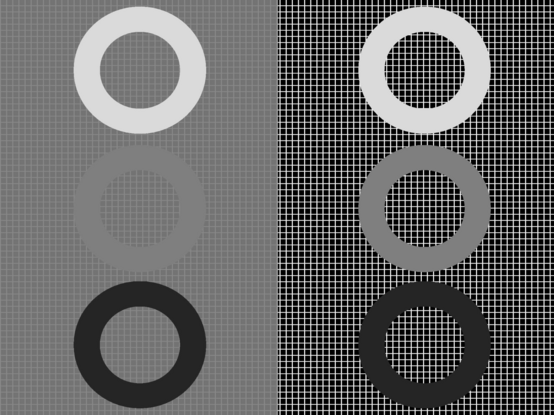
looking at these you can really get a gut feel for the idea that grey shades do NOT form a 1-D continuum: one simply cannot conceive of the disks on the black background with white spokes as "living in the same space" as the disks surrounded by white background and black spokes. indeed, adjusting the luminance of one set of disks will never lead to a match with the other set. yet the classical 1-D conception predicts that there should be a match (see https://journals.plos.org/ploscompbiol/article?id=10.1371/journal.pcbi.0030179)
Brightness and Darkness as Perceptual Dimensions

Author SummaryVision scientists have long adhered to the classic opponent-coding theory of vision, which states that bright–dark, red–green, and blue–yellow form mutually exclusive color pairs. According to this theory, it is not possible to see both brightness and darkness at a single spatial location, or an extended set of locations, such as a uniform surface. One corollary of this statement is that all perceivable grey shades vary along a continuum from bright to dark. At first glance, the notion that brightness and darkness cannot coexist on a single surface accords with our common-sense notion that a given grey shade cannot be simultaneously both brighter and darker than any other grey shade. The results presented here suggest that this common-sense notion is not supported by experimental data. Our results imply that a given grey shade can indeed be simultaneously brighter and darker than another grey shade. This seemingly paradoxical conclusion arises naturally if one assumes that brightness and darkness constitute the dimensions of a two-dimensional perceptual space in which points represent grey shades. Our results may encourage scientists working in related fields to question the assumption that perceptual variables, rather than sensory variables, are encoded in opponent pairs.

Lustre, original and inverted, after Pinna et al
It’s very funny to me that the dominant Twentieth Century conception of AI was a slightly awkward nerd with an inhuman mastery of facts and logic, when what we actually got is smooth-talking bullshit artists who can’t do eighth-grade math.
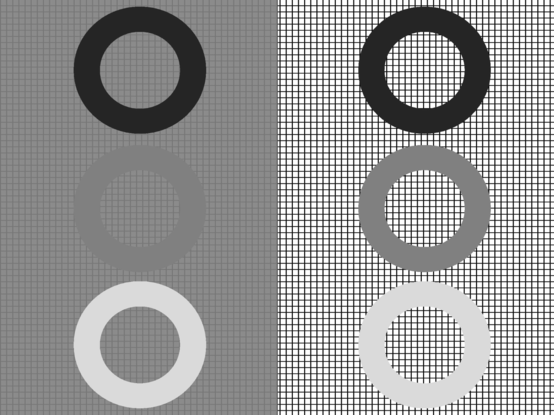
Achromatic rings & inverted rings
Unreal Keanu Reeves

This is the official deepfake channel of actor Keanu Reeves. Like, share, subscribe!

YouTube

Received an amazing review comment for my drawing app Exsto in the US App Store. I really wanted to share it with the world, so attaching a screenshot here 😁

The person who wrote the review described the app better and more eloquently than we did 😅 I should look into using some of their phrases in my future marketing campaigns for the app 😆

And if you want to check out Exsto (a "truly magical iPad app" 😊), it's available on iPad App Store: https://apps.apple.com/app/apple-store/id6444933770

‎Exsto

‎Exsto is an app that helps you to explore your creativity and discover the artist you never knew you were or could be. Relax, unwind, have fun and get a unique digital creation in the end. LET EXSTO GUIDE YOUR JOURNEY OF CREATIVE DISCOVERY. Exsto takes an active part in your creative process by g…

App Store

Mathstodon was not a big enough ecosystem to get the job done on its own. I had to summarize the state of the art in a blog article to attract the attention of the right expert.

I'm not saying this is a bad thing! It's just how it works. I often help solve problems that are too hard for me personally by running around and talking to different people until I bump into the right one. These people are not all sitting in one "place".

(4/n, n = 4)

Yet another AI reproducibility / reliability / generalizability crisis, this time in medicine

https://www.nature.com/articles/d41586-023-00023-2

The reproducibility issues that haunt health-care AI

Health-care systems are rolling out artificial-intelligence tools for diagnosis and monitoring. But how reliable are the models?

Yep. Sounds about right.