Matthew Jennings

@TheISArchitect
6 Followers
24 Following
35 Posts

I'm a cybersecurity architect, instructor, and thought leader with over 20 years of combined experience helping organizations strengthen their security posture across government, financial, and enterprise sectors. Known for bridging the gap between technical implementation and executive decision-making, I bring clarity and strategy to an often-complex security landscape.

My mission is to empower organizations and individuals to make risk-informed, data-driven security decisions.

Websitehttps://survivaltrait.com/
LinkedInhttps://www.linkedin.com/in/jennings-matthew/

Triage is what keeps an incident from becoming five incidents.

It’s how professionals prevent spread and protect what matters most.

Do you have shared triage language for systems during incidents?

#IncidentResponse #CyberSecurity #Leadership #Resilience #RiskManagement

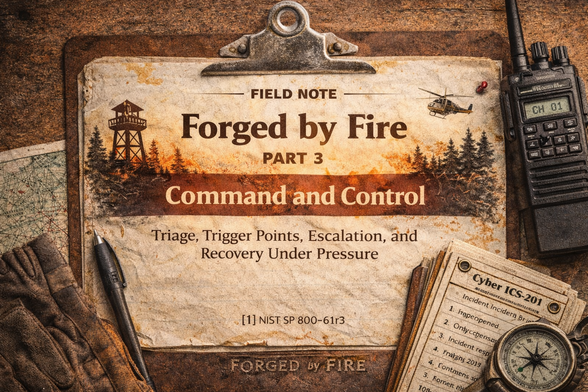
Part 3 is command and control.
If you improvise governance during the incident, you will waste time and take unnecessary damage.
What’s your biggest friction point: authority, comms, triage, or recovery?
https://theisarchitect.substack.com/p/forged-by-fire-part-3-command-and
#IncidentResponse #CyberSecurity #Leadership #RiskManagement #Resilience
Forged by Fire, Part 3: Command and Control

Triage, trigger points, escalation, and recovery under pressure

Matthew's Substack

Part 2 is live: The Field Manual. Templates and pocket cards you can copy and run.

Link: https://theisarchitect.substack.com/p/forged-by-fire-part-2-the-field-manual

#IncidentResponse #CyberSecurity #RiskManagement #Resilience

Forged by Fire, Part 2: The Field Manual

Templates and pocket cards for cyber incident response

Matthew's Substack

A one-page incident briefing prevents the worst failure mode: everyone running in different directions.

Name the incident, declare command, state objectives, set the next update time.

Do you start incidents with a real briefing?

#IncidentResponse #CyberSecurity #Leadership #Resilience #RiskManagement

Part 2 is the gear: The Field Manual.

Pocket-card tools for cyber IR: incident briefing, Cyber LCES, containment menu, recovery sequencing, AAR template.

If you could add only one this quarter, what would it be?

#IncidentResponse #CyberSecurity #RiskManagement #Resilience

Field Note is live: “The New Insider Threat Is Authorized.”

Two risks, one theme: failures that are authorized but violate intent.
Auditability and safe override are not nice-to-haves anymore.

https://theisarchitect.substack.com/p/the-new-insider-threat-is-authorized?r=7cykfo

#InsiderThreat #AIGovernance

The New Insider Threat Is Authorized

There is a comforting story we tell ourselves about insider threat.

Matthew's Substack

If you are rolling out copilots or agents, ask:

1. What can it read?
2. What can it summarize and where can it display it?
3. What is logged?
4. What is the safe mode?
5. Who can disable it quickly?

Full Field Note is on my Substack today.

#InsiderThreat #AIGovernance

Part 1 is live: Forged by Fire. Wildfire incident response doctrine mapped to modern NIST incident response guidance (SP 800-61r3).
Link:
https://open.substack.com/pub/theisarchitect/p/forged-by-fire?r=7cykfo&utm_campaign=post&utm_medium=web&showWelcomeOnShare=true

#IncidentResponse #CyberSecurity #NIST #RiskManagement

Forged by Fire

Wildfire incident response doctrine mapped to NIST Cyber IR

Matthew's Substack
Insider threat is changing.
It is still: access + intent + opportunity.
But now it is also: access + automation + unexpected behavior.
The scary part is that both can happen without “breaking in.”
#InsiderThreat #HumanRisk #AIGovernance
#SecurityArchitecture #DataProtection
Size-up is a loop, not a meeting.
Wildland operations treat risk management as continuous. Cyber IR should too: scope hypothesis, evidence, containment options, reassess, repeat.
Do you run response as a loop or a committee?
#IncidentResponse #CyberSecurity #RiskManagement #Leadership