Taïssa Danilovich

147 Followers
92 Following
103 Posts
I study molecules around evolved stars. Some of the stardust we’re made of. Astronomy/astrophysics researcher, currently in Australia. Formerly Sweden and Belgium.
BlueSky@stellaralchemist.bsky.social
For those curious about what goes into writing a paper, I have written a "Behind the Paper" blog post to accompany my latest publication. You can read it here: https://communities.springernature.com/posts/using-chemistry-to-understand-a-stellar-orbit
Using chemistry to understand a stellar orbit

Springer Nature

This is fine...
"We observed that participants who had access to the AI assistant were more likely to introduce security vulnerabilities for the majority of programming tasks, yet were also more likely to rate their insecure answers as secure compared to those in our control group."

https://arxiv.org/abs/2211.03622

Do Users Write More Insecure Code with AI Assistants?

We conduct the first large-scale user study examining how users interact with an AI Code assistant to solve a variety of security related tasks across different programming languages. Overall, we find that participants who had access to an AI assistant based on OpenAI's codex-davinci-002 model wrote significantly less secure code than those without access. Additionally, participants with access to an AI assistant were more likely to believe they wrote secure code than those without access to the AI assistant. Furthermore, we find that participants who trusted the AI less and engaged more with the language and format of their prompts (e.g. re-phrasing, adjusting temperature) provided code with fewer security vulnerabilities. Finally, in order to better inform the design of future AI-based Code assistants, we provide an in-depth analysis of participants' language and interaction behavior, as well as release our user interface as an instrument to conduct similar studies in the future.

arXiv.org

These types of dying stars are responsible for enriching their galaxies as they throw off material that goes on to become the building blocks of future stars and planets. We study them to better understand this process.

This time, we also got to better understand the star itself, its longer-lived sunlike companion, and how the two are interacting over timescales longer than a human lifetime.

Once more, the full article: https://rdcu.be/du204

And press-release: https://www.monash.edu/science/news-events/news/current/cosmic-chemistry-unveils-stellar-dance-alma-telescope-discovers-hidden-orbit-secrets

We studied a binary system, known as W Aquilae, which is made up of a dying star and a sunlike star. We discovered that the two stars pass very close to each other once a millennium. The last time this happened was around 200 years ago.

We know this because the flyby (or periastron, in scientific terms) left a chemical imprint in the wind of the dying star.

What is a stellar wind? That's the material being ejected as the star dies and throws off its outer layers.

My paper is out today in Nature Astronomy! You can read a summary the press release here: https://www.monash.edu/science/news-events/news/current/cosmic-chemistry-unveils-stellar-dance-alma-telescope-discovers-hidden-orbit-secrets

If you want to see the paper in all its scientific details, you can do so here: https://rdcu.be/du204

More details in thread...

Cosmic chemistry unveils stellar dance: ALMA telescope discovers hidden orbit secrets

Science

In their book “The Dawn of Everything,” David Graeber and David Wengrow provide multiple accounts by early European settler colonists of the indigenous societies they encountered in the woodlands of northeastern North America.

Over and over, these Europeans noted that these societies were well and truly stateless, lacking rulers, laws, courts, police, prisons, or anything like what they were used to in Europe.

They quote one Jesuit, writing in 1644 about the Wendat:

“I do not believe that there is any people on earth freer than they, and less able to allow the subjection of their wills to any power whatever – so much so that Fathers here have no control over their children, or Captains over their subjects, or the Laws of the country over any of them, except in so far as each is pleased to submit to them. There is no punishment which is inflicted on the guilty, and no criminal who is not sure that his life and property are in no danger…”

1/ #thread
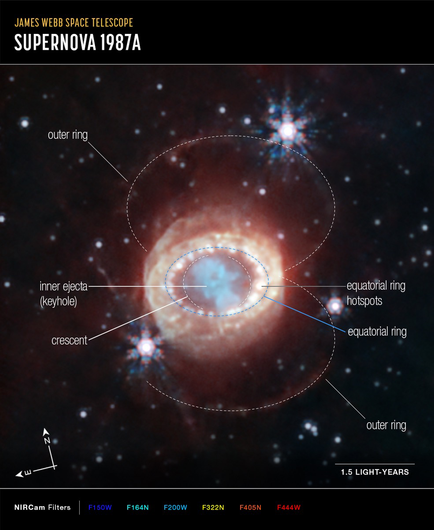
Just catching up on the JWST SN1987A image!

It’s glorious!

In 1987, astronomers around the world witnessed a first in modern times - a nearby supernova.

One of the biggest mysteries to me is why we haven’t seen the neutron star or pulsar that formed during the event.

Wrote about this for #SpaceAustralia … you can read the feature article here: https://www.spaceaustralia.com/feature/did-1987-supernova-produce-pulsar

Also …. hurry up pulsar!

#Astrodon #Astronomy #Pulsar #Supernova

Did the 1987 Supernova Produce A Pulsar? | Spaceaustralia

35 years ago, a bright new star appeared in a relatively close southern galaxy. A massive star had died in a spectacular supernova, providing astronomers with the first opportunity in about 400 years to study a relatively nearby event. But to this day, a mystery still remains – what did the supernova leave behind?

This is the kind of dream #photography that many would like to #shoot. This #picture from Petr Horálek taken in the #Maldives last February shows the #MilkyWay over a beach, with a #meteor passing by.

What's make this #image so gorgeous is the #bioluminescence of the #planktons, which are even brighter than the stars.

Just a pity the #sky is polluted by artificial #lights.

Credits: Petr Horálek / #TWAN
Source: https://twanight.org/gallery/the-lights-of-thodoo-nights

#Astronomy #Sky #Space #Astrophotography #Night #Star

Lots more technical details in the paper itself, but that's the basic gist. https://arxiv.org/abs/2302.06221
The unusual 3D distribution of NaCl around the AGB star IK Tau

NaCl is a diatomic molecule with a large dipole moment, which allows for its detection even at relatively small abundances. It has been detected towards several evolved stars, among which is the AGB star IK Tau, around which it is distributed in several clumps that lie off-center from the star. We aim to study the three-dimensional distribution of NaCl around the AGB star IK Tau, and to obtain the abundance of NaCl relative to H$_2$ for each of the clumps. First, a new value for the maximum expansion velocity is determined. The observed ALMA channel maps are then deprojected to create a three-dimensional model of the distribution of NaCl. This model is then used as input for the radiative transfer modelling code magritte, which is used to obtain the NaCl abundances of each of the clumps by comparing the observations with the results of the magritte simulations. Additionally, the rotational temperature of the clumps is determined using population diagrams. We derive an updated value for the maximum expansion velocity of IK Tau $\upsilon_\mathrm{exp}$ = 28.4 km/s. A spiral-like shape can be discerned in our three-dimensional distribution model of the NaCl. This spiral lies more or less in the plane of the sky. The distribution is also flatter in the line-of-sight direction than in the plane of the sky. We find clump abundances between $9 \times 10^{-9}$ and $5 \times 10^{-8}$ relative to H$_2$, where the relative abundance is typically lower for clumps closer to the star. For the first time, we used deprojection to understand the three-dimensional environment of an AGB star and calculated the fractional abundance of NaCl in clumps surrounding the star.

arXiv.org