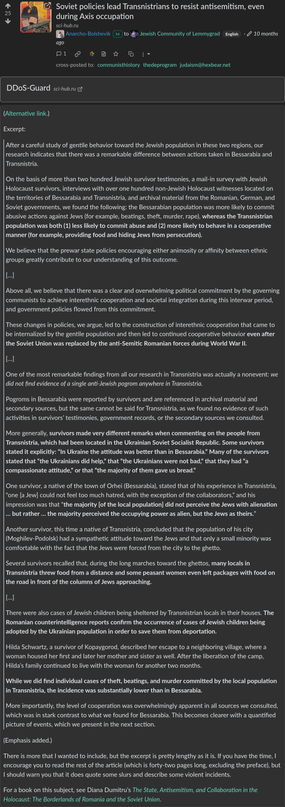
tankie claims there was never anti-Semitism in the USSR and cites Russian media as "evidence"

you don’t seem to understand that every country has the right to self-determination, including defending itself from hordes of cultural Marxists and Jihadists if necessary
if you got a problem with the right to self-defense, you are more than welcome to move to Cuba or North Korea
tankie claims there was never anti-Semitism in the USSR and cites Russian media as "evidence"
I know that BulldogMuhammad is an easy target, but this joke is so overrated and misleading that I can’t help myself. >As surprising as it might sound, the Roman Republic had no formal policing forces at all! An unusual point of unity between an ancient polity noted for its sense of hierarchy, and hierarchy-averse modern anarchist ideology! What’s the problem with this? I’ll tell you what the problem is. Quoting Christopher J. Fuhrmann in The Oxford Handbook of Roman Law and Society, page 298 [https://books.google.com/books?id=cOEoDQAAQBAJ&pg=PA298]: >Yet casual readers might form the impression that Rome was completely without police, and rarely intervened in matters of public order. A generation of undergraduate students has absorbed the same message from the lecture hall: Rome had no police. This claim is untrue, and recent work on ancient policing [https://ojs.bibl.u-szeged.hu/index.php/suc/article/download/47763/46027] is hopefully beginning to correct that misconception. > >For our purposes, the working definition of police covers any group of men armed or organised by the state, who compelled civilians to obey laws, or otherwise imposed the state’s will, including official guards, market inspectors, arrest parties, prison staff and Roman soldiers tasked with temporary security duties in civilian areas. > >Police institutions typically were not planned out as such, but evolved from the accrual of ad hoc administrative innovations. Policing measures were normally motivated by the cynical interests of the state, its rulers and society’s élites, but this unsurprising fact does not preclude incidental benefits to others; in fact, we have some explicit evidence for governmental concern towards ordinary people and their safety. > >The scattered nature of the evidence, and the unsystematic development of the relevant institutions, makes understanding Roman policing difficult; the effort is rewarding nonetheless for shedding light on an underappreciated aspect of ancient state activity in general, and the practicalities of Roman law and order in particular. No, the Roman Republic did not have ‘cops’ in the modern sense, and there was some self-policing [https://books.google.com/books?id=cOEoDQAAQBAJ&pg=PA297], but it co-existed with Roman élites hiring authorities to protect them along with their property. In other words, formal policing forces did exist to some extent, and joking that the Roman Republic was kinda sorta anarchist because it had no modern police is not funny in the way that you intended; it’s funny only insofar as it makes you look embarrassingly unsophisticated. Rather than admit to cracking a lousy joke based on an oversimplified conclusion, BulldogMuhammad instead defended it to the point of frustration: >That was never denied, dipshit, >It’s astounding that you can say shit like this >No one fucking said Roman society was non-hierarchical as a whole, dipshit, it’s the third fucking sentence in the explanation which you didn’t read, >that’s not how Roman law fucking worked >an utterly fucking stupid reading of both the explanation and of Roman law. >and I again I [sic] fucking quote, Seriously, why keep a topic up if it causes you this much frustration? Are you algophilic? Anyway, if you use Internet memes as substitutes for history research, you may as well go watch The Flintstones if you want to understand prehistoric living better. Read a history book, listen to an audiobook, watch a documentary—whatever you do, don’t rely on Internet memes, especially if they’re BulldogMuhammad’s!
how triggered do you have to be to walk 3 miles just to take down a piece of cloth
why is everybody so sensitive these days
you are the reason more and more businesses are failing right now.
enjoy your economic crisis I guess.
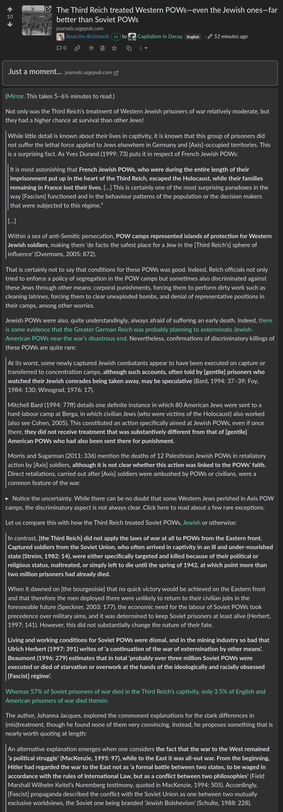
tankies are literally denying the holocaust now
just like every US president ever?
nobody’s forcing you to live there.
LOL
btw did you already see this comment of hers? idk if its concern trolling or butthurt or what but I think somebody might be a little obsessed with you (among other things).

Thumbnail is Marx’s manuscript for The German Ideology. Summary below is a compilation of my notes I wrote when reading Materialism and the Dialectical Method [https://comlib.encryptionin.space/epubs/cornforth1953/] by Maurice Cornforth, along with general knowledge from reading various Marxist authors. Often times, Marxists use the term “material conditions,” and “dialectics.” What does this mean? Why do Marxists care so much about material conditions? The answer is that Marxists seek materialist explanations for observed processes as opposed to idealist, and do so dialectically, as opposed to metaphysically. In other words, Marxists apply dialectical analysis to find materialist explanations for phenomena. Dialectical materialism is the world outlook of the proletariat as a class, and serves as the most vital ideological tool for overthrowing capitalism. In order to understand dialectical materialism, we need to understand its component parts, materialism and dialectics, and their historical predecessors, idealism and metaphysics. *** # Idealism [https://lemmy.ml/pictrs/image/eb4a0933-3129-468e-869d-2ba598c044a7.jpeg] Idealism is, in short, to put ideas prior to matter. Idealism has been used by feudal lords to justify their position above the serfs, forming the ideological basis for feudalism. The 3 major assertions of idealism are as follows: 1. Idealism asserts that the material world is dependent on the spiritual 2. Idealism asserts that spirit, or mind, or idea, can and does exist in separation from matter. (The most extreme form of this assertion is subjective idealism, which asserts that matter does not exist at all but is pure illusion.) 3. Idealism asserts that there exists a realm of the mysterious and unknowable, “above,” or “beyond,” or “behind” what can be ascertained and known by perception, experience, and science. *** # Early Materialism [https://lemmy.ml/pictrs/image/c93a1859-cebb-435f-9df5-fd729757d4db.jpeg] Common idealist arguments are appealing to a supernatural “human nature,” or “good vs. evil” explanations for processes. Materialism arose over time, as people grew to understand the world more deeply, and especially as a tool to overthrow the feudal aristocracy that justified its existence via the church. In other words, materialism rose to help the bourgeoisie. The 3 basic teachings of materialism as counterposed to idealism are: 1. Materialism teaches that the world is by its very nature material, that everything which exists comes into being on the basis of material causes, arises and develops in accordance with the laws of motion of matter. 2. Materialism teaches that matter is objective reality existing outside and independent of the mind; and that far from the mental existing in separation from the material, everything mental or spiritual is a product of material processes. 3. Materialism teaches that the world and its laws are fully knowable, and that while much may not be known there is nothing which is by nature unknowable. *** # Shortcomings of Metaphysical Materialism [https://lemmy.ml/pictrs/image/19bfd580-ef8f-4dce-afe5-73e9c5f851b6.jpeg] The type of materialism that overthrew the feudal lords was still underdeveloped, and metaphysical. The bourgeoisie needed an explanation for why the feudal lords were illegitimate, but still needed to support their own static, permanent rule. This was called mechanistic materialism, for the bourgeois scientists saw the world as a grand machine repeating simple motions forever. Mechanistic materialism, therefore, makes certain dogmatic assumptions: 1. That the world consists of permanent and stable things or particles, with definite, fixed properties; 2. That the particles of matter are by nature inert and no change ever happens except by the action of some external cause; 3. That all motion, all change can be reduced to the mechanical interaction of the separate particles of matter; 4. That each particle has its own fixed nature independent of everything else, and that the relationships between separate things are merely external relationships. *** # Moving from Metaphysics to Dialectics [https://lemmy.ml/pictrs/image/8d77a74c-5859-4014-aebb-d5052c609c33.avif] This, of course, has proven false. History did not end with the dissolution of the USSR, despite what modern mechanistic materialists claim. Mechanistic materialism relies on metaphysics, seeing everything as a static abstraction, devoid of its context. It has no explanation for how new qualities emerge, and ultimately fell to idealism to explain the “first mover,” ie “God.” Dialectical materialism holds instead: 1. The world is not a complex of things but of processes; 2. That matter is inseperable from motion; 3. That the motion of matter comprehends an infinite diversity of forms which arise one from another and pass into one another; 4. That things exist not as separate individual units but in essential relation and interconnection. *** # Dialectical Materialism [https://lemmy.ml/pictrs/image/e5a79e07-790f-4079-9af7-93bf7bbdc6b7.jpeg] This became remarkable for the proletariat, as it sees nothing as static, and therefore marks the eventual downfall of the bourgeoisie. Putting it all together, we get the following: 1. Dialectical materialism understands the world, not as a complex of ready-made things, but as a complex of processes, in which all things go through an uninterrupted change of coming into being and passing away. In other words, when analyzing events and contextualizing them, we must always viee them as a struggle between the rising and the falling, the old and the new, for example the concentration of capital in markets and the rise in socialize labor. [https://lemmy.ml/pictrs/image/2b66a4af-3afe-4f75-b3bf-0f90a9c60eda.jpeg] 2. Dialectical materialism considers that matter is always in motion, that motion is the mode of existence of matter, so that there can no more be matter without motion than motion without matter. Motion does not have to be impressed upon matter by some outside force, but above all it is necessary to look for the inner impulses of development, the self-motion, inherent in all processes. In other words, all movement is a result of contradiction. Your foot presses on the Earth, and the Earth presses back on you. [https://lemmy.ml/pictrs/image/3656ac40-ca7f-4972-bdcd-6bfc3ed5d967.jpeg] 3. Dialectical materialism understands the motion of matter as comprehending all changes and processes in the universe, from mere changes of place right to thinking. It recognizes, therefore, the infinite diversity of the forms of motion of matter from the simple to the complex, from the lower to the higher. In other words, dialectical materialism recognizes that development exists as a change of quantity into quality. Addition or subtraction gives way to qualitative change. A balloon is filled with air, until at a given point it pops due to pressure buildup. Water goes from liquid to gas at its boiling point, and back into liquid when cooling down to said point. [https://lemmy.ml/pictrs/image/d16de8cd-d1a4-41f8-9354-3bc72a4a1da6.jpeg] 4. Dialectical materialism considers that, in the manifold processes taking place in the universe, things come into being, change and pass out of being, not as separate individual units, but in essential relation and interconnection, so that they cannot be understood each separately and by itself but only in their relation and interconnection. In other words, everything is connected, and must be analyzed in context to truly understand it. A worker isn’t just an individual, but instead part of a social class of many workers. Wages are not something invented brand new every time, but instead are set by societal standards, controlled by the ruling capitalist class. [https://lemmy.ml/pictrs/image/7f34b316-53d0-40fa-8720-0ec0786be269.webp] *** # Conclusion Karl Marx created dialectical materialism by turning Hegel’s idealist dialectic into a materialist one. Then, he applied it to the progression of society, creating historical materialism. By analyzing social structures and progress as a dialectical process based in materialism, we can learn from history and analyze where it’s going. This is scientific socialism in progress. Human thought is shaped by our social experience, forming class consciousness and ideology. How we produce and distribute determines our ways of thinking. Socialism and communism also have their own contradictions as well, and just because we progress on to socialism does not mean we cannot fall back to capitalism. The dialectical materialist world outlook understands that nothing is static, and there is always new contradiction and new movement from that. If you keep these in mind, you can do your own dialectical materialist analysis. Always seek explanations based on the material, not the ideal, and always do so by contextualizing the processes, analyzing their contradictions, the unity and struggle of opposing tendencies. Quantitative changes lead to qualitative development, and progresses as a result of the conflict or struggle of opposite tendencies. There’s much more to dialectical materialism, but this should help serve as a simple overview!