
Rienk Eelkema

22 Followers
61 Following
2 Posts
Prof @ TU Delft | org chem | soft matter | responsive materials | radiation | chemical reaction networks

In the paper, we show how to make polymer gels containing coacervate crosslinks, using our recent allylic substitution chemical reaction network. https://pubs.rsc.org/en/content/articlelanding/2022/SC/D2SC00805J & https://www.nature.com/articles/s41467-022-33810-y

These gels are shear shinning and self healing, and can be injected through needles as thin as 26G. Because the coacervate cations are reactive to nucleophiles, the gels disintegrate after injection in culture medium by reaction with amino acids and thiols.

Fuel-driven macromolecular coacervation in complex coacervate core micelles

Fuel-driven macromolecular coacervation is an entry into the transient formation of highly charged, responsive material phases. In this work, we used a chemical reaction network (CRN) to drive the coacervation of macromolecular species readily produced using radical polymerisation methods. The CRN enables tr

Worried about your injectable gels remaining after their use? Make them reactive to biological signals! Just out in Chemical Science: Chemical signal regulated injectable coacervate hydrogels
#openacces #ERCfunded https://t.co/6qAyECQp6K

Phenomenal work by Bohang Wu and Reece Lewis (look out for these two!). Collaboration with Martien Cohen Stuart at ECUST.
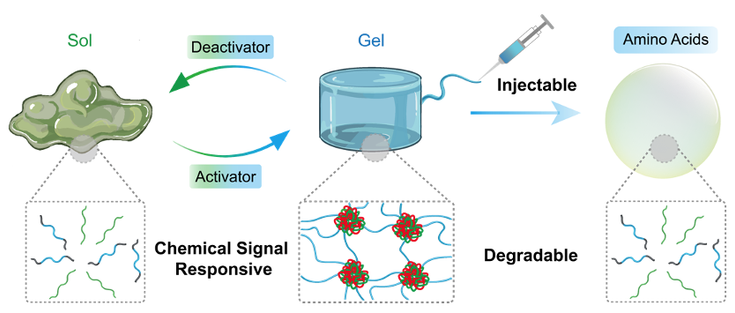
Chemical signal regulated injectable coacervate hydrogels

In the quest for stimuli-responsive materials with specific, controllable functions, coacervate hydrogels have become a promising candidate, featuring sensitive responsiveness to environmental signals enabling control over sol–gel transitions. However, conventional coacervation-based materials are regulated by rela