The battle at Domokos was over. So where did the bedraggled Greek army go on May 18, 1897?
Lamia.
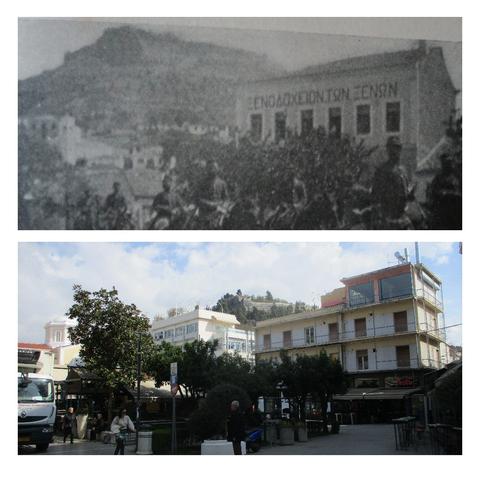
A final Substack Note on the battle... and a bit of Lamia then and now.
| Richard Byrne Plays | https://www.richardbyrneplays.com/ |
| Stage Write | https://richardbyrne.substack.com/ |
The battle at Domokos was over. So where did the bedraggled Greek army go on May 18, 1897?
Lamia.
A final Substack Note on the battle... and a bit of Lamia then and now.
Today - 126 years ago - the last senseless battle of the Greco-Turkish War was fought at Domokos.
My Substack note on the battle and my recent visit to the town:
https://substack.com/profile/601801-richard-byrne/note/c-16202335?utm_source=notes-share-action
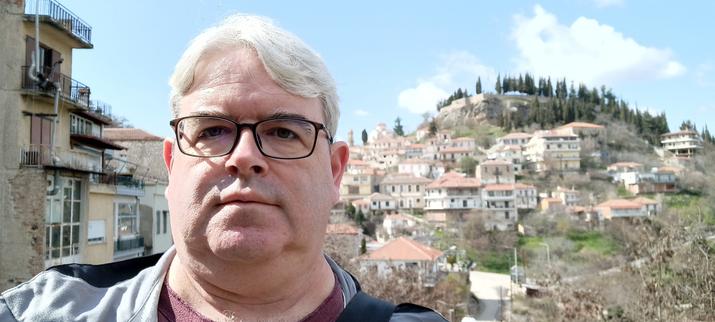
On this day, 126 years ago, a senseless and bloody battle was fought between a surging Ottoman Army and a demoralized Greek Army in Thessaly in a town called Domokos. The Greeks knew the war was lost, and there was talk of an armistice. The battle on May 17, 1897 was so senseless, in fact, that a number of journalists thought that common sense dictated that it should not be fought — and that since it should not take place, it would not take place. They left the front lines and returned to Athens, confident in their common sense. They were wrong. Back in March, I visited Domokos and tried to see what the journalists and combatants on the Greek side of the lines saw. So much has changed in the town. The view from its citadel is obscured by stands of tall pine trees. And more than a century has modernized the place in significant ways. Yet I was startled by what still remained. From a number of vantage points, one can still see the military road tracing its thin line in the plain below. The town itself still felt much like journalist Cora Crane had described it on a scrap of notepaper only a little more than two weeks before: situated on top of a mountain - grim old tumbled down place Much of the blood was spilled on the Ottoman side of the ledger. Turkish troops marched in open view on the plain below the town. The Greek guns took an awful toll as they advanced. Many observers thought the Greeks would win a victory in the early hours of the battle. Yet this grand assault was a feint that drew attention away from an Ottoman flanking movement on the Greek right. It nearly cut off the Greek Army’s retreat. The war was a series of Greek retreats. Some of them were nothing more than disorderly panic and chaotic flight. The retreat of 24 miles from Domokos back to the city of Lamia was a similar shambles. Undertaken in darkness through the Phourka Pass, most of the combatants marched on foot. One nurse complained later that carriage meant for medical personnel was hijacked by fleeing correspondents. (She and the others walked all the way back.) Two days later, on May 20, a ceasefire that ended the war was agreed upon. When you’re researching a narrative, being in a place where something happened is a gift. It seeps into everything that you do in a project. I spent much of the day trying to find where my characters watched the battle. Taking notes. Soaking it all in. I felt so much closer to them after traveling to Domokos.
New on my Substack Notes:
Ambrose Bierce and his *peculiar* view on the Greco-Turkish War of 1897:
https://substack.com/profile/601801-richard-byrne/note/c-16174895?utm_source=notes-share-action

On this date in 1897, as the Greco-Turkish War was reaching its culmination, the New York Journal and Advertiser published an op-ed by Ambrose Bierce that took up the side of the Ottoman Empire. Labeling Bierce’s view as “peculiar” fits in well with his well-known contrarian impulses. The overwhelming tenor of U.S. news coverage of the war had been pro-Greece. (Journalists who covered the Greek army often used “we” in their writings about the war.) Yet this op-ed is not one of Bierce’s most compellingly-argued pieces. First: Bierce soft-pedals the cruelty and lethality of Ottoman rule: The sway of the Sultan was of the same mild, tolerant character distinguishing Mohammedan rule everywhere. The Turks are not the ferocious fanatics … They are a good-natured. rather Indolent people among whom all races and religions find security and, in so far as differences of social and religious customs allow, fraternity. Worse yet, Bierce actually dismisses reports of massacres of Armenians that were a prelude to the larger genocide committed against them at the end of WWI, arguing that ”they are mostly moonshine — as massacres”: This much anyone may know who has the sense to learn, that the troubles in Armenia are not religious persecutions, but political disturbances, and that next to Mohammedan Kurds, the most incorrigible scamps in Asia are the Armenian Christians. History has rendered a different verdict. Yet the kernel of truth in Bierce’s op-ed is his blunt assessment of the Greco-Turkish War itself: From the first the cause of the Greeks has been hopeless. They are a feeble nation making an unjust war against a strong one … It was the act not of heroes, but of madmen. As Bierce’s op-ed rolled off the presses, the war he held in such contempt was racing to its climax, as the Ottoman Army prepared its climactic assault on the Greek Army at Domokos the very next day.

I’ve been working for a few months now on a new project about the long-forgotten Greco-Turkish War of 1897. It’s meant long hours in the archives, but also a chance to actually visit some of the places I am investigating. One of those places is Velestino. Long ago (when it was called Pherae), it was the setting for Euripedes’ play ALCESTIS. But 126 years ago this week, it was the site of one of the fiercest battles of the war. I visited Velestino and walked around for a day back in March. There are very few markers or monuments now, but one can still see the battlefield just as journalists described it many years ago. Time has moved on. The town has grown. But the hills and mountains haven’t changed much at all. The train station that played a key role in the story is also still there — the very same building that was used in 1897. This conflict was a small war with some very big ripples in history. Stay tuned as we explore them.
An absolute outrage against #publichealth here in Washington DC.
The reckoning is going to be huge. A community cannot live on gaslight alone.
I wrote a piece about my friend and colleague Dušan Veličković, who passed away last week. It is a bit of a stylistic homage to him - mingling personal reminiscence and observations on larger cultural currents.
What Dušan achieved with his magazine and small literary press Alexandria at the end of the Milošević regime in Serbia should not be forgotten.
https://www.richardbyrneplays.com/post/some-time-in-belgrade-du%C5%A1an-veli%C4%8Dkovi%C4%87

1. My friend Dušan Veličković passed away last week. His death hit me hard. We had a deep professional relationship in the 1990s and 2000s, when he founded Alexandria – a magazine and a publishing house that was a beacon of free expression and civil society in Serbia in the darkness of the final years of the Milošević regime. Our friendship continued even after Alexandria had run its course. Dušan turned his sights to Italy, where his richly expressive meditations on history, politics, literatur
The radical insurrectionist GOP electing a speaker on the anniversary of #Jan6 is an affront to every American who cares about American democratic institutions.
This was the Capitol in January 2021. How soon we forget these things.
My colleague and friend Dusan Velickovic passed away in Belgrade yesterday.
His Fall 2020 Wilson Quarterly essay on the "spomenici" of former Yugoslavia demonstrates his extraordinary gift for blending personal anecdote with larger currents of history.
I will miss him terribly.
https://www.wilsonquarterly.com/quarterly/the-ends-of-history/monuments-and-memory
Today is the anniversary of the #Jan6 attacks on the US government, led by a sitting president.
It's fitting that President Biden will give courageous Georgia election workers Ruby Freeman and Shaye Moss the Presidential Citizens Medal today.


