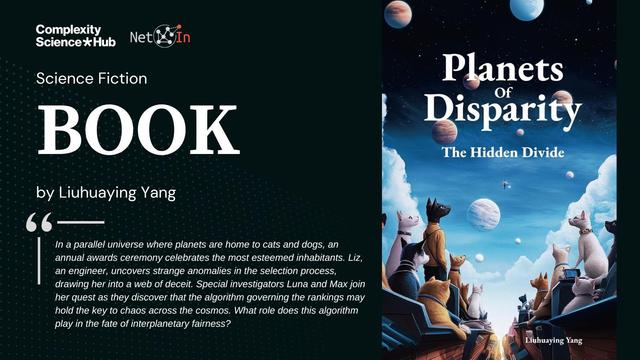
Excited to share our colleague Liuhuaying Yang's sci-fi book inspired by our research on inequality in ranking systems! A creative take on how the rich-get-richer effect & homophily shape visibility. A must-read for all curious minds! Order on Amazon:
https://amzn.eu/d/cyMLz4V@csh.ac.at
Happy New Year from our lab! Grateful to our community—colleagues, partners, mentors, and followers. 2024 was a year of growth in exploring network inequalities, publishing research, and sharing knowledge. Thanks to our team, speakers, and @CSH.ac.at . Here's to an inspiring 2025!
🚀 We’ve landed on @bluesky! Come vibe with us where the sky’s the limit. 🌌
We’re still hanging out here on X (for now) but the future’s looking pretty blue. 💙
Follow us there & stay ahead of the curve: https://bsky.app/profile/netincsh.bsky.social
#StayConnected @CSHVienna

Network Inequality (@netincsh.bsky.social)
Algorithmic Fairness and Network Inequality group at the Complexity Science Hub, Vienna, Austria
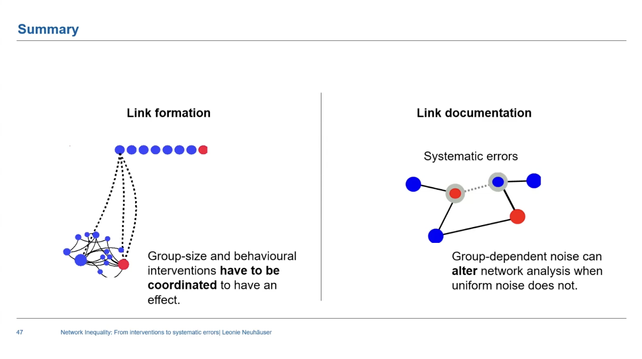
Fascinating talk by @leoneuhaeuser: We learned two network interventions to change the representation of minorities in top-k ranks, and how systematic errors (missing links/nodes) affect this representation.
Watch the video: https://bit.ly/LSNI-2024-videos
@CSHVienna #LatePost
📢Happening today!!!
The Overlooked Need for Ethics in Complexity Science: Why it Matters? by @ana16_jaramillo Samantha Dies & @YasAsgari
Nov 15, 3pm CET
Preprint: https://arxiv.org/abs/2409.02002
More info: https://csh.ac.at/events/the-overlooked-need-for-ethics-in-complexity-science-why-it-matters
@CSHVienna
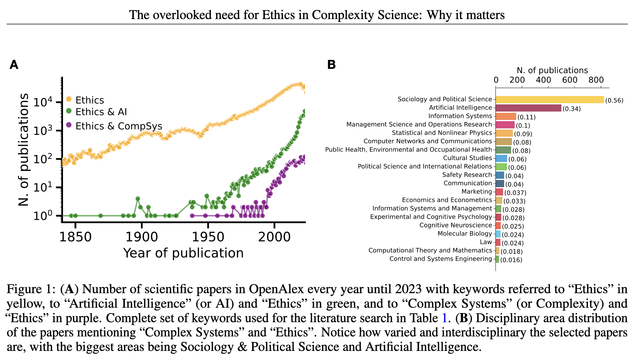

The overlooked need for Ethics in Complexity Science: Why it matters
Complexity science, despite its broad scope and potential impact, has not kept pace with fields like artificial intelligence, biotechnology and social sciences in addressing ethical concerns. The field lacks a comprehensive ethical framework, leaving us, as a community, vulnerable to ethical challenges and dilemmas. Other areas have gone through similar experiences and created, with discussions and working groups, their guides, policies and recommendations. Therefore, here we highlight the critical absence of formal guidelines, dedicated ethical committees, and widespread discussions on ethics within the complexity science community. Drawing on insights from the disciplines mentioned earlier, we propose a roadmap to enhance ethical awareness and action. Our recommendations include (i) initiating supportive mechanisms to develop ethical guidelines specific to complex systems research, (ii) creating open-access resources, and (iii) fostering inclusive dialogues to ensure that complexity science can responsibly tackle societal challenges and achieve a more inclusive environment. By initiating this dialogue, we aim to encourage a necessary shift in how ethics is integrated into complexity research, positioning the field to address contemporary challenges more effectively.
Can network interventions like #quotas truly improve minority representation in rankings? Find out in the next #NetworkInequality Lecture by @leoneuhaeuser
🗓️ November 21, 11AM CET (new date!!!)
>> Please, register again if you want to attend <<
https://bit.ly/LSNI-2024
(we lost previous registrations, sorry)
Complexity Science Hub Vienna @[email protected]


Welcome! You are invited to join a meeting: [LSNI@CSH] Improving the visibility of minorities through network growth interventions by Leonie Neuhäuser. After registering, you will receive a confirmation email about joining the meeting.
Abstract: Improving the position of minority groups in networks through interventions is a challenge of high theoretical and societal importance. However, a systematic analysis of interventions that alter the network growth process is still missing. In this work, we propose a model to examine how network growth interventions impact the position of minority nodes in degree rankings over time. We distinguish between (i) group size interventions, such as introducing quotas; and (ii) behavioural interventions, such as varying how groups connect to each other. We find that even extreme quotas do not increase minority representation in rankings if the actors in the network do not adopt homophilic behaviour. Thus, interventions need to be coordinated in order to improve the visibility of minorities. In a real-world case study, we explore which interventions can reach gender parity in academia. Our work provides a theoretical and computational framework for investigating the effectiveness of interventions in growing networks.
https://www.nature.com/articles/s42005-023-01218-9.pdf
Bio: Passionate about people and interdisciplinary projects, I use my background in computer science, mathematics and psychology to tackle societal challenges with a human-centric approach. I am currently working at Amprion, one of Germany's transmission system operators, on the development and implementation of their data strategy. Previously, I was a doctoral researcher in the Computational Network Sciences Group at RWTH Aachen University. My interests include Network Science and Complex Systems, Computational Social Sciences and Graph Neural Networks, investigating group effects in networks and their impact on diversity and fairness in algorithmic decision making.
https://leonieneuhaeuser.netlify.app
https://twitter.com/leoneuhaeuser
---
>>This is the last talk of the NetIn Lecture Series 2024<<
Previous Talks: https://bit.ly/LSNI-2024-videos
🚨 Important Announcement: The final talk of this year’s lecture series, originally scheduled for today, has been postponed. New date and time will be shared soon. Stay tuned for updates!
Register to this talk (even if you already did - we lost all pre-registrations, sorry): http://bit.ly/LSNI-2024
Watch previous talks: https://bit.ly/LSNI-2024-videos
Welcome! You are invited to join a meeting: [LSNI@CSH] Improving the visibility of minorities through network growth interventions by Leonie Neuhäuser. After registering, you will receive a confirmation email about joining the meeting.
Abstract: Improving the position of minority groups in networks through interventions is a challenge of high theoretical and societal importance. However, a systematic analysis of interventions that alter the network growth process is still missing. In this work, we propose a model to examine how network growth interventions impact the position of minority nodes in degree rankings over time. We distinguish between (i) group size interventions, such as introducing quotas; and (ii) behavioural interventions, such as varying how groups connect to each other. We find that even extreme quotas do not increase minority representation in rankings if the actors in the network do not adopt homophilic behaviour. Thus, interventions need to be coordinated in order to improve the visibility of minorities. In a real-world case study, we explore which interventions can reach gender parity in academia. Our work provides a theoretical and computational framework for investigating the effectiveness of interventions in growing networks.
https://www.nature.com/articles/s42005-023-01218-9.pdf
Bio: Passionate about people and interdisciplinary projects, I use my background in computer science, mathematics and psychology to tackle societal challenges with a human-centric approach. I am currently working at Amprion, one of Germany's transmission system operators, on the development and implementation of their data strategy. Previously, I was a doctoral researcher in the Computational Network Sciences Group at RWTH Aachen University. My interests include Network Science and Complex Systems, Computational Social Sciences and Graph Neural Networks, investigating group effects in networks and their impact on diversity and fairness in algorithmic decision making.
https://leonieneuhaeuser.netlify.app
https://twitter.com/leoneuhaeuser
---
>>This is the last talk of the NetIn Lecture Series 2024<<
Previous Talks: https://bit.ly/LSNI-2024-videos
Can network interventions like #quotas truly improve minority representation in rankings? Find out in the next #NetworkInequality Lecture by @@leoneuhaeuser!
🗓️ October 24, 11AM CET ***(postponed, new date TBA) ***
Register to all talks: http://bit.ly/LSNI-2024
Info: https://networkinequality.com/lecture-series
@[email protected]

Welcome! You are invited to join a meeting: [LSNI@CSH] Improving the visibility of minorities through network growth interventions by Leonie Neuhäuser. After registering, you will receive a confirmation email about joining the meeting.
Abstract: Improving the position of minority groups in networks through interventions is a challenge of high theoretical and societal importance. However, a systematic analysis of interventions that alter the network growth process is still missing. In this work, we propose a model to examine how network growth interventions impact the position of minority nodes in degree rankings over time. We distinguish between (i) group size interventions, such as introducing quotas; and (ii) behavioural interventions, such as varying how groups connect to each other. We find that even extreme quotas do not increase minority representation in rankings if the actors in the network do not adopt homophilic behaviour. Thus, interventions need to be coordinated in order to improve the visibility of minorities. In a real-world case study, we explore which interventions can reach gender parity in academia. Our work provides a theoretical and computational framework for investigating the effectiveness of interventions in growing networks.
https://www.nature.com/articles/s42005-023-01218-9.pdf
Bio: Passionate about people and interdisciplinary projects, I use my background in computer science, mathematics and psychology to tackle societal challenges with a human-centric approach. I am currently working at Amprion, one of Germany's transmission system operators, on the development and implementation of their data strategy. Previously, I was a doctoral researcher in the Computational Network Sciences Group at RWTH Aachen University. My interests include Network Science and Complex Systems, Computational Social Sciences and Graph Neural Networks, investigating group effects in networks and their impact on diversity and fairness in algorithmic decision making.
https://leonieneuhaeuser.netlify.app
https://twitter.com/leoneuhaeuser
---
>>This is the last talk of the NetIn Lecture Series 2024<<
Previous Talks: https://bit.ly/LSNI-2024-videos
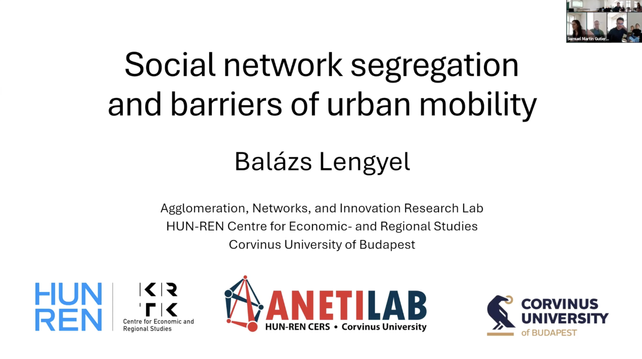
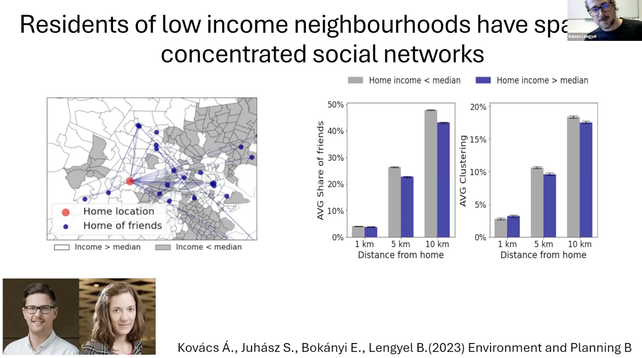
Fascinating talk by Balazs Lengyel from ANETI Lab. We learned that urban inequalities are amplified by social network fragmentation, driven by geographic barriers and segregation, linking mobility, social ties, and income disparities.
Watch the video: https://bit.ly/LSNI-2024-videos
#CSHVienna #LatePost