I was wondering how my theoretical indebtedness to Marx and my intuitive support for anarchism align with each other. Guess I got it now. Marx helps me to understand past and present. Anarchism is the concept for an open, still unknown future. There is no scientific analysis for the future because its not determined in advance. We create it. Thank you, #GraeberDavid.

Nejme
- 4 Followers
- 21 Following
- 12 Posts
Learned farming in my youth; heterodox, applied economist; in search for the emancipatory, anarchist, communitarian society; admire Herzensbildung. My pseudonym has been given to me by Najad. She was the first revolutionary, wild, and free young woman I knew. I lost sight of her due to my own deficiencies. Excuse my deficiencies in the english language as well, please.
 🔴 Rosa-Luxemburg-Stiftung
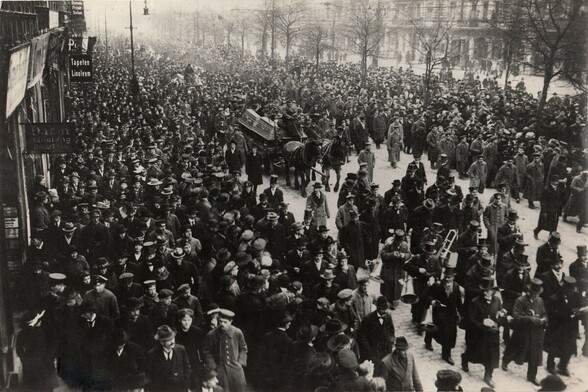
#RosaLuxemburg 5.3.1871 - 15.1.1919
#KarlLiebknecht 13.8.1871 - 15.1.1919
Der Mann wird zum Sieb, die Frau
mußte schwimmen, die Sau,
für sich, für keinen, für jeden. -
Der Landwehrkanal wird nicht rauschen. Nichts
stockt.
#Luetzi seems to have become one of the global symbols of the global fight against the carbon based economy. It is simultaneously a symbol for the fight against corporate power. Let me take this as a starting point for same thoughts on what is being propagated as alternative to fossil fuels even by some comrades: Nuclear power.
The population in Germany is very sceptical against nuclear power in the vision of its risks and unresolved questions concerning nuclear waste. From an anarchist perspective, there is another, very troublesome aspect about nuclear technologies: Their scale and their risky nature let them be linked intimately to a hierarchical organization of society. In fact, these awful technologies are the inevitable outcome of hierarchical societies. They might have been discovered, but would have not been put into use, by autonomous, emancipated, anti-authoritarian people who know about the threat of authoritarianism.
Materialism tells us that the society which surrounds us coins our consciousness. But it also coins our technological path.
Once we have started to implement the emancipated society of autonomous people who live in solidarity, a new technological path will evolve. This will happen the more so, as we possess the technological means to realize it: The digital world opens up the possibility to decentralize completely what until now seems to require large-scale technologies that come along with unjust ownership, surveillance and opression. Energy provision is one of the industries that will have to be reorganized soon. For the sake of efficiency, autonomy, sustainability and justice. Reorganization of enery production could even act as a game-changer in social development if accompanied by a new emancipated consciousness of the people.
The population in Germany is very sceptical against nuclear power in the vision of its risks and unresolved questions concerning nuclear waste. From an anarchist perspective, there is another, very troublesome aspect about nuclear technologies: Their scale and their risky nature let them be linked intimately to a hierarchical organization of society. In fact, these awful technologies are the inevitable outcome of hierarchical societies. They might have been discovered, but would have not been put into use, by autonomous, emancipated, anti-authoritarian people who know about the threat of authoritarianism.
Materialism tells us that the society which surrounds us coins our consciousness. But it also coins our technological path.
Once we have started to implement the emancipated society of autonomous people who live in solidarity, a new technological path will evolve. This will happen the more so, as we possess the technological means to realize it: The digital world opens up the possibility to decentralize completely what until now seems to require large-scale technologies that come along with unjust ownership, surveillance and opression. Energy provision is one of the industries that will have to be reorganized soon. For the sake of efficiency, autonomy, sustainability and justice. Reorganization of enery production could even act as a game-changer in social development if accompanied by a new emancipated consciousness of the people.
 BookQuestChin
Statecraft is the opaque organization of the different elements of a complex body or activity such that elements that would allow for self-governance are disabled, while elements that enforce domination and control, are enabled.
In this perspective, Capital is an enabled element of Statecraft, just like enforced bureaucracy, and legally codified social divisions are.
Rebellion is enabling the disabled elements within a state and thus empowering people to self-govern and resist the domination of the state. The state doesn't want you going on strike, and so makes strike actions and protests illegal, and the only way to fight this, is to coordinate strike actions and protests in spite of the state's attempts to disable these elements of self-governing.
Dismantling the state must begin by turning opacity to full transparency, thus revealing the disabled part of the system.
In the same vein, anarchism is the transparent and participatory organization of the different elements of a complex body or activity so as to enable them to work together effectively as self-governing.
You know "The art of not being governed" by James C. Scott? Read it! It shows how in South-East Asia, in "Zonia", as well as in other places of our world, non-governed, "wild" locations were occupied by people in search of autonomy. How new peoples were founded by them that were later sometimes mistakenly seen as "natives". No, they were not accidentially born into the "wild". They had chosen to be there to avoid despotism and hierarchy. And they were not "primitive". Quite to the contrary, they had found ways and institutions to avoid "to be governed".
Historically, the free hinterlands were the virtual country for free people. The free hinterlands created a global nation of anarchism!
We have lost it. Hardly any free hinterlands any more. Capitalism has won this fight, too. Almost... because there is this small gallium village... No, there is Rojava.
Rojava is of such high importance today because it is one of very few exceptions in this world of totalitarian capitalism. One of the very few free hinterlands. We know it is in a precarious situation. It is offended, not only by Turkey but by the western world as a whole. Because they KNOW that Rojava is important. That it is dangerous for their narrative of unavoidable hierarchies.
It is an example. A rare opportunity. People can show there that humans can govern themselves. They do not need to be governed. If we have the place to do so, we can maximize our autonomy. Maximizing our autonomy is identical to realizing our full human potential. However, this can't be done in the contested capitalist space. We need the free hinterland! We need Rojava!
[5] The last message here was one of the rare retweets in this thought diary. What the young woman there said is true: All of us, who believe in the possibility of an emancipatory world of solidarity and cooperation, need the example of the brave people from Rojava. They show us that another world is possible. They make us believe in human autonomy.
Human autonomy is the opposite of "Sachzwänge", a German word used by German politicians in order to silence the people by insisting that there are no alternatives. No alternatives to social hardships, to competition, to privatizing and capitalism, to support for huge corporations....
In fact there are always alternatives once we are allowed to use our autonomy in order to create our environment such that it suits our true needs. Autonomy is more than freedom. In the neoliberale Utopia, people might be formally free, but the system imposes its rules upon them. The people in real existing capitalism might be formally free, but they are deprived from the material and immaterial resources they would need in order to overcome "the rules of the game". They lack autonomy because the system imposes the "Sachzwänge" of competition, profit, and economic efficiency upon all people, who do not have the money to make the system work for them.
I lack autonomy if I am formally free but have no access to free resources. If I gain access to free resources, i.e., resources not required in order to just keep going, I gain autonomy. However, as long as I am alone, the amount of resources I can employ in order to adapt the environment to my own demands is restricted. In order to realize the full potential of human autonomy we therefore need to cooperate towards our common ends.
Rojava shows how this is possible even under extremely adverse conditions. It is possible if people use their collective autonomy to make rules that suit their demands.
In capitalism, some people, the capitalists, have the power to make others work for their own, individual advantages. They maximize their individual autonomy at the cost of others' autonomy. These others' potential for the creation of the good life for everyone ist lost. They are not allowed to change the rules. Their freedom is only the freedom to consume what others produce. What is being produced is dictated by the market. Most people have no say in what is being produced and how it is produced. Their voice is not being heard, their demands are not taken into account or only insofar as they are "marketable".
We have to create a cooperative world because only then can we maximize our common autonomy. The idea of maximized autonomy can guide us towards the best of all possible worlds, because autonomy is a means as well as an end in itself. If we all have common access to all available resources, and if we manage to use them cooperatively, then we can give us the rules that suit our needs and produce what meets our preferences as individuals and as society as a whole. Then we are individually and collectively autonomous. Only then can we realize our full human potential.
 #ColonialismIsNotOver
RT @RISEUP4R0JAVA
🎥A message from #YPJ internationalist to the world
[4] I have been thinking about nation states last time. This one is going to be short. Have been discussing with my husband this time. Yes, am married. Otherwise he would have had to leave 20 years ago because of matters of "nationality". Our experinces differ fundamentally. One raised in capitalism, the other in Sowiet socialism. Now we agree that humanity is about to fail. But that it has failed already if we don't pretend that it won't. We just act as if it makes a difference. That's the right thing to do. Have a good night.
[3] (sorry for technical complications)
So, we will not need nation states without capitalism. And we have to overcome nation states in order to overcome capitalism, and in order to build the emancipatory, communitarian, anarchist society. We have to do all that in order to maximize individual and collective human autonomy. Then we can realize the great human potential for the creation of good lifes.
With the nation, we abolish top-down hierarchies. Command an control, arms and forces, alienation and exploitation will be replaced by autonomous and cooperative local decision making processes. Where "local" does not necessarily imply a geographically delineated area in the digital age. Then, demands and decisions of the people, of those who build their own lives and their own world with their own work and in collaboration with others, will gain primacy over any bureaucratic "superstructures". In a dialectical turn, we will only then realize a true "globalization" as borders become meaningless. Then the current "fuel" of development, competition, will naturally be relaced by a new fuel: solidarity.
That week, when hanging up with two comrades, we briefly touched upon the concept of the nation. I was upset as I was not able to pin down its problematic core. Even though the nation state is not an old concet, we have unlearned to question it!
In fact, in the nation state cumulate all of our problems. Its formal institutions cement hierarchies and patriarchism. It provokes rassism as it requires the differentiation between "us" and the "other". Given all this, the nation state is the natural ally of real existant capitalism. Capitalism, in sharp contrast to its neoliberal defendance, requires protection from the state. It demand the exploitation of resources in other nations in order to overcome its inner contradictions. Capatalists require protection of "their" production capacities by the nation state's police.
Abolishing the nation state is, in other words, an invitation into the imagination of a better world. Where the best of all world is one, where all people can live in autonomy. General autonomy requires access to necessary resources for all. And it requires the right, the ability, and the capability to use these resources cooperatively.