Molecular Cages

13 Followers
6 Following
1.1K Posts

Molecular cages bot šŸ¤– maintained by https://mstdn.science/@vtemarticent

This bot will search the literature and post regularly publications in the field of #MolecularCages, including organic cages, metal-organic cages, nanocages, etc.

If you have a paper published that is not automatically indexed, please contact to update the search algorithm

Cargo-loaded lipid-shielded breakable organosilica nanocages for enhanced drug delivery http://pubs.rsc.org/en/Content/ArticleLanding/2023/NR/D3NR02155F
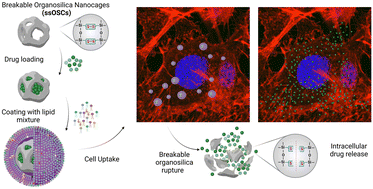
Cargo-loaded lipid-shielded breakable organosilica nanocages for enhanced drug delivery

The recent nanomedicine advancements have introduced a variety of smart nanoparticles in cancer treatment and diagnostics. However, their application to the clinic is still hindered by several challenges related to their biocompatibility, elimination and biodistribution. Here we propose breakable organosilica mesop

Tuning properties of biocatalysis using protein cage architectures http://pubs.rsc.org/en/Content/ArticleLanding/2023/TB/D3TB00168G
Tuning properties of biocatalysis using protein cage architectures

Compartmentalization of cellular activities is an extremely important mechanism within cells, across all domains of life, for high efficiency of cell function. Bacterial microcompartments are exemplary protein-based cage structures that act as subcellular compartments encapsulating biocatalysts. They are able to ac

Maximized axial helicity in a Pd2L4 cage: inverse guest size-dependent compression and mesocate isomerism http://pubs.rsc.org/en/Content/ArticleLanding/2023/SC/D2SC06629G
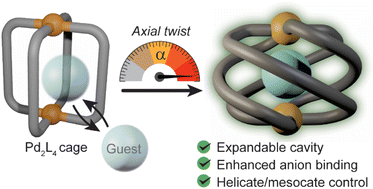
Maximized axial helicity in a Pd2L4 cage: inverse guest size-dependent compression and mesocate isomerism

Helicity is an archetypal structural motif of many biological systems and provides a basis for molecular recognition in DNA. Whilst artificial supramolecular hosts are often helical, the relationship between helicity and guest encapsulation is not well understood. We report a detailed study on a significantly coile

PET Imaging of Self‐Assembled 18F‐Labelled Pd2L4 Metallacages for Anticancer Drug Delivery https://chemistry-europe.onlinelibrary.wiley.com/doi/10.1002/chem.202202604
Charge‐Assisted Halogen Bonding in an Ionic Cavity of a Coordination Cage Based on a Copper(I) Iodide Cluster https://onlinelibrary.wiley.com/doi/10.1002/anie.202215689
Molecules, Vol. 28, Pages 595: Calix[6]arene-Based [3]Rotaxanes as Prototypes for the Template Synthesis of Molecular Capsules https://www.mdpi.com/1420-3049/28/2/595
Calix[6]arene-Based [3]Rotaxanes as Prototypes for the Template Synthesis of Molecular Capsules

In this work, the ability of several bis-viologen axles to thread a series of heteroditopic tris(N-phenylureido)calix[6]arene wheels to give interwoven supramolecular complexes to the [3]pseudorotaxane type was studied. The unidirectionality of the threading process inside these nonsymmetric wheels allows the formation of highly preorganised [3]pseudorotaxane and [3]rotaxane species in which the macrocycles phenylureido moieties, functionalised with either ester, carboxylic, or hydroxymethyl groups, are facing each other. As verified by NMR and semiempirical computational studies, these latter compounds possess the correct spatial arrangement of their subcomponents, which could lead, in principle, upon proper bridging reaction, to the realisation of upper-to-upper molecular capsules that are based on calix[6]arene derivatives.

MDPI
Chemistry, Vol. 4, Pages 494-519: Metal–Organic Cages: Applications in Organic Reactions https://www.mdpi.com/2624-8549/4/2/36
Metal–Organic Cages: Applications in Organic Reactions

Supramolecular metal–organic cages, a class of molecular containers formed via coordination-driven self-assembly, have attracted sustained attention for their applications in catalysis, due to their structural aesthetics and unique properties. Their inherent confined cavity is considered to be analogous to the binding pocket of enzymes, and the facile tunability of building blocks offers a diverse platform for enzyme mimics to promote organic reactions. This minireview covers the recent progress of supramolecular metal–organic coordination cages for boosting organic reactions as reaction vessels or catalysts. The developments in the utilizations of the metal–organic cages for accelerating the organic reactions, improving the selectivity of the reactions are summarized. In addition, recent developments and successes in tandem or cascade reactions promoted by supramolecular metal–organic cages are discussed.

MDPI
Chemistry, Vol. 4, Pages 535-547: Self-Assembly of a Rare High Spin FeII/PdII Tetradecanuclear Cubic Cage Constructed via the Metalloligand Approach https://www.mdpi.com/2624-8549/4/2/38
Self-Assembly of a Rare High Spin FeII/PdII Tetradecanuclear Cubic Cage Constructed via the Metalloligand Approach

Polynuclear heterobimetallic coordination cages in which different metal cations are connected within a ligand scaffold are known to adopt a variety of polyhedral architectures, many of which display interesting functions. Within the extensive array of coordination cages incorporating Fe(II) centres reported so far, the majority contain low-spin (LS) Fe(II), with high-spin (HS) Fe(II) being less common. Herein, we present the synthesis and characterisation of a new tetradecanuclear heterobimetallic [Fe8Pd6L8](BF4]28 (1) cubic cage utilising the metalloligand approach. Use of the tripodal tris-imidazolimine derivative (2) permitted the formation of the tripodal HS Fe(II) metalloligand [FeL](BF4)2Ā·CH3OH (3) that was subsequently used to form the coordination cage 1. Magnetic and structural analyses gave insight into the manner in which the HS environment of the metalloligand was transferred into the cage architecture along with the structural changes that accompanied its occupancy of the eight corners of the discrete cubic structure.

MDPI
Chemistry, Vol. 4, Pages 855-864: A Benzimidazolium-Based Organic Cage with Antimicrobial Activity https://www.mdpi.com/2624-8549/4/3/61
A Benzimidazolium-Based Organic Cage with Antimicrobial Activity

Considering the wide interest in (benz)imidazolium-based drugs, we here report our study on a benzimidazolium-based organic cage as potential antimicrobial and antifungal agent. Cytotoxicity studies on a human derived cell line, SH-SY5Y, showed that the cage is not cytotoxic at all at the investigated concentrations. Anion binding studies demonstrated that the cage can bind anions (chloride and nitrate, in particular) both in organic solvent and 20%v D2O/CD3CN mixture. The cage was also tested as anionophore, showing a weak but measurable transport of chloride and nitrate across LUVs vesicles. Nonetheless, the compounds have antimicrobial activity towards Staphylococcus aureus (Gram-positive bacteria). This is probably the first organic cage studied as anionophore and antimicrobial agent.

MDPI
Chemistry, Vol. 4, Pages 865-871: Virus-like Cage Hybrid: Covalent Organic Cages Attached to Metal Organic Cage https://www.mdpi.com/2624-8549/4/3/62
Virus-like Cage Hybrid: Covalent Organic Cages Attached to Metal Organic Cage

A well-defined virus-like cage hybrid (VCH) with 24 covalent organic cages (COCs) attached to one metal organic cage (MOC) is presented here. The quantitative assembly of VCH was completed through coordination between soluble anisotropic COC bearing one bipyridine moiety and Pd(II) ions. The obtained VCH exhibited discrete, uniform and stable structures with good solubility and was well characterized by NMR, FT-IR, TEM, AFM, DLS, TGA, and so on. This designable cage hybrid promotes a new strategy to expand the structural and functional complexities of porous molecular cages.

MDPI