Matti Vihola

104 Followers
91 Following
49 Posts
Professor of Statistics, University of Jyväskylä. Computational statistics, applied probability, Monte Carlo methods, Bayesian inference.
Webhttps://iki.fi/mvihola
Google Scholarhttps://scholar.google.fi/citations?user=nqLmOf4AAAAJ
GitHubhttps://github.com/mvihola
Blueskyhttps://bsky.app/profile/mattivihola.bsky.social
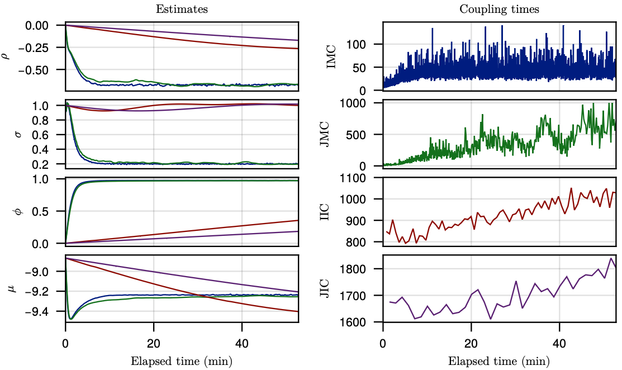
We revised our paper on conditional backward sampling particle filters https://arxiv.org/abs/2312.17572 focusing on implementable couplings:
• We use unbiased gradients for maximum likelihood estimation
• Generalised coupling algorithm which can handle potentials/weights that depend on current and previous state variable (a coupling of conditional marginal particle filters)
We revised our paper about particle filter forgetting: https://arxiv.org/abs/2309.08517
Substantial new content:
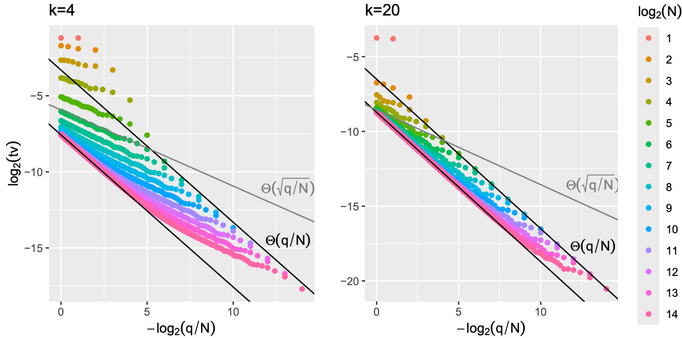
• New example which shows that the O(log N) rate in total variation forgetting is optimal, where N is the number of particles
• Propagation-of-chaos bounds (total variation distance between the law of q particles out of N and the i.i.d. draw from the ideal filter) which vanish if q = o(N)
• Method for handling out-of-sequence measurements
On the Forgetting of Particle Filters

We study the forgetting properties of the particle filter when its state - the collection of particles - is regarded as a Markov chain. Under a strong mixing assumption on the particle filter's underlying Feynman-Kac model, we find that the particle filter is exponentially mixing, and forgets its initial state in $O(\log N )$ 'time', where $N$ is the number of particles and time refers to the number of particle filter algorithm steps, each comprising a selection (or resampling) and mutation (or prediction) operation. We present an example which shows that this rate is optimal. In contrast to our result, available results to-date are extremely conservative, suggesting $O(α^N)$ time steps are needed, for some $α>1$, for the particle filter to forget its initialisation. We also study the conditional particle filter (CPF) and extend our forgetting result to this context. We establish a similar conclusion, namely, CPF is exponentially mixing and forgets its initial state in $O(\log N )$ time. To support this analysis, we establish new time-uniform $L^p$ error estimates for CPF, which can be of independent interest. We also establish new propagation of chaos type results using our proof techniques, discuss implications to couplings of particle filters and an application to processing out-of-sequence measurements.

arXiv.org
Adaptive MCMC can be very useful in practice, but theoretical results are technical. We attempted to write a more accessible story about adaptive MCMC theory: https://arxiv.org/abs/2408.14903 It starts from the beautiful martingale decomposition of Andrieu & Moulines (2006):
An invitation to adaptive Markov chain Monte Carlo convergence theory

Adaptive Markov chain Monte Carlo (MCMC) algorithms, which automatically tune their parameters based on past samples, have proved extremely useful in practice. The self-tuning mechanism makes them `non-Markovian', which means that their validity cannot be ensured by standard Markov chains theory. Several different techniques have been suggested to analyse their theoretical properties, many of which are technically involved. The technical nature of the theory may make the methods unnecessarily unappealing. We discuss one technique -- based on a martingale decomposition -- with uniformly ergodic Markov transitions. We provide an accessible and self-contained treatment in this setting, and give detailed proofs of the results discussed in the paper, which only require basic understanding of martingale theory and general state space Markov chain concepts. We illustrate how our conditions can accomodate different types of adaptation schemes, and can give useful insight to the requirements which ensure their validity.

arXiv.org
Conditional backward sampling particle filters are great MCMC updates for general hidden Markov model smoothing. We (together with Joona Karjalainen, Anthony Lee & Sumeetpal Singh) proved that their mixing time is O(log T), where T is time horizon, with fixed number of particles: http://arxiv.org/abs/2312.17572 The proof is based on analysis of an implementable coupling algorithm, so unbiased smoothing is also available with O(T log T) expected cost. Coupling develops progressively over time indices 👇
Mixing time of the conditional backward sampling particle filter

The conditional backward sampling particle filter (CBPF) is a powerful Markov chain Monte Carlo algorithm for general state space hidden Markov model smoothing. We show that, under a general (strong mixing) condition, its mixing time is upper bounded by $O(\log T)$ where $T$ is the time horizon. The result holds for a fixed number of particles $N$ which is sufficiently large (depending on the strong mixing constants), and therefore guarantees an overall computational complexity of $O(T\log T)$ f or general hidden Markov model smoothing. We provide an example which shows that the mixing time $O(\log T)$ is optimal. Our proof relies on analysis of a novel coupling of two CBPFs, which involves a maximal coupling of two particle systems at each time instant. The coupling is implementable, and can be used to construct unbiased, finite variance estimates of functionals which have arbitrary dependence on the latent state path, with expected $O(T \log T)$ cost. We also investigate related couplings, some of which have improved empirical behaviour.

arXiv.org
Santeri Karppinen had his PhD defense today. I enjoyed a lot the discussion between the opponent, Nick Whiteley, and Santeri. The PhD thesis "Non-linear state-space methods for Bayesian time series modelling" is available here: https://jyx.jyu.fi/handle/123456789/83847.
JYX - Non-linear state-space methods for Bayesian time series modelling