Jarold the fey familiar of a trash druid, coughing up some glitter
For me it’s just amazing to be part of the scientific process of telling a Mars rover what to do, looking at the data, and learning a little bit more about the red planet. I just hope that one day I’ll get to look at one of these samples with my own eyes.
So Perseverance has taken samples of those rocks and stored them in special tubes that will be brought to Earth by a follow up mission, named Mars Sample Return. On Earth we will be able to analyse them in more detail, and figure out exactly what they’re made of. They probably won't be brought back until the mid 2030s, but planetary exploration is all about patience!
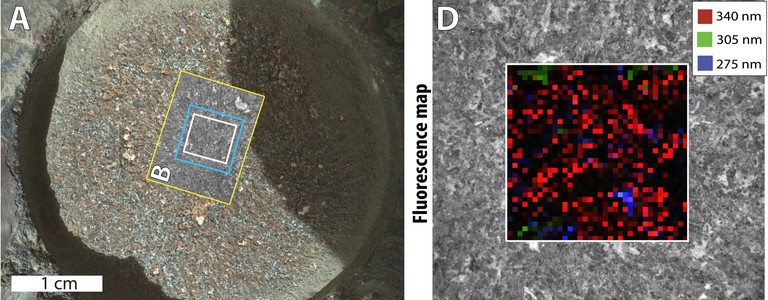
SHERLOC has detected fluorescence signatures consistent with aromatic organic molecules. This class of organics include some of the components that make up life on Earth, but they can also be made by non-biological processes, meaning that they are not proof of life on their own. We will need to bring them back to Earth for more detailed analysis to determine exactly what organics are present, and whether it could have been made by living things.
We also saw evidence for sulphates & perchlorates, minerals there were likely formed when briny water evaporated away, leaving behind salts. These detections support the idea that Jezero once contained a lake, probably 3-4 billion years ago. That was around the same time that life evolved on Earth, but did the building blocks of life as we know it also exist when water flowed on Mars? Some of these minerals can preserve organic material, so may contain a record of what was in that ancient water.
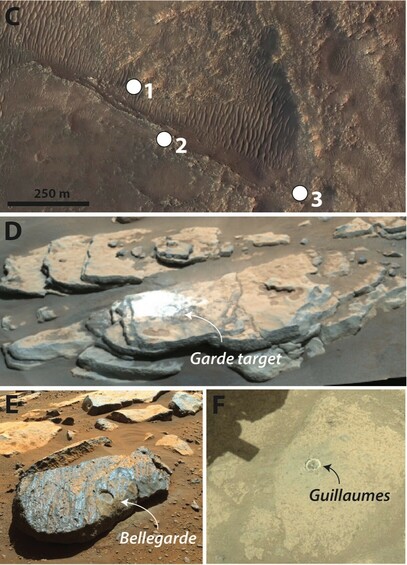
This paper, written by @EvaLScheller and myself with help from the rest of the team, reports some of the major findings from @SHERLOC2020 during the first 200 sols (martian days) of the @NASAPersevere mission when the rover was exploring the floor of Jezero Crater.
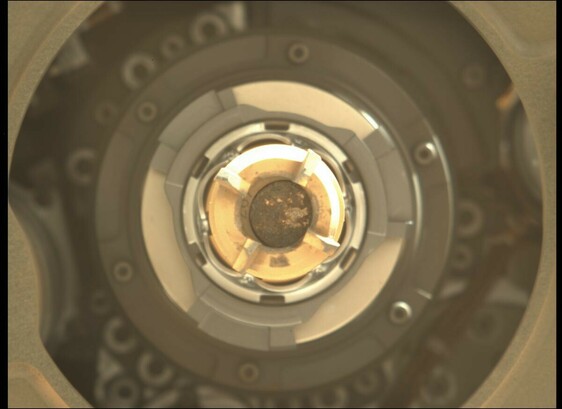
After drilling holes in rocks to expose less-weathered material, SHERLOC and other instruments have detected igneous olivines, and that they were later altered by water, producing carbonates and amorphous silicates.
I’m proud to announce that we just published a paper in @ScienceMagazine, describing how NASAPersevere has detected carbonates, sulfates, and other minerals in Jezero Crater that suggest water did indeed flow there billions of years ago.
https://www.science.org/doi/10.1126/science.abo5204I made a friend (yesterday)
Videos don’t work so well on here huh


 PossumEveryHour