This #FursuitFriday
Me with some of the @madebymercury.bsky.social Fam!
I appear to have "Accidentally" given @draegarth.bsky.social some rather attractive new horns!
Goo dragon/Shapeshifter thing. Tinkerer and maker. He/Him.
Drgn NOT Derg!
Occasionally suggestive Content, 18+
| The Museum - EMCOA | https://emcoa.co.uk/ |
| Kofi | https://ko-fi.com/jencen |
| LinkTree | https://linktr.ee/jencen |
This #FursuitFriday
Me with some of the @madebymercury.bsky.social Fam!
I appear to have "Accidentally" given @draegarth.bsky.social some rather attractive new horns!
Spent the past 2 evenings building up the cabinets in the living room. TV no longer looks all alone on the wall now!
Also populated the cabinets as they didn't look right empty!
On the other side of the cabinet are the mechanica-ma-bobs.
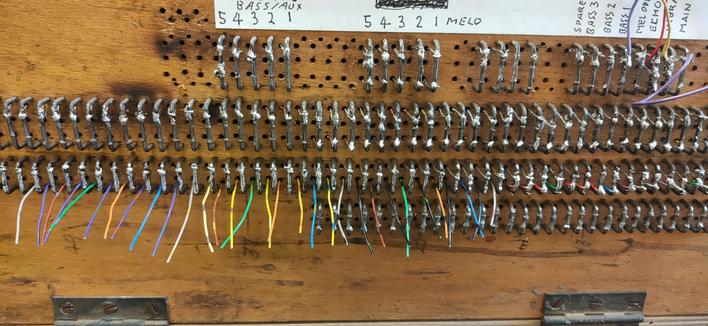
The 12 wheels are the note generators. One for each note, belt driven and geared to make sure they have the right speed for each note. Above are the ladder switches that take the 15v on each note of the keyboard, and switch the 500v that comes from the TC and voicing sections and then feed into the relevant parts of each generator.
Each generator has 2 parts. A rotor and a stator. The 500v is fed into the stator which energises each engraved sine wave. Then as the stator moves over it, it creates a variable capacitor that couples out to the amplifier, and after. To the horn speaker
Today on #JencenMakes
The Compton Melotone (pronounced like Monotony)
This example is actually a Compton 356 (I think. There's so many numbers) that has been gently transferred from its 2 manual and pedal case to this fuckin' thing.
On the rear side you have the test panel on the left. Then the boards behind that are the "Time Constant" circuits that decide the "envelope" of the sound. Think Attack/Decay.
To the bottom are the voicing resistors.
These decide which sine waves are added together to produce a complex waveform. It's pre determined on this unit instead of there being a set of stop tabs.
At the very bottom are the chassis for the power supply to provide 500Vdc to all this, the empty spot is the amplifier which is out for poking at. And then the pedal contact assembly.
And with that. Tis done!
Original power switch controls the power. Tuning indicator still moves the needle.
Little Bluetooth amp sits on a custom plate
Speakers are bolted to a wooden panel ready to be sorted properly!
Love having the laser working again >.>
Oh I need a front panel for a little amplifier?
Measure measure. Cutty cut! Done! ^_^
Rewiring the lights. Originally off the 6.3v for the valve filaments. I'm gonna be running it on 24V for the amp. So 2 12v in series should work.
Replacing a load of old rubber wires too. Because it's crumbling o.<
I have found the source of the shmoo!
Looks like the input transformer has gotten somewhat warm and dribbled out a mysterious black goo! Which is somewhat offensive..... /I/ am meant to be the Mysterious black Goo around here!!!
Anyway. The underside is somewhat messy. Being used to Mullard and Avo test equipment and Compton amplifiers (Which are a work of art!) This looks like someone was eating spaghetti and sneezed!...... Then set fire to it!
My job today is to hijack the power switch and internal illumination lines so that I can keep this thing as stock as possible.
I'm removing the internal speaker and associated audio transformer that has also "shat out its guts" and put in a modern bluetooth amplifier and pair of speakers.
The tuner/Amp chassis is entirely removable making servicing a breeze!
To the left is the mains transformer that provides 6.3v for the heaters, and "Fucking OW!" levels of voltage for the HT side of the tubes.
Next to that are the EZ40 rectifier to make the DC, and EL41 beam tetrodes being used as the push pull for the speaker, and the EBC41 Double diode triode (try saying THAT 5 times fast!) that's used as the phase inverter for the pull stage.
The guy at the front is another EBC41 which is the diode signal detector.
The final 2 valves are the ECH42 and EF41 that do the frequency changing and amplification respectively.
Then on the right are the plates used for the tuning itself
On today's episode of #JencenMakes
This fuckin' thing!
A Bush SUG23 Superheterodyne gramophone receiver Circa late 40's early 50's.
Am not gonna go into how a SuperHet works - @TechConnectify did a fantastic runthrough of that here! https://www.youtube.com/watch?v=hz_mMLhUinw
This is for my FoxShape to have some tunes in his room whilst maintaining his late 1800's aesthetic ^_~
Sadly something has "Done a poo" all over the inside of the cabinet.
Powering up you get the heaters on the valves but no hum or noise of any kind implying the HT has gone somewhere!
Dunno where. Some sort of holiday I guess!
Sooooo....... I'm gonna annoy a few people by ripping out its guts and installing some modern gear.
Am not going to bin the tuner/amp chassis as it's all valve based and interesting/important to the museum story of making wiggles. And at some point I'll restore it and do a writeup/video about it.
For now though. Follow this thread for more info and blasphemy!!!
Don't worry. the case won't be harmed!
Too late. Snapping at the TV o.<
Justified I think... But anger into the "throwing things" stage o.<