257 Followers
11 Following
29 Posts

EECS UC Berkeley.

. Research Interests: Wireless, 5G (Architecture, Security, and Privacy), Networks, Systems, Applied ML/RL.
. Research Scientist @ LIG Lab.
. Computational Linguist.
. [Xyz: Bell Labs, Skylark Wireless, Qualcomm].

Other:
. Care about e-waste, animals, and climate change.
. Speak Persian, Fraçais, livello medio di italiano, and un poco de español.

Twitter: @Hechenoz

I will be attending #RSAC conference this week in San Francisco, CA. Please feel free to reach out, if you are around!
The opposite of “return to office” advocates isn’t “work from home” advocates. It’s a rich tapestry of “open offices are distracting” people and “I’ve never gone this long without being sick” people and “commutes are a waste of time I don’t get paid for” people and “I’m an introvert and playing house with coworkers sucks the life out of me” people and “I have a family and appreciate the flexibility” people and “I primarily communicated with coworkers through Slack anyway” people and “no one wa…

It's been a wonderful time in Boston for NSDI '23, seeing so many folks reunited in person. The hallway track has been exceptionally vibrant.

Want to join us for NSDI '24 in Santa Clara, CA? Paper titles and abstracts are due Thursday, April 27! Full papers are due the following week. Details: https://bit.ly/nsdi24cfp

NSDI '24 Call for Papers

The 21st USENIX Symposium on Networked Systems Design and Implementation (NSDI '24) will take place April 16–18, 2024, at the Hyatt Regency Santa Clara in Santa Clara, CA, USA. NSDI focuses on the design principles, implementation, and practical evaluation of networked and distributed systems.

USENIX
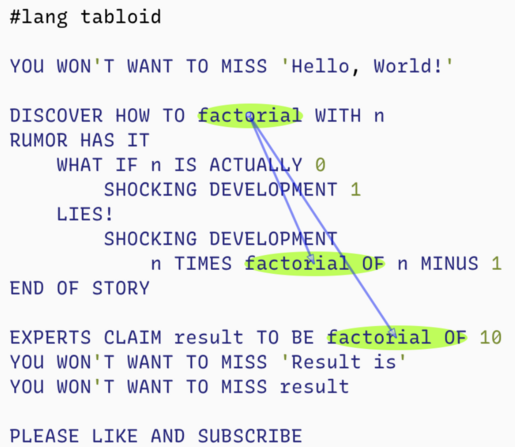
YOU WON'T BELIEVE what it looks like to have an IDE for the TABLOID programming language!
https://github.com/otherjoel/tabloid
To be clear: the author is @joeld
GitHub - otherjoel/tabloid: 📰😱‼️ A Racket implementation of Tabloid, the clickbait programming language!

📰😱‼️ A Racket implementation of Tabloid, the clickbait programming language! - GitHub - otherjoel/tabloid: 📰😱‼️ A Racket implementation of Tabloid, the clickbait programming language!

GitHub

🚨 Call for Papers 🚨

jsys.org/cfp/

Next deadline: May 1st
Notification: June 15th 🚀

12 areas are welcoming submissions!

- [Computer Architecture](https://www.jsys.org/cfp_compArchitecture/)
- [Configuration Management for Systems](https://www.jsys.org/cfp_confManagement/)
- [Data Science and Reproducibility](https://www.jsys.org/cfp_dataRepro/)
- Decentralized Systems
- [Distributed Consensus](https://www.jsys.org/cfp_distConsensus/)
- [Networking](https://www.jsys.org/cfp_networking/)
- [Real-time and Cyber-physical Systems](https://www.jsys.org/cfp_rt_cps/)
- [System Security](https://www.jsys.org/cfp_security/)
- [Serverless Systems](https://www.jsys.org/cfp_serverless/)
- [Storage](https://www.jsys.org/cfp_storage/)
- [Streaming Systems](https://www.jsys.org/cfp_streaming/)
- [Systems for ML and ML for systems](https://www.jsys.org/cfp_sysML_MLsys/)
- [Wireless Embedded Systems](https://www.jsys.org/cfp_wes/)

Too tight to submit this time around? No worries!

jsys has four deadlines per year 😉

- March 1st
- May 1st
- August 1st
- October 1st

We look forward to helping you improve your work and disseminate your ideas 🥳 🎉

Each area welcomes up to four types of papers, each with specific acceptance criteria.

- Systemization of Knowledge (SoK)
- Tool/benchmark
- Problem
- Solution

JSys offers several progressive features, including

- All JSys submissions are reviewed publicly on openreviewnet
- Passing an artifact evaluation is **compulsory** for Tool and Solution papers 🔍💪

We look forward to reading your work! 🙃

JSys

Journal of Systems Research

"Don't assume you understand how the Internet works"
ANRW ’23 Preliminary Call for Papers: ACM/IRTF Applied Networking Research Workshop (ANRW) 2023 will be co-located with IETF-117 in San Francisco. Submissions are due on May 12. https://irtf.org/anrw/2023/cfp.html
ANRW ’23 Call for Papers

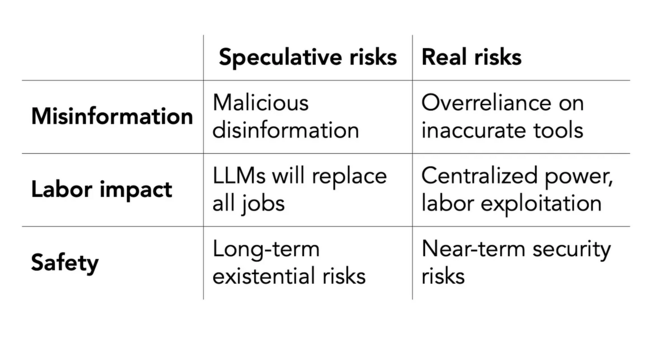
The AI moratorium letter only fuels AI hype. It repeatedly presents speculative, futuristic risks, ignoring the version of the problems that are already harming people. It distracts from the real issues and makes it harder to address them. The letter has a containment mindset analogous to nuclear risk, but that’s a poor fit for AI. It plays right into the hands of the companies it seeks to regulate. By @sayashk and me. https://aisnakeoil.substack.com/p/a-misleading-open-letter-about-sci
A misleading open letter about sci-fi AI dangers ignores the real risks

Misinformation, labor impact, and safety are all risks. But not in the way the letter implies.

AI Snake Oil

I guarantee that this is the wildest paper you’ll read all year. Drewes et al., “Pentimento: Data Remanence in Cloud FPGAs,” https://arxiv.org/abs/2303.17881

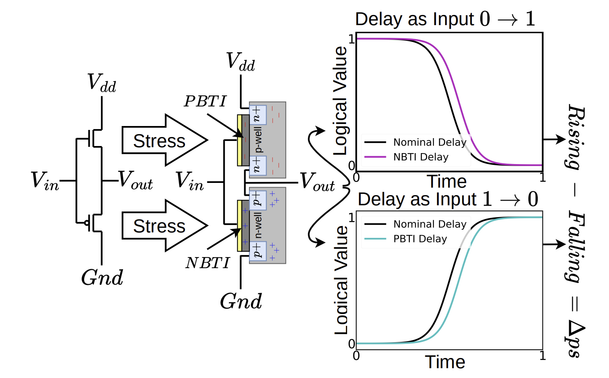
We find that a remote attacker can recover “FPGA pentimentos” — long-removed secret data belonging to a prior user or proprietary design image on a cloud FPGA. Just as a pentimento of a painting can be exposed via infrared imaging, FPGA pentimentos can be exposed via signal
timing sensors instantiated on a remote cloud FPGA. The sensitive data constituting an FPGA pentimento is imprinted to the device through bias temperature instability effects on the underlying transistors. We demonstrate how this slight degradation can be measured using a time-to-digital converter when an adversary programs one into the target cloud FPGA. This technique allows an attacker to ascertain previously safe information, after it is no longer explicitly present, on cloud FPGAs. Notably, it can allow an attacker to (1) extract proprietary details or keys from an encrypted FPGA design image available on the AWS marketplace and (2) recover information from a previous user of a cloud-FPGA. Both threat models are experimentally validated on the AWS F1 platform.

Pentimento: Data Remanence in Cloud FPGAs

Cloud FPGAs strike an alluring balance between computational efficiency, energy efficiency, and cost. It is the flexibility of the FPGA architecture that enables these benefits, but that very same flexibility that exposes new security vulnerabilities. We show that a remote attacker can recover "FPGA pentimenti" - long-removed secret data belonging to a prior user of a cloud FPGA. The sensitive data constituting an FPGA pentimento is an analog imprint from bias temperature instability (BTI) effects on the underlying transistors. We demonstrate how this slight degradation can be measured using a time-to-digital (TDC) converter when an adversary programs one into the target cloud FPGA. This technique allows an attacker to ascertain previously safe information on cloud FPGAs, even after it is no longer explicitly present. Notably, it can allow an attacker who knows a non-secret "skeleton" (the physical structure, but not the contents) of the victim's design to (1) extract proprietary details from an encrypted FPGA design image available on the AWS marketplace and (2) recover data loaded at runtime by a previous user of a cloud FPGA using a known design. Our experiments show that BTI degradation (burn-in) and recovery are measurable and constitute a security threat to commercial cloud FPGAs.

arXiv.org

What to do about “Flight Shaming”? Fly or Never Fly?

Can We Reduce the Carbon Footprint of our Travels?

I love traveling, but I also care about climate change. Are there wise trade-offs to make⁉️

✈️ 🌏 Flights have a significant impact on the climate due to high emissions released high in the atmosphere.

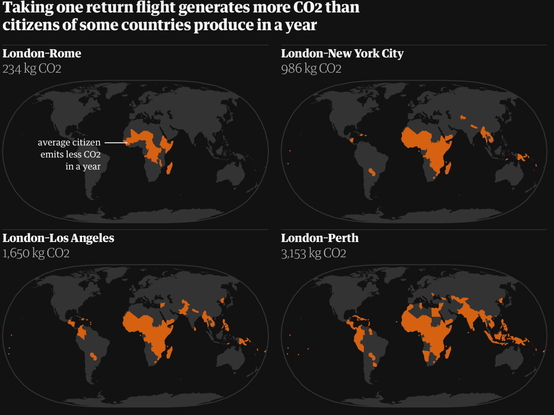
🔴 A return trip from London to New York generates 986kg of CO2 per passenger, more than the average person's yearly emissions in 56 countries. A trip to Rome generates 234kg of CO2 per passenger, more than the average person's yearly emissions in 17 countries.

13 Ways to Reduce the Carbon Footprint of our Travels?

🌟 1. Avoid flying to nearby destinations

🌟 2. Book non-stop flights

Non-stops take the most direct route to the destination, they require less fuel than itineraries with multiple legs.

🌟 3. Fly economy

An air passenger’s emissions are determined by the amount of space they take up on the plane. On average, business class seats are two times larger than those in economy.

🌟 4. Pack light

The heavier your luggage, the more fuel it takes to transport it by plane, bus, car, or train.

🌟 5. Choose efficient transportation to explore your destination

🌟 6. Turn down the AC and heat, switch off electronics

On vacation it’s the hotels that shoulder the cost. This can lead people to be less conscientious about their energy use during their travels than when they are at home. But regardless of who’s footing the bill, our planet will pay the price.

🌟 7. Use the “Do Not Disturb” sign

To reduce energy consumption

🌟 8. Eat the local cuisine

By eating local foods instead of imported ones, you’ll reduce the carbon footprint of your meal while also supporting the local economy.

🌟 9. Reduce food waste

With all the delicious and exotic food dishes to try, it’s hard not to over indulge while on vacation. But did you know that food production is responsible for roughly one-quarter of the world’s emissions? As forests are cleared to graze cows and grow crops, the carbon they store is released into the air. Food also produces carbon when it’s processed, packaged, transported, and refrigerated; and when we throw our uneaten food away, it creates harmful methane emissions as it rots in a landfill.

🌟 10. Buy meaningful souvenirs that you will actually use

Invest in high quality products instead of poorly made items that you’ll have to trash after one use.

🌟 11. Stay at eco-friendly hotels

🌟 12. Offset your carbon footprint

🌟 13. Support sustainable tourism projects and initiatives

References:

[1]https://sustainabletravel.org/how-to-reduce-travel-carbon-footprint/
[2]https://www.bbc.com/future/article/20200218-climate-change-how-to-cut-your-carbon-emissions-when-flying
[3]https://www.theguardian.com/environment/ng-interactive/2019/jul/19/carbon-calculator-how-taking-one-flight-emits-as-much-as-many-people-do-in-a-year

How to Reduce the Carbon Footprint of Your Travels - Sustainable Travel International

Read these tips to discover how you can reduce the emissions produced by your trip.

Sustainable Travel International