GSV_Empiricist

61 Followers
55 Following
76 Posts

@emmalovelace

Not a mechanic, but that looks like someone's idea of an intake-air preheater. I expect you'd be perfectly well off without it.

@nosat @Syberia

is to progressively *raise* the apparent location of objects by distance, it is easy to show that images below horizontal must be of objects *further* below horizontal.

If Earth were truly flat, the effect of air refraction would be to make it look concave - like standing at the bottom of a shallow saucer. 🤔

@nosat @Syberia

because radial distortion is *radial* (ie it only affects the distance of a point from the lens's optical center) any actually-straight lines passing through lens center remain projectively-straight.

You are also conflating lens distortion with external effects (ie air refraction) - which is a real thing, but also mostly predictable and correctable. Further, because the effect of standard air refraction 2/

@nosat @Syberia

Good grief. I was a pro VR photographer for ~15 months, doing stitched-spherical panoramas. I am *fully* aware of optical and projective distortion effects and how to accurately characterize and correct them.

Yes, pretty much all camera lenses (especially wide-angle ones) produce some degree of radial distortion - barrel, pin-cushion, or moustache (compound).

However - fun bit of trivia: 1/

@nosat @Syberia

Similarly, for the Sun setting: if the Sun moves at constant height over a flat Earth (and only appears to set due to perspective) the Sun's apparent size and its apparent distance above the horizon must shrink proportionally: if the Sun is 100 diameters above the Earth, it will always appear 100 diameters above the horizon, even as the apparent Sun-diameter shrinks.

#Oops!

@nosat @Syberia

"unaware" 😂 Pull the other one, #IdiotTroll

Perspective - the angular size of objects shrinking as the arccotangent of their distance - is very well understood, and disproves #FlatEarth

That angular shrinking affects the top and bottom halves of objects at any distance equally; it can never hide the bottom half of an object while leaving the top half visible.

(Img: Thornton Bank offshore wind farm)

@nosat @soretski @Syberia

There are plenty of photos and videos showing Earth's curvature - and you dismiss every single one, sight-unseen, as "CGI", not because you have the slightest bit of evidence or knowledge, but because every single one blows up your #IdiotTroll game.

Himawari-8
https://himawari8.nict.go.jp/

GOES-East
https://www.star.nesdis.noaa.gov/goes/fulldisk.php?sat=G16

DSCOVR
https://epic.gsfc.nasa.gov/

ISS live feed
https://www.youtube.com/watch?v=ddZu_1Z3BAc

#FlatEarthFails

@nosat @Syberia

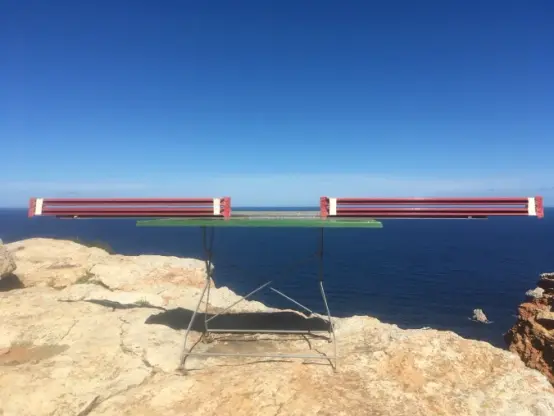
That is a custom-built horizontal reference set up 603 feet ASL. When cropped and horizontally compressed, Earth's left-to-right horizon curvature is clearly visible.

(Reference: https://mctoon.net/left-to-right-curve/)

Left to right curve of the horizon

MCToon

@nosat @Syberia

In rectilinear projection, this out-of-plane circle - like looking down at the edge of a horizontal hula-hoop centered on your chin - results in a shallow hyperbola with its apex at the center of your view.

This is actually photographable (with considerable difficulty). 3/

@nosat @Syberia

(a hair less than twice as far above the center of the horizon-circle as you are above sea-level) and in rectilinear projection (because that's how your eyes work). If viewed in cylindrical projection, the constant horizon dip would translate into a straight horizon at constant declination. But that's *not* how your eyes work. 2/