292 Followers
278 Following
1.5K Posts
I recently joined @guresuke in a metal project called MATHEMORPHOSIS

http://mathemorphosis.xyz/


Our first song, "Long Winter", was written by Guresuke-san. Its lyrics evoke in me the spirit of these days of social segregation -- the reign of Camus' Absurd. Song and lyrics are here:
http://mathemorphosis.xyz/song/longwinter.php

Our second song, "Bygone Days", focuses on a different types of absurd -- the one that sometimes we face in the course of our daily activities. Song and lyrics are here: http://mathemorphosis.xyz/song/bygone_days.php

And our latest work is called “Nightfall”. It tells of apocalyptic scenarios, of a humanity that has made a mistake too many and is one step away from extinction; at the end of the game, to put it with Beckett. But it’s also a song that speaks of hope, of a different relationship between man and the World Ecosystem. Of a new rebirth, a new Humanity — definition and never again oxymoron.

You can find it on our website: http://mathemorphosis.xyz/song/nightfall.php


#Metal #Mathemorphosis #μαϑͱεμόρφωσις

A Swiss Trick” is a funny short animation film by John Foster of Van Beuren Studios. I’m amazed at the way my piece magically matches that (accelerated) video. You may find the original on the Internet Archive.

The soundtrack is called “S​ā​g​ī​tur” and is on bandcamp

The title comes from the fact that the piece was conceived and played by me on guitars (a beautiful Fender 12-string that my friend Bart kindly lent me). The only other instrument is percussion (drumkit, darbuka, riq, and derbake).

Incidentally, “s​ā​g​ī​tur” is Latin for “It is perceived quickly or keenly with the senses”, and also “It is perceived acutely with the intellect” (www.wordsense.eu/sagitur/)

If you like my work, please follow me:

All of my music is on sale (Name Your Own Price) via https://eidon.bandcamp.com.

The original video, “A Swiss Trick”, is Creative Commons License public domain (see https://archive.org/details/swiss_trick).

This clip is also

Swiss Trick : Free Download, Borrow, and Streaming : Internet Archive

You can find more information regarding this film on its IMDb page.

Internet Archive
Could it be that the lad in the bottom right be Morohoshi Daijiro-sama Themselves?

This is “\Beep* Lain”*, a generative composition for piano, contrabass, marimba, and flute.

https://fb.watch/hUZdpN2LuX/

The clip combines excerpts from the three videos https://archive.org/details/pet1193r1a, https://archive.org/details/pet1193r1b, and https://archive.org/details/pet1193r1c, parts of the 35mm Stock Footage available on the Internet Archive.

“Rights to this collection are held by Internet Archive. You may download and reuse material under the Creative Commons Attribution License.” Credit: Internet Archive. License: https://creativecommons.org/licenses/by/2.0/. Changes were made.

#minimalism #minimalmusic #originalmusic

*Beep* Lain | This is *Beep* Lain, a generative composition for piano, contrabass, marimba, and flute. The clip (also on #youtube: https://youtu.be/3c_YruMgFyc)... | By Eidon | Facebook

16 views, 1 likes, 2 loves, 0 comments, 1 shares, Facebook Watch Videos from Eidon: This is *Beep* Lain, a generative composition for piano, contrabass, marimba, and flute. The clip (also on...

I called this piece Susanoo ( スサノヲ ), after the Shintō god of the sea, storms, fields, the harvest, marriage, and love. “One of the central deities of the imperial Japanese mythological cycle recorded in the Kojiki (c. 712 CE) and the Nihon Shoki (720 CE)” (Wikipedia), and also the god at the center of the manga “The Dark Myth” (暗黒神話 , Ankoku Shinwa), by the great Morohoshi Daijirou (諸星 大二郎).

Susa-no-o is also the god of unexpected behavior — one that disrupts the established order by introducing chaotic, sometimes violent outbursts. In this piece, I assigned this role to slap bass — the only instrument exclusively playing quarter tones; the only character whose temperament is off the scale, if you’d allow me the pun. In opposition, pianos, marimba, vibraphone, trombones, and darboka all play in standard 12-TET.

I hope you’re going to enjoy Susanoo!

Best, Eidon.

#Bandcamp: https://eidon.bandcamp.com/track/susanoo

#Youtube: https://youtu.be/nAT10gfL7oY

#諸星大二郎 #MoroboshiDaijirou #暗黒神話 #AnkokuShinwa

Music by Eidon, (c) Eidon ([email protected], [email protected]).

The video makes use of the following videos:

Zooming in on the Horsehead Nebula (3D) https://esahubble.org/videos/heic1307b/ Credit: NASA, ESA, the Hubble Heritage Team (STScI/AURA); G. Bacon, T. Borders, L. Frattare, Z. Levay, and F. Summers (Viz 3D team, STScI); ESO. ESA/Hubble video released under the Creative Commons Attribution 4.0 International license.

3D visualisation of the Horsehead Nebula https://esahubble.org/videos/heic1307d/ Credit: NASA, ESA, the Hubble Heritage Team (STScI/AURA); G. Bacon, T. Davis, L. Frattare, Z. Levay, and F. Summers (Viz 3D team, STScI); ESO.

Hubblecast 65: A whole new view of the Horsehead Nebula — celebrating Hubble’s 23rd birthday https://cdn.spacetelescope.org/archives/videos/hd_1080p25_screen/heic1307a.mp4 Credit: ESA/Hubble Visual design and editing: Martin Kornmesser Web and technical support: Mathias Andre and Raquel Yumi Shida Written by: Nicola Guttridge Presented by: Joe Liske (Dr J) Narration: Sara Mendes da Costa Images: NASA, ESA, and the Hubble Heritage Team (AURA/STScI); ESO Animations: NASA, ESA, the Hubble Heritage Team (AURA/STScI); F. Summers, L. Frattare, T. Davis, Z. Levay, T. Borders, and G. Bacon (Viz 3D team, STScI) Music: Steve Buick Directed by: Nicola Guttridge Cinematography: Peter Rixner (www.perix-media-gmbh.de) Executive producer: Lars Lindberg Christensen
Shinto - Wikipedia

Pictures and video from The Dark Myth (暗黒神話, Ankoku Shinwa), manga and anime by Daijiro Moroboshi.

The key concept here is the shuji:

Shuji are syllables that contain, as if compressed, divine concepts. The shuji, emitted in one of the “exact” modalities, express the shingon [true word], which in turn enclose in their entirety and express the “words of god” and of the Initiates.

Here, the shuji are “ya” “ma” “ta” and “i”, which create the shingon “Yamatai”.

Daijiro Morohoshi - Wikipedia

The piece I included has been inspired by a beautiful photo that [Mr. Norbert Woehnl(@[email protected]) kindly shared with me. Mr. Woehnl entitled his work “Autumn Reflection”.

Quoting from Mr. Woehnl’s original post, Autumn Reflection depicts

>>> “A tranquil autumn scene along a pond at Showa Memorial Park (Shōwa Kinen Kōen, 昭和記念公園) in #Tachikawa, around 30 minutes from central #Tokyo.”

No better title I could choose for my piece. “Autumn Reflection” is a placid piece for clarinet, oboe, and piano. A Grundgestalt based on three seeds, namely strings

>>> 000020020110440140054162106751633100953, >>> 000220324110444140554162106751633100953, and >>> 01102220324110444140554162106751633107953.

(The first string is also “played” at the end of the piece.)

More information on the generative process that produces music from the above seeds is available here.

As a curiosity, this is the first piece of mine that uses SCAMP.

The piece is available as a 24-bit 48MHz FLAC on bandcamp.

Again, heartfelt thanks to @norbertwoehnl for giving me permission to use his photo!

I hope you’re going to like our “Autumn Reflections”!

Best, Eidon

Mr. Woehnl’s photo.

Norbert Woehnl :coffefied:: “"Autumn Reflection" A tranquil autumn scene along a pond at Showa Memorial Park (Shōwa Kinen Kōen, 昭和記念公園) in #Tachikawa, around 30 minutes from central #Tokyo.Shot with #Nikon D200 and Nikkor 18-2...”

Norbert Woehnl :coffefied: (@[email protected]): “"Autumn Reflection" A tranquil autumn scene along a pond at Showa Memorial Park (Shōwa Kinen Kōen, 昭和記念公園) in #Tachikawa, around 30 minutes from central #Tokyo.Shot with #Nikon D200 and Nikkor 18-2...”

Al-jabr” (in Arabic, الجبر) means ‘reunion of broken parts’, or ‘bonesetting’. The term can be found in the title of the early 9th century book “cIlm al-jabr wa l-muqābala” “The Science of Restoring and Balancing” by the Persian mathematician and astronomer al-Khwarizmi. In his work, the term al-jabr referred to the operation of moving a term from one side of an equation to the other.” (Wikipedia).

“Al-jabr” is also the title of this piece, which is the result of a reunion of spurious parts provided by a Steinway D piano, assorted Arabic percussion (darbuka, riq, etc.), and a Rickenbacker bass (plain and “treated” with various effects; kindly lent to me by dear friend Jan). The whole emerging from those parts is a minimal piece. Surprisingly, at least to me, is the fact that I had not decided to write one such composition. The piece wanted it thus. Sometimes I feel more like a midwife than a composer…

The piece is available

This post is also available on my blog, https://noblogo.org/eidon/al-jabr-ljbr

Share with me your opinions, if you like! Thanks in advance,

栄屯

Music composed and arranged by Eidon. Rickenbacker bass played by Eidon. (c) Eidon (Eidon@@tutanota.com). All right reserved.

Video: Sped up, truncated version of “Zelda Breath of the Wild Copics on Shikishi Board Time-lapse,” by olyvee (Etsy shop: https://www.etsy.com/shop/olyvee, Instagram: https://www.instagram.com/olyvee_, Twitter: https://www.twitter.com/olyvee_) Video is Attribution 3.0 Creative Commons License (https://creativecommons.org/licenses/by/3.0/): “Free to Adapt — remix, transform, and build upon the material for any purpose, even commercially. “

Please follow me on #bandcamp! To do so, visit https://eidon.bandcamp.com/follow_me. Thank you!

Pleroma

A couple of years ago I wrote an album called “Les Fleurs du Mal”. despite its title, that album is NOT dedicated to Baudelaire’s famous collection of poems — rather, it proposes pieces inspired by the manga 惡の華 (“Aku no Hana”, that is “The Flowers of Evil”), by Oshimi Shūzō.

So far I have posted three pieces from that album. This is a fourth one, called “Saeki”, as one of the dramatis personae of that manga. The video is given by the first scene of “Nosferatu – Eine Symphonie des Grauens”,

<<a 1922 silent German Expressionist horror film directed by F. W. Murnau and starring Max Schreck as Count Orlok, a vampire who preys on the wife ([Ellen, interpreted by] [Greta Schröder](https://en.wikipedia.org/wiki/Greta_Schr%C3%B6der)) of his estate agent (Gustav von Wangenheim) and brings the plague to their town>> ([Wikipedia](https://en.wikipedia.org/wiki/Nosferatu))

The tragic figure of Ellen, and her utmost sensibility, led me to the present association with Nanako Saeki. If you read the manga, my guess is you’re going to understand why.

Please note that Greta Schröder was actually born as Margarethe Schröder.

If you like this music, you might consider to listen to the whole album on #bandcamp:

Les Fleurs Du Mal: https://eidon.bandcamp.com/album/les-fleurs-du-mal

The video is also on my #youtube channel, https://www.youtube.com/@eidonveda, at https://youtu.be/GUYRfzjA91k.

Murnau’s film was downloaded from https://archive.org/details/nosferatu_eine_symphonie_des_grauens, Public Domain Mark 1.0 Creative Commons License publicd omain

Post also on facebook.

Die Schauspielerin Greta Schroeder, 1919. Ernst Reichardt (gest. 1932) - Privatfotographie Ernst Reichardt. Public domain.

Thank you for taking the time to check my work out!

Les Fleurs du Mal, by Eidon

13 track album

Eidon
フラグマー 1

This is “フラグマー 1” (“Furaguma I”), an algorithmic piece based on a compositional approach that I called Wohlgestaltete Komposition. It is a hybrid process, in which machine and man cooperate. In a nutshell:

  • I identify musical quanta that represent initial configurations for a game simulator.
  • When fed into the simulator, those “μQuanta” produce 3-voice music fragments. I select the μQuanta that produce fragments that I consider of interest, and I compose them together.
  • I consider the music emerging from the combined fragments, and I operate modifications in the order and quantity of μQuanta in order to accentuate musical aspects that enhance the overall musical quality (according to my own perception) and to dampen aspects that I consider detrimental to that subjective concept of quality.
  • I continue the process by disrupting the selected μQuanta by flipping / adding / subtracting certain elements. Those disruptions in some cases aim at producing more “balanced” initial configurations, such that the corresponding games and music fragments last longer. In some other cases they may be purely random.
  • I include the disrupted μQuanta in the ongoing compositional process, and continue to build up the “piece” until its overall shape and contents assume what I arbitrarily recognize as a unique “identity”.

I refer to the overall selection of μQuanta in a piece such as “Furaguma I” as to “the Grundgestalt of Furaguma I”.

In fact, the term “Wohlgestaltete” means “well-shaped”, but it’s actually a reference to the above process of selection of μQuanta that shape up the piece by defining its “basic form” — its Grundgestalt.

When time allows, I will write a paper describing the Wohlgestaltete Komposition. I would appreciate it very much if you would have suggestions regarding possible target journals. Thank you!

CreditsA curiosity

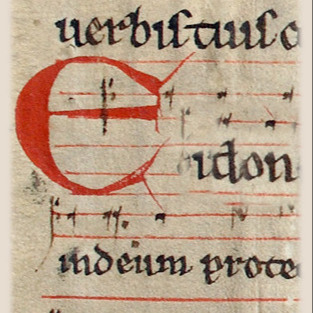
Comment about Mi 75 “One of the challenges in sorting out the fragments from Mi 75 is that the scriptorium seems to have a rather casual attitude to ruling – two pages of the same leaf can have different writing space, and the columns may be of different widths. Lat. fragm. 896, 1-4 are related to Mi 75 through initials, pigment and parchment, but differ in scribe, music scribe and format. Still, the scribe seems to be imitating the main scribe of Mi 75, and may therefore have collaborated on the same book.”

…and finally:

#μQuanta #WohlgestalteteKomposition. #Grundgestalt #GenerativeMusic #AlgorithmicComposition

Eidon / HeartQuake · GitLab

Simulates the HeartQuake game for a given number of cycles. Reports winners and ongoing games

GitLab