EASAC European Academies

26 Followers
20 Following
119 Posts
We unite the National Academies of Science of the EU Member States, Norway, Switzerland and the United Kingdom to provide independent science-based advice to policymakers in Europe.

The #EU Governance Regulation and National Energy and Climate Plans are vital to Europe’s #EnergyTransition.

In feedback to a call for evidence by the @EUCommission for the review of the #EnergyUnion and #ClimateAction governance regulation, #EASAC urges it to use this revision to:

📋 Enforce common reporting standards
⚖️ Strengthen accountability
📈 Address energy poverty systematically

https://easac.eu/news/details/easac-feedback-on-the-review-of-the-eu-governance-regulation-on-the-energy-union-and-climate-action

EASAC Feedback on the Review of the EU Governance Regulation on the Energy Union and Climate Action

The EASAC Energy Steering Panel submits response to a public consultation and call for evidence by the European Commission to help shape the upcoming revision of the Governance Regulation on the Energy Union and Climate Action.

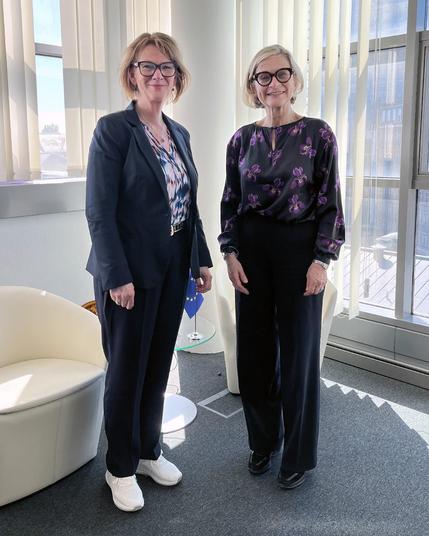
On International Women’s Day, we launch #FromPresenceToPower, a mini-series on leading #WomenInScience in cooperation with @IAPartnership!

Our first feature, EASAC President Lise Øvreås reminds us that advancing gender equality in science requires structural change so women can lead, influence, and help shape the agenda. Let’s keep pushing for structural change, equal opportunity, and representation at every level.

💬 Which woman has inspired your career? #IWD2026 #ItsScience

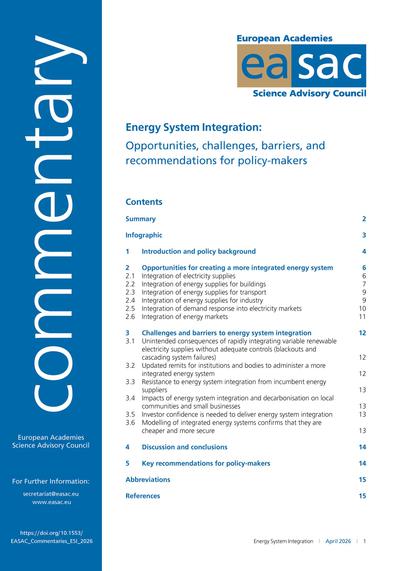
💡 “It is important that the voice of science, channelled through the academies of #Europe, is heard and has an impact on #energypolicy decisions,” says Alessandro Allegra, EASAC’s Energy Programme Director.

🇪🇺 Alessandro joined EASAC in November 2025. Previously employed by the European Commission’s Science, Policy and Ethics Unit, he brings knowledge of and expertise at the science-policy interface to #EASAC.

Learn more: https://easac.eu/programmes/energy

#scienceadvice #itsscience

♻️ The #CircularEconomy is not only essential to keep a habitable planet; it is also major business opportunity. Yet the EU remains far from its goal to double circularity to 24% by 2030.

As @EP_Environment is to debate #plastics circularity tomorrow, we reiterate EASAC’s scientific advice:

https://easac.eu/publications/details/update-on-the-easac-plastics-report-towards-a-plastics-treaty

#EASAC works across 3 #science4policy programmes: #Energy, #Environment and #Biosciences & Public Health.

🔬 But what are biosciences, actually? And why do they matter for policy, industry and society? Here, we explain the key principles and disciplines.

🧬 Learn more: https://easac.eu/programmes/biosciences

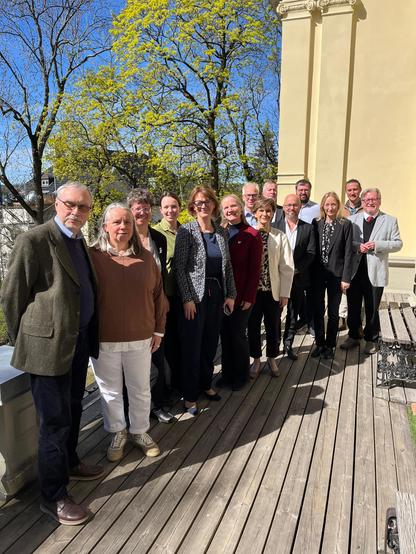
On International #WomenInScience Day, we celebrate the brilliant women who led #EASAC science advice over the past year. Their leadership and expertise advanced evidence-based policy across Europe. Many more are involved—thank you for inspiring the next generation. #Science4Policy #itsscience
“Europe will increasingly have to learn to live with fire and adapt society to a new challenging reality,” warns Prof. Thomas Elmqvist.
https://easac.eu/publications/details/changing-wildfires
“Suppressing fires alone is not enough. We need to address root causes, better fight climate change, invest in resilient landscapes, and engage society in living with fire,” says Dr Cathelijne Stoof.
@EASAC
Changing Wildfires - Policy Options for a Fire-literate and Fire-adapted Europe

“Europe will increasingly have to learn to live with fire and adapt society to a new challenging reality,” warns Prof. Thomas Elmqvist, EASAC Environment Director. “More than twice as many urban areas are at risk of fire in Europe than in North America and Asia.“ Already today, wildfires in the EU burn, on average, half a million hectares yearly - nearly twice the size of Luxembourg.

Rising global autocratization threatens academic freedom and scientific integrity, weakening the foundations of sustainability science and environmental policy.

A new comment in Nature Sustainability, authored by Robert I. McDonald, Dagmar Haase, Thomas Elmqvist & David Maddox, makes it clear that this trend undermines the central foundations of sustainability science and environmental policy.

https://www.nature.com/articles/s41893-025-01739-x

Uncharted political waters for sustainability - Nature Sustainability

Increasing autocratization globally threatens academic freedoms and scientific integrity, undermining core assumptions of sustainability science and environmental policymaking. To stay relevant, sustainability scientists and environmentalists must change how we work and ally with those defending academic freedom.

Nature

Restore Nature - or pay trillions in damage...

Launched today: Our new Commentary on "Opportunities in Nature Restoration" highlights nature restoration as a strategic investment in Europe’s security, prosperity, and ecological stability.

Read more 👉 https://easac.eu/news/details/nature-restoration-commentary-launched

#Norway - who initially planned to issue exploration permits this year - had a change of heart, had a change of heart on #DeepSeaMining and decided on Tuesday to postpone plans by 4 years. Discover why this is good nows from a scientific perspective:

https://easac.eu/publications/details/deep-sea-mining-assessing-evidence-on-future-needs-and-environmental-impacts