
Brenden

@BrendenBeck
28 Followers
79 Following
7 Posts
Sociologist at the Rutgers School of Criminal Justice. I study policing, city budgets, housing, and suburbs. brendenbeck.net

You can decide whether tax evasion receives 6x more attention from the press and elected officials than property theft.

Sources:
https://ucr.fbi.gov/crime-in-the-u.s/2019/crime-in-the-u.s.-2019/topic-pages/tables/table-24
https://crsreports.congress.gov/product/pdf/IF/IF11887

Table 24

FBI

Here on Tax Day, let's remember the ubiquity of tax evasion. The IRS estimates that 13% of taxes that are owed are never paid, totaling $171 billion in the typical year. For comparison, Americans lost $9.4 billion to property theft in 2019 according to FBI data.

If we assume that underreporting means the actual property theft number is three times higher than $9.4b, tax evasion is responsible for *six times* more lost money than all shoplifting, car thefts, robberies, and burglaries combined.
Research into the spatial context of the criminal justice system has grown lately, but it faces challenges. In a new Annual Review of Sociology article, Jessica Simes, John Eason, and I summarize the sub-field, critique its focus on large cities, and venture some recommendations. https://www.annualreviews.org/doi/abs/10.1146/annurev-soc-031021-035328
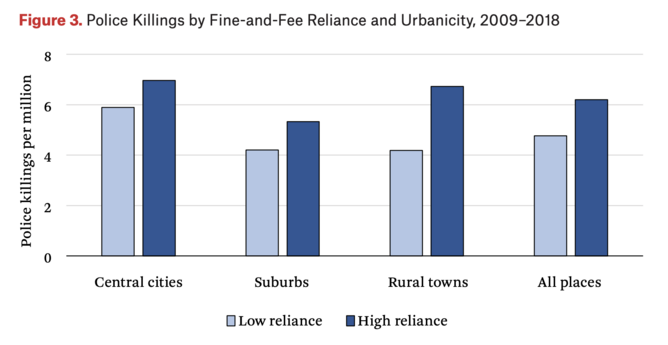
Police in Ferguson, MO prioritized generating revenue. Did that play a role in the death of Michael Brown? In a study out today, I find that police in cities that relied on fine & fee revenue killed more people. The article is free to read. https://www.rsfjournal.org/content/9/2/161
Police Killings and Municipal Reliance on Fine-and-Fee Revenue

High-profile police killings in the United States have drawn attention to how municipalities generate revenue through citations and arrests. This article investigates whether killings by police are more frequent in places that rely on fine-and-fee revenue by first describing the types of municipalities that collect the most money from monetary sanctions. It then analyzes whether fine-and-fee reliance and a municipality’s status as urban, suburban, or rural are associated with police killings. Descriptive statistics and negative binomial models reveal that suburbs with large Black populations rely the most on fine-and-fee revenue and police killings are higher in central cities than suburbs or rural towns. Cross-sectional and longitudinal regression models find that municipalities that rely more on fines and fees have more police killings, suggesting municipal fiscal imperatives influence police violence.

RSF: The Russell Sage Foundation Journal of the Social Sciences
"Prime Minister Rishi Sunak is building new prisons and recruiting more police officers as part of his party’s pledge to be tough on crime. He has also proposed a budget that would make deep spending reductions in the coming years, forcing officials to find savings in programs that have already been whittled to the bone during a decade of austerity." https://www.nytimes.com/2023/02/04/world/europe/london-austerity-youth-violence.html
In London’s Poor‌ ‌Areas, Budget Cuts‌ and Youth Violence Collide

Poor neighborhoods that have been hit hardest by austerity have also seen violence among young people surge or remain stubbornly high. Residents say that’s no coincidence.

The comedy wildlife photography awards never disappoint. https://www.comedywildlifephoto.com/competition/competition-2022-winners.php
2022 Winners :: Comedy Wildlife Photography Awards - Conservation through Competition

RT @[email protected]

Thankfully, gun violence appears to be dropping nationwide, as shown in Year-to-Date city-level data compiled by @[email protected]. Definitely recommend checking out his post on Substack. https://jasher.substack.com/p/gun-violence-2022

🐦🔗: https://twitter.com/Data_David1/status/1603396260567957505

Gun Violence Appears To Be Falling Nationally

Gun violence rose at an unprecedented rate in 2020, but evidence is accumulating that it is starting to fall.

Jeff-alytics