 Ana Tudor 🐯
@[email protected] tusky is pretty nice
| web | https://ganslandt.xyz |

| web | https://ganslandt.xyz |
✨ On sharp transitions: whether we have a linear or a radial gradient, if the current stop position is equal or smaller than the position of the previous stop one, we have a sharp transition. Since `0` is smaller than any positive value, we can make the code of our gradient with sharp transitions more easily maintainable by writing
✅ `red 9%, tan 0`
instead of ❌ `red 9%, tan 9%`.
This way, if we need to change that stop position later, we only need to change it in one place, not two!
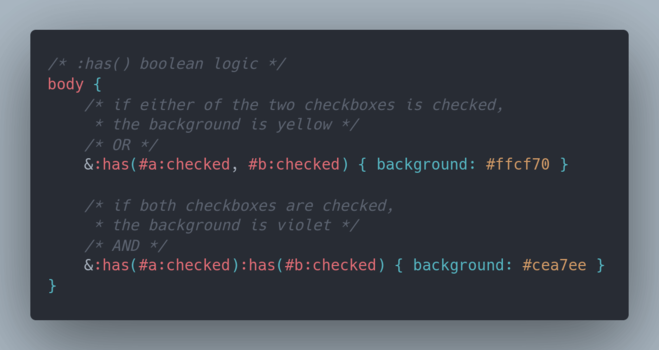
✨ `:has()` boolean logic ✨
💫 OR - use comma-separated values inside `:has()`
💫 AND - use chained `has()` selectors
You can play with it here https://codepen.io/thebabydino/pen/KKeMLja
Oh hello, I'm here now - after a brief life as terribleMia over on mastodon.social - and it's lovely to see so many of you.
- I like weird art
- I like weird CSS
- people are cooler than tech
I helped put this server together, and I hope it grows to host a thriving community of cool people. Thanks to everyone who's joined already. We'll get some guidelines in place soon.
🍃 WDRL 304: New CSS, an unplugged life, and new Open Source challenges.
Day 28: custom properties and web components
We already know that we can encapsulate styles within a web component and we know that web components inherit styles. Another interesting feature of web components in terms of CSS is that custom properties used in a web component can be modified from the outside.
 Mia (web luddite)
 Anselm Hannemann

 Manuel Matuzović
 Axel Rauschmayer