Nanoraptor
Some terrifically titled papers from a discovered collection of NASA research documents found in a skip
(with thanks to @JuliaRez for the original pic)
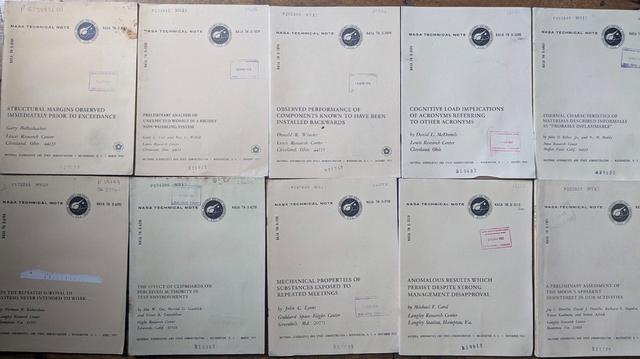

Some terrifically titled papers from a discovered collection of NASA research documents found in a skip
(with thanks to @JuliaRez for the original pic)
I know this is sometimes a contentious topic, but I'd like to ask the CS profs in my corner of the fediverse:
What are the *core CS topics* that every student should know?
I think data structures & algorithms is indisputably a core topic. Interpreters and compilers—that might just be my bias.
I'm thinking about how to express to people why I think some core CS should be as important to a well-rounded education as, say, algebra. What would you hope every high schooler/undergrad understand?
https://www.theregister.com/2026/01/21/curl_ends_bug_bounty/
(I will blog about the details next week)
@mattblaze I've never commented on any of your photographs before but I figured it's past due for me to say they are all absolutely amazing, including this one. Hoping you continue to post these, as they are a wonderful palate cleanser from the InfoSec stuff I'm mainly here for. Thank you!
P.S. Publish a coffee table book!
ACM recently announced a move to Open Access for all their publications, as our community has long requested (and where SIGCOMM has been a leader).
You can learn more about ACM’s transition here:
https://authors.acm.org/open-access
https://conferences.acm.org
https://www.acm.org/diversity-inclusion/equity-through-oa
We understand that publication fees are a concern. We wanted to provide the following additional information:
• SIGCOMM will be providing funding to offset fees for all authors for its events. This means fees will already be reduced below ACM’s standard charges for this year.
• Papers with at least one author from an institution participating in ACM Open will have their fees waived by ACM.
• ACM offers a geography-based waiver program for researchers in certain developing regions.
• SIGCOMM will in addition host its own Financial Hardship Waiver program (SIGCOMM-FHW).
• Priority will be given to authors from low-income countries or from institutions and research groups without active grant funding.
• Authors with financial need can submit a brief statement, and we will approve applications based on that need.
• Looking ahead, SIG leadership is continuing to work with ACM to explore avenues to further reduce fees in future years.
Our goal is to make this transition as smooth and supportive as possible for everyone in our community. If you notice problems, have questions or need assistance, we very much hope you will reach out to us.
Thank you for your continued dedication to advancing networking research and practice. Together, we can ensure that SIGCOMM’s work reaches the widest possible audience in a more open and accessible future.
SIGCOMM Executive Committee

It's December 2nd, which means that for the next 23 days, there's a high probability that you will encounter the classic film A Christmas Story broadcast on TV or streaming services.
One of the plot points in the film concerns decrypting a radio message from Orphan Annie's Secret Society, which was based on a real radio program of the era.
A while back I wrote up a little post on the (basic, but still interesting) cryptography involved.
🎁 GenAI x Sec Advent 2 - PromptIntel
This year I released PromptIntel. It is an open database that lists what I call Adversarial Prompts or Indicators of Prompt Compromise (IoPC).
An adversarial prompt (IoPC) is a crafted instruction built to exploit or abuse your AI system.
If you deploy an AI model, these prompts are the signals you want to detect, block or at least monitor!
Have a look at PromptIntel. 👇
promptintel.novahunting.ai
 Ashton Wiersdorf
 daniel:// stenberg://
 ACM SIGCOMM
 InfoSecSherpa
 Matt Blaze
 Thomas Roccia