 SoSyM
SoSyMA theory of composable modeling language components
Jérôme Pfeiffer & Andreas Wortmann
doi.org/10.1007/s102...
A theory of composable modelin...
A theory of composable modeling language components - Software and Systems Modeling
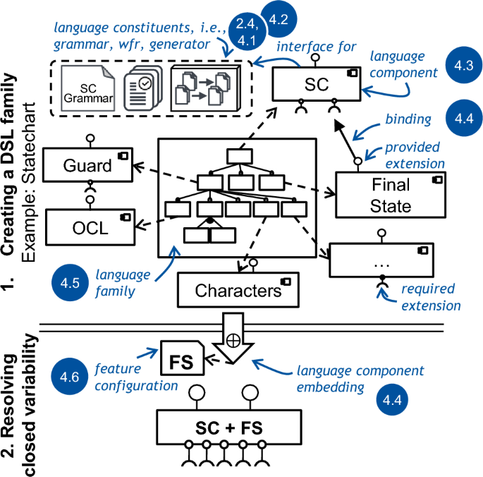
Modern-day software has become increasingly complex and ubiquitous in many domains. In many cases, the scarcity of software engineering experts means that domain experts must engage in software development tasks. (DSLs) can help bridge this gap by enabling domain experts to express solutions in familiar domain terms. Engineering such (DSLs) is complex. This complexity arises from the variety of artifacts involved—such as grammars, well-formedness rules, and code generators—and from the need to integrate these artifacts across languages. In software language engineering, language workbenches for textual, external modeling languages with translational semantics seem to be a popular, which includes inhabitants such as Xtext, Neverlang, MontiCore, and Spoofax. Yet, reusing existing languages in these environments is often piecemeal and driven by the constraints of specific realization technologies (e.g., Xtend, FreeMarker). This typically requires software language engineers to create DSLs for domain experts, rather than enabling domain experts to reuse and adapt languages themselves. As a result, enabling the systematic reuse of software languages remains a fundamental challenge in software engineering. To reduce the gap between problem domain expertise and software language engineering solution expertise, we have conceived a top-down software language reuse method that enables domain experts to reuse existing languages through formally specified language components that encapsulate the realizations of syntax and semantics of (a fragment of) a language packed ready for systematic reuse. To ease its understanding of our method and its adoption to other technological spaces, we describe our methods and the composition process independent of specific technologies. The presented method of language reuse aims to advance software language engineering for textual, external, translational (DSLs) and may serve as the basis for further investigation of formalizing language reuse.