Northern Highland #Scotland folk: if you live near a beach it could be worth looking for fulgerite tomorrow, patches of sand that have been hit by lightning. If you (very gently, they're fragile!) dig down you may find a branch-like structure where the lightning fused the sand into a kind of glass. Rare, special thing to find.
There's a similar sand-to-glass thing called Trinitite. I've got about a gram of it. It dates to precisely 05:29 local time, 16th of July 1945. It was created by the detonation of the first nuclear weapon.
Illegal to collect from the site these days (and most of it was buried elsewhere to prevent that), but buying/selling/owning samples collected before the ban is legal. Still *faintly* radioactive, but no more than some things you can buy in supermarkets. But don't eat it, cos alpha.
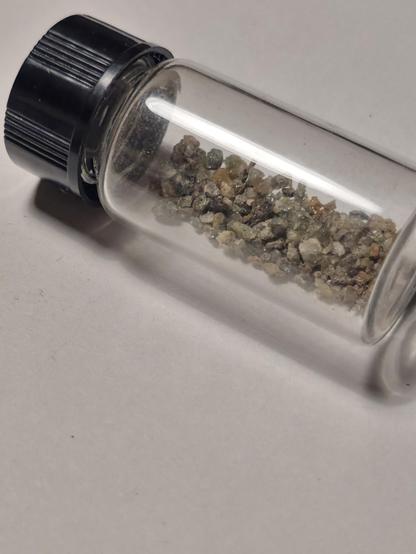
I did a Geiger counter test out of curiosity, it's about 15% above background here. Low-sodium salt from the supermarket, to put on your chips, is about 50% above background.
Doesn't guarantee it's safe though, the test doesn't discriminate between alpha, beta and gamma. Potassium chloride salt is mostly beta, so meh on eating it at that level. Eating alpha emitters is always dodgier at any level, if that's what I detected.
@_thegeoff Try it through paper and then tinfoil for a very basic alpha/beta blocker?
@BashStKid I'd need to do very long tests (multiples at hours a time) to get anything statistically significant. For my purposes, which are "is it actually radioactive, and am I safe having it in a jar on the shelf?" my test is enough ;)
@_thegeoff I feel like this is a part of a Tom Clancey novel
@gahlord Oddly, one of my favourite books as a kid was Angus MacVicar's "Return To The Lost Planet", where kids visit a deserted alien world and realise there was a nuclear war, from all the green glass in deserts. Written in 1954 by someone who served in WWII.
@gahlord Also, as a book that was already 30 years old in the 80s, it smelled *amazing*.

@_thegeoff
Lightning strikes also leave a permanent radiating structure in the soil that is visible in magnetometry. Those have confused many archaeologists since the tech became available.

#geophys #archaeology

@mrundkvist I've always wondered how magnetite can end up with a magnetic field far, far stronger than Earth's. My only idea is high currents due to lightning strikes.
@_thegeoff Fulgurites are so cool.
@_thegeoff Hot tip! Wait until the lightning ⚡️ has finished before starting to collect…
@_thegeoff If anyone needs pics of sand fulgurites: https://oumnh.ox.ac.uk/fulgurites
Fulgurites

It is astonishing to think that a split second of stormy weather can be captured in stone. This is is exactly what happened when a bolt of lightning struck drifting sand near Drigg, in Cumbria, and the intense heat fused the sand grains together.