#InPlace 1

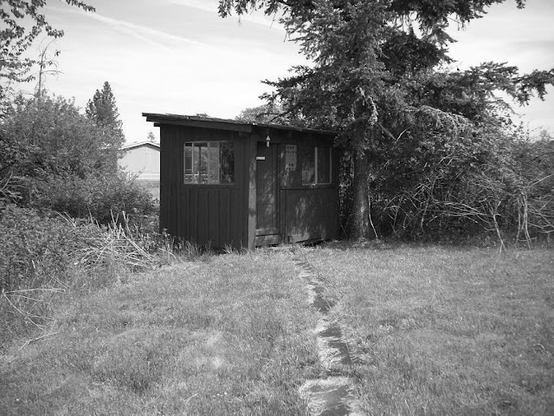
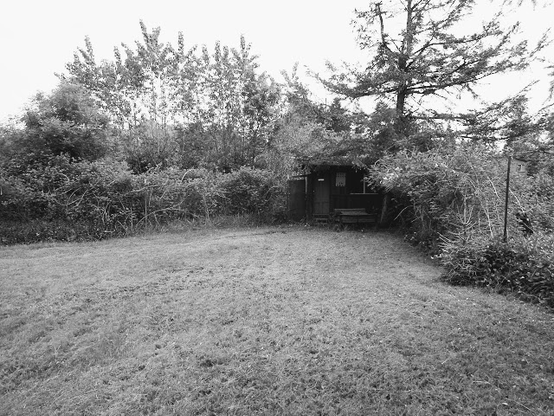
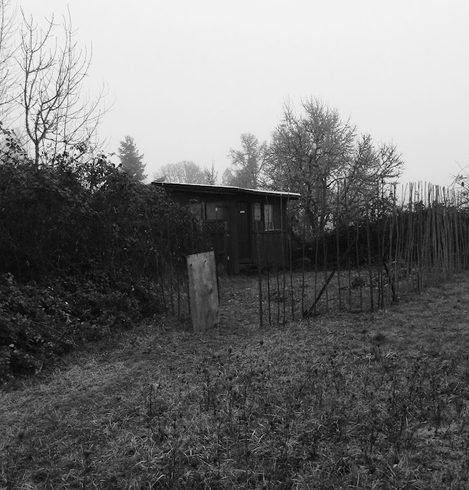
Decades ago, a playhouse for her children

but too much window glass for their play

by the fence it stands now, forlorn, lost;

neighbors' horses seem amused

The image was probably taken about 2010, when the playhouse had been mostly unused for almost two decades. The shade tree, a Douglas fir, is already looking a little stressed, perhaps partly because the playhouse was built so near it when it was a small sapling.

I move my table to read sutras by moonlight
I pick wildflowers to fill my altar vase

-- Shiwu (Stonehouse, tr. Red Pine)

#InPlace 2

Retired from public life, she moves in, old

eight books she's written here

not bad books, yet she must admit

she has failed to save the world


"Failing to save the world" in this instance means having attempted, without much impact, to promote to society at large an agrarian subsistence lifestyle as a response to resource depletion and climate change. Those who speak for corporations proved to have the louder voice, and like many others the old woman has been worn down considerably. She is trying a new approach.


To glorify the Way what should people turn to?
To words and deeds that agree
But oceans of greed never fill up
and sprouts of delusion keep growing

—Shiwu (Stonehouse) (after Red Pine, tr.)

#InPlace 3

Thoughts pursued, thoughts of

thoughts pursued, writer's cramp

alternating with writer's block

one old mouse chases her tail


While writing these books the retired woman began to see the limits of her own vision and to consider how she might, if not actually "escape the circle of discourse," at least resolve some doubts.

"All your opinions are still not put to rest. Your mind is still hindered by attachments. Thus, you are as one sitting outside the gate."
-- Keizan, "Instructions on How to Do Pure Meditation" (tr. Nearman)

#InPlace 4

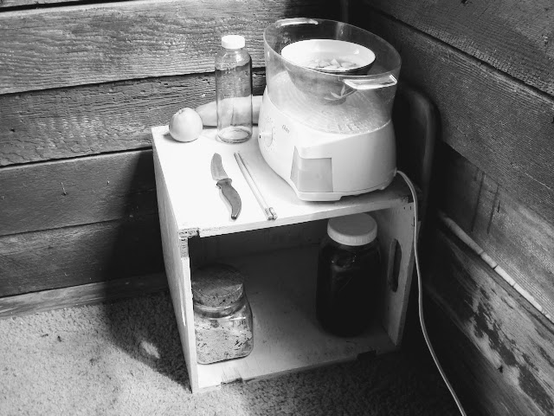
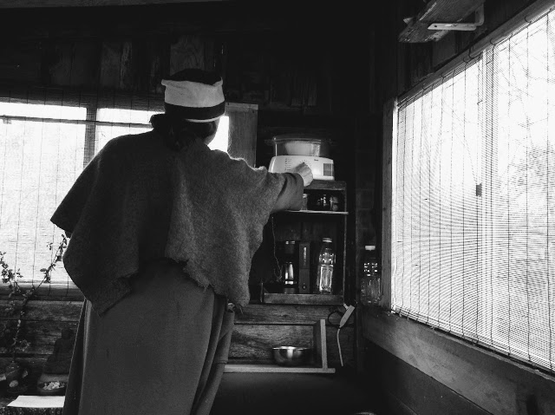
An impromptu kitchen appears

rice with powdered vegetable leaves

sips tea while watching

rain slant into cottonwoods


The old woman cut down and firewooded five cottonwood trees here in 2009 because hawks were using them to rest in while counting Beloved's chickens. Some thirty young cottonwoods, and a few ash trees, sprouted from among the stumps and roots, and are now (2015) the "woodland" associated with the hut. Their trembling leaves are wonderful teachers.

The steamer handles rice, barley, oats, potatoes and leafy vegetables with ease, providing a measure of day-to-day independence from the homestead, which is a couple of hundred feet away. Mice took an interest in the cork lid of the rice jar, so that had to be replaced.


Though the hut is small, it includes the entire world.
-- Shitou (tr. Leighton and Tanahashi)

#InPlace 5

She cleans up this site;

weeping, she finds toys

her children had mislaid among thorns

and stones, moss-covered

Here in 2013 the impending demise of the fir tree has become quite evident. It had shaded the hut as a playhouse and a writer's cabin, as well as numerous picnics. In the 1990s, children played round this structure and inevitably lost some things; plastic toys last a long time but moss may hide them for awhile, waiting to be rediscovered like archeological treasures.


...retiring to my hut I accept white hair
but sigh that today and the years gone by
are mindless like the rivers flowing east

-- Han Shan (Cold Mountain, tr. Red Pine)

#InPlace 6

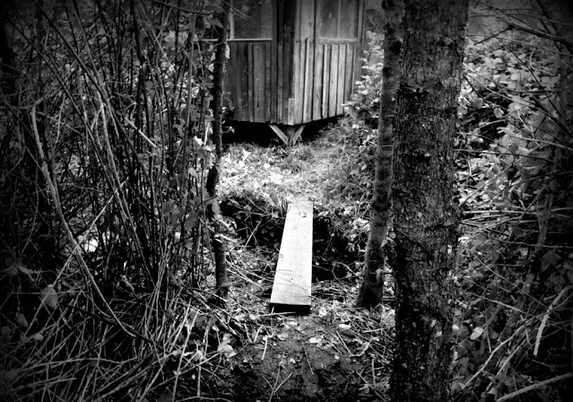
She's thrown a heavy old fir beam

from bank to bank, replacing a bridge

long gone, and cut new trail right

through old undergrowth: back door


An intimidating thicket of Himalaya berry canes of course grew up beneath the cottonwoods along the dry wash (a respectable creek in rainy season) but with time and a pair of secateurs such things can be pushed back, if a path is wanted.


If you don’t understand the way right before you,
how will you know the path as you walk?

-- Shitou (tr. Soto-Shu Liturgy Conference)

#InPlace 7

Snips rusty fence wire
to set a gate; a tiny parkland in
deep brush -- this dry wash
silent in summer; in winter roaring


The gate provides an entryway from the poultry pasture, allowing access to the hut should anything happen to the main bridge, which crosses the creek elsewhere, nearer the homestead. Three bridges have been washed away by floods in times past. It is a very dynamic landscape.


Though the river's current never fails, the water passing, moment by moment, is never the same. Where the current pools, bubbles form on the surface, bursting and disappearing as others rise to replace them, none lasting long. In this world, people and their dwelling places are like that, always changing.
-- Chomei, Hojoki

#InPlace 8

Shade tree leans on hut;

old woman, sad, makes cuts

then cables tree uphill

firewood she had not needed


The tree began an imperceptibly slow but undeniable lean to the east, downhill, a path that would take it through the hut. Two feet thick and fifty feet tall, it presented a problem for the old woman. She considered whether to give up the hut, then elected to draw the tree uphill with wire rope and pulleys. Cutting the tree while it was under pressure from the cable presented its own set of difficulties, as the tree could split and crash backward into the building. By cutting most of the way through the stump and then cranking and resetting the tension many times, she eventually brought the tree within reach of a pole saw. Daylight where shade had been -- she'd foolishly counted on that shade for the hot summers.


Across the valley
I hear the sounds of trees being felled

-- Ryokan (tr. Abé and Haskel)
#impermanence

#InPlace 9

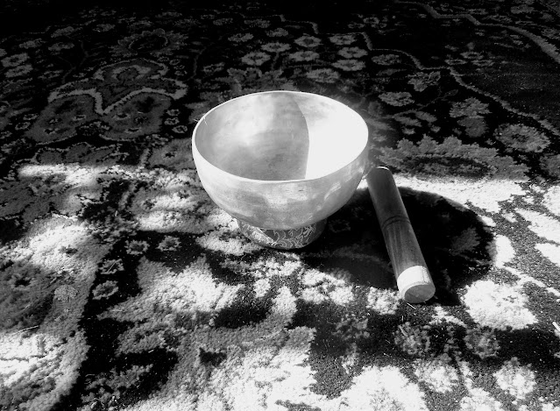
She lays carpeting; an old brass bowl

will teach by singing— it tells her

she may stop thinking, or may

even stop stopping thinking


In 2013 the old woman experienced a crisis of gloom over perceived diminishing likelihood that most species, including humankind, could survive the oncoming exponential increase of environmental degradation. A friend advised her to take up some form of meditation.

Having been a "book Buddhist" off and on for decades, she joined a Soto Zen Buddhist sangha. She had known her teacher decades before, when her teacher was a farm housewife. They seem to be a good fit in these new roles. The hut was now repurposed as a zendo (meditation hall) of sorts. “Stop thinking, or even stop stopping thinking” is a reference to Eihei Dogen’s "Fukanzazengi."


Think of not thinking, ‘Not thinking —what kind of thinking is that?’ Nonthinking. This is the essential art of zazen.

— Dogen (tr. Tanahashi)

#InPlace 10

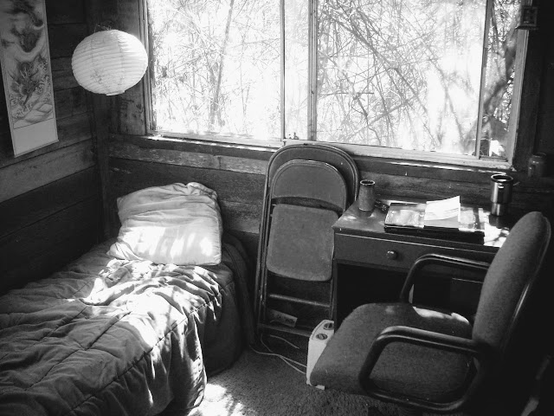
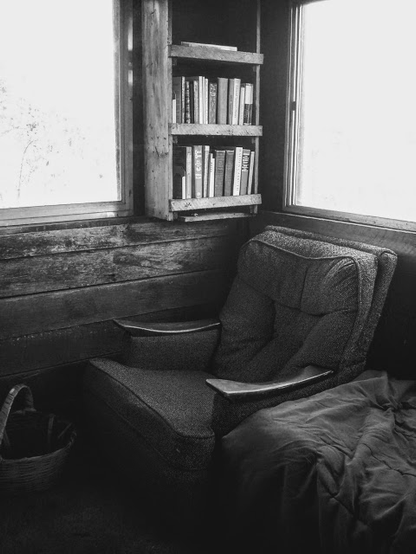
Books, lamp, her mother's desk,

a small cot from which, lying down,

she may observe trilling leaves

of spring and fall cottonwoods

Most of her books are studies of women in Buddhism and some books by Eihei Dogen, Hongzhi, Shunryu Suzuki, Kosho Uchiyama, Ryokan, Red Pine, Shiwu (Stonehouse) and Han Shan (Cold Mountain), along with several collections of Chinese poetry translated by Kenneth Rexroth. The collection changes as the old woman's studies change. From the cot there is an especially intriguing view of young cottonwood and ash trees just across the small creek.

In my hut, I listen to the evening rain
and stretch my legs without a care in the world.

-- Ryokan (tr. Abé and Haskel)

#InPlace 11

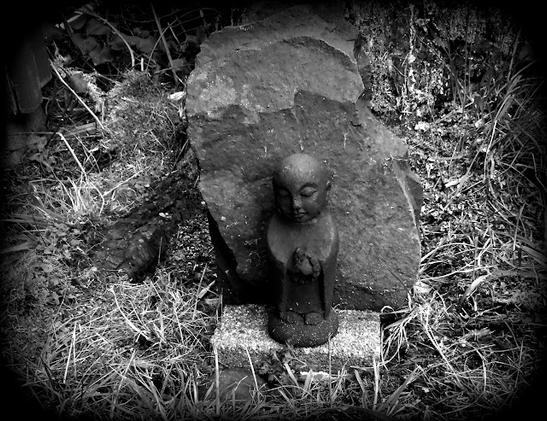
By her door she sets a young friend,

monkish, said to represent

one who vowed to watch over

mad old wet hens and others

This is Kshitigarbha, called in Japanese Jizo. He is said to take an interest in those who obviously need watching over, such as old fools. Does he? Maybe so:

...ontologically everything is interdependent and empty of independent existence. Dōgen pushes this logic to assert that “All beings are Buddhanature.” This deliberate reconfiguration of the Nirvana Sūtra teaching that “All sentient beings have Buddha-nature” highlights Dōgen’s more thoroughgoing nondualistic understanding, for Dōgen’s articulation does not distinguish between sentient and nonsentient beings nor does it allow for some beings to have Buddha-nature and others not. Buddha-nature is not an object one can have, in the same way one cannot have a dog or a self, for everything is empty of independent existence.

Paula Arai, "The Zen of Rags" -- in which she muses on cleaning-rags as Buddhas ...

#InPlace 12

A friend donates chairs; with these,

two to four may sit

thinking no thoughts

or thinking of thinking no thoughts

while gazing at knotty cedar


Four folding chairs came with someone’s spare card table. It’s encouraging how many useful things one can tuck into an eight by ten shed and not feel that it is cluttered.


The first thing is to learn how to quiet the mind, relax the mind, and bring the awareness to the front so that we are conscious of what we're doing when we're doing it without all the commentary. -- Tenzin Palmo

#InPlace 13

The old woman finds a bench difficult,

more so every day; one last sit

before she gives it up —tap bell, groan, rise —

lotus, half lotus? Ha!


When she first began sitting at the hut, use of the seiza or kneeling bench was easy for the old woman; but it became increasingly painful for her; here we see it being used for the last time (2015?) and it has since been replaced by a chair. All things come to an end, as will the use of the hut, as will this old woman’s life. The book on the floor is an edition of some of Ryokan’s poetry.


Falling blossoms.
Blossoms in bloom are also
falling blossoms.

— Ryokan (tr. Tanahashi)

#InPlace 14

Half householder, she lives here

part time, and so makes tea and rice

as needed, washing dishes outdoors:

pantry is under the bed


In use for more than a decade, her old steamer can cook many things, but is most in demand for rice (pre-seasoned with home-grown dried herbs, kept in a Mason jar underneath the altar) and vegetables (mostly beets, potatoes, kale, chard and zucchini, in season). The little coffeemaker is used to make what the old woman calls “yard” tea — seasonally available forage such as (deep breath) chicory, dandelions, nipplewort, narrow leaf plantain, crimson clover, deadnettle, cat’s ears, blackberry leaves, fir or spruce needles, money plant, Bigleaf maple flowers, and crop foliage such as kale, chard, beet greens, squash blossoms and leaves, pea and bean foliage, corn silk, and the like. There are two bowls that also serve as cups, a few utensils, a knife, and a cutting board. Water is brought from the homestead's well in half gallon bottles.


Do not arouse disdainful mind when you prepare a broth of wild grasses; do not arouse joyful mind when you prepare a fine cream soup. Where there is no discrimination, how can there be distaste? — Dogen (tr. Tanahashi)
#InPlace 15

Rain comes, fogs settle in;

her ceiling does drip a little;

path grows muddy; to keep her footing

she throws flat stones in low spots


In summer she gathers stones — basalt, mostly — from the dry creek bed and stores them for winter projects.

With the shade tree gone, the roof has been painted white; walls will be painted soon. It won't be as attractive as when the building was red, but Gogo-an would be too hot in the summer without its tree.

The fence is to keep deer (or potentially sheep) out of the small garden.


I always wanted to go to East Cliff,
more years than I can remember, until today
I just grabbed a vine and started up.
Halfway up wind and a heavy mist closed in,
and the narrow path tugged at my shirt:
it was hard to get on. The slickery
mud under the moss on the rocks
gave way, and I couldn’t keep going.
So here I stay, under this cinnamon tree,
white clouds for my pillow,
I’ll just take a nap.
— Han Shan (Cold Mountain, tr. Seaton )