 Prof. Sam Lawler
Between my normal meetings and writing, I'm watching a few talks at the American Astronomical Society's (AAS) Division for Dynamical Astronomy (DDA) annual meeting this week. They have this fantastic option where you pay US$10 and you can watch all the talks at the meeting. I'll try to share summaries of a few highlights using #DDA2026
Robin Canup (SWRI) is giving a prize talk on the formation of the Moon. The Moon was definitely formed by a giant impact, but the details are hard! Mars-size impactor makes most sense, but you have to shed a bunch of angular momentum. Can do this with "evection resonance" which keeps the Moon-Earth-Sun in a specific configuration and messes with the Moon's eccentricity. Big problem: matching isotopic composition. Maybe impactor was the same as Earth? #DDA2026
Talks about how tidal dissipation would change as the impact-melted Earth resolidifies.
What about co-accretion? Not for our Moon, but works for jovian planets' large moons. Shows that many generations of moons formed around jovian planets and were eaten by planets during Solar System's planet formation phase. The ones we see today are the last generation before gas disk dispersed.
She just told a story about being totally obsessed with Saturn as a middle schooler during the Voyager mission. She wrote a letter to JPL and they sent her a packet of Saturn photos and info! Comments that "I bet they had a good outreach budget back then." SIGH.
Saturn has 1 big moon, did smaller moon get Roche-shredded into the rings? Rings appear to be young, so probably not the right explanation.
Can co-accretion and giant impacts work together to explain Uranus/Neptune moons?
Peas-in-a-pod exoplanet systems (multiple similar-mass planets closely packed) maybe follow the co-accretion pattern? Simulations with gas migration show a characteristic mass for surviving planets, that doesn't depend strongly on stellar metallicity. Cool!
Ian Brunton (Caltech) shows that Io and Europa's 2:1 mean-motion resonance can be primordial, but Ganymede's 4:2:1 mean-motion resonance wouldn't have been stable in the primordial disk and would need to fall into place later
K. Dabroski (U. Idaho) How did Saturn's rings form? Uses only Chrysalis (a.k.a. proto-Hyperion), Titan, and Saturn's J2 as perturbers in REBOUND https://rebound.hanno-rein.de/ Iapetus is important for getting eccentricities high enough for a collision. More sims needed!
Guangyi Zhang (Caltech) Moon-planet tidal system is like a damped harmonic oscillator. 100 bonus points for having a cute animation of a moon on a surfboard "surfing" on the peak "gravito-inertial mode" location as it moves outwards from planet. Applies to Jupiter's and Saturn's moons
Wen-Han Zhou (U. Tokyo) why do Saturn A and B rings have such sharp inner rings? Can't be explained by moons. Yarkovsky changes spins through absorbtion and re-radiation of light being in different places (due to rotation). Adding in an eclipse, as for a binary system, changes the average force. This gets REALLY complicated for a ring made of particles all eclipsing each other! Calculate using pkdgrav package, including Saturn radiation. Inner edge is sharp, outer edge leaks outwards
Yurou Liu (Yale): hot-Jupiter hosting binaries are more eccentric, OR hot Jupiters are preferentially aligned with their binaries. They found this through building a bunch of simulated hot Jupiter systems and letting the Kozai effect change the eccentricities and inclinations and looking at the final distributions
Grant Weldon (UCLA): oh I like this talk title "Saving Doomed Planets". Hot Jupiters like to fall into their stars. But mass loss is important - by losing mass some of them end up not falling into their stars. High eccentricity migration can be survived, but sometimes hot Jupiters turn into hot Neptunes.
Sacha Gavino (U. Bologna) millions of sims of 3 equal mass earth planets in extremely compact orbits, mapping out 3 body interactions with orbit spacing. Really complex stability structure, depends on initial longitudes of planets. Holy cow that's a complicated map of "the 3-body resonance network", looking at where resonances overlap and chaos happens, and where resonances push planets into higher stability orbital configurations.
Julia Esposito (Georgia Inst of Tech) looking at planet-planet scattering, uses REBOUND TRACE and Reboundx because need close encounters between planets, long integrations, general relativity, and tides (wow). Cold scattering (distances outside 1AU) is needed to produce hot Jupiters. Made lots of eccentric, aligned, warm Jupiters. Predict warm Jupiters should have nearby companions with >30 degree mutual inclinations
Konstantin Batygin (Caltech): most common planets are super-Earths on very short orbits. How do they not fall into their star? How do they pick which resonance to lock in to? (Bonus points for joke about a system with a 6:7 resonance for everyone with middle-school-aged kids)
Giant equation in a confetti explosion (this guy likes giving talks). Shows that 6:7 resonance requires planets to form simultaneously at 1-3AU: the "planet factory ring"
Gabriel Teixeira Guimaraes (National Obs of Japan) more REBOUND sims! Aligned pericenters are important for stability, but absolutely required for higher eccentricity systems.
As part of the CV-rejiggering for academic stuff that I previously complained about, I also need to update my academic website (which is embarrassingly simple, but at least I didn't write it in 1999 and it doesn't have a dancing-linux-penguin-gif like Some Other Academics). Will be trying to do that while listening to the next set of #DDA2026 talks
Kaustub Anand (Purdue). Did Mars' moons form from capturing asteroids or a giant impact? Giant impact would make a ring, would cycle with moon - but previous studies ignore collisions within disk. They don't use REBOUND (weird!) they use Swiftest.
Sesquinary catastrophe is the best name! I guess that is caused by moon debris ring re-impacting and destroying the moon. Oo Yarkovsky-Schach effect invoked, constrains ring, helps avoid castrophe
Thea Faridani (U. of Rochester) What if we had another Moon closer-in shortly after Moon formation? Impact-migrate-moonlet-merge. Back to REBOUND again! Early results: mutual inclinations and obliquities are really important for keeping moonlets around.
Raluca Rufu (SWRI) high angular momentum impact could well-mix Earth's mantle and the moon precursor, but then you have to get rid of excess angular momentum. Dumping that depends on internal thermal evolution of Earth, and its spin. Moon's outward migration speeds up after Earth cools enough to re-solidify, how long solidification takes depends on Earth's atmosphere post-collision.
Evection resonance doesn't seem to remove enough angular momentum.
Helena Buschermohle (Instituto Nacional de Pesquisas Espacias) what happens to moons around circumbinary planets? As planets migrate inwards, Hill sphere gets smaller and moons would become unbound. HAHA she calls stable moons "smoons" and a moon that becomes a planet a "ploonet"
All circumbinary exoplanets discovered so far are gas giants, but maybe moons could be habitable, now that we know some moons survive migration.
Now it's a prize talk by Sam Hadden (CITA) about resonant planetary systems, and he's PLAYING MUSIC to demonstrate orbits I love this so much (although I have to say it's not working super great over Zoom, sounds drown out the speaker, oh well). Mean-motion resonances function very much like chords! (This is very well explained in this fantastic website, read it all and enjoy: https://www.system-sounds.com/about/)
Oooo he's got a bunch of orbital sonification on his website! https://shadden.github.io/sonification/
Oooo really neat to hear a chord change during an N-body simulation when stability is lost and a planet swaps to a different resonance.
Resonant chain migration behaves like masses on springs, says it's like vibrato! Cool.
"So that's a lot of fun, but so what?" Unstable modes grow or decay depending on how eccentricities are damped.
Most super earth systems are not resonant (they don't sound so nice), and lots are near-resonant and sound a little out of tune (some sound quite ominous!)
If you throw a few Plutos in to the system, scattering will disrupt the chain that formed, sometimes leaves them near but not quite in the resonance.
Ends with a note to Kepler (the astronomer) who thought the planets should be in perfect resonance, if not now, maybe when formed. Cool!
Leia Shen & Kavi Dey (Harvey Mudd College) current categorization looking for asteroid dynamical families takes ~30 minutes of computation per asteroid. Vera Rubin observatory will discover 10 million more asteroids. Using machine learning and computationally cheaper asteroid properties to find families. Code is available, but they only gave it as QR code not a link...sigh.
David Minton (Purdue): Starts with really cool animation of Moon getting blasted by asteroids! Compares craters to dino footprints. Makes the point that better data (seeing smaller craters) changes the story dramatically
Ben Cassese (MPC): here comes the flood of Solar System small body data! Expect 200 million observations per year from Rubin, + 200 million from NEO Surveyor. MPC has to quickly link previous observations into new orbits, this is hard. Will need machine learning to process everything.
Paul Wiegert (U. Western Ontario): finding interstellar meteors is really hard! Lots of meteors are from comets with high-eccentricity orbits, hard to get good enough data to measure meteor pre-impact orbits. There *are* interstellar meteors, just not as many as that Harvard astronomer (who the speaker did not name) seems to think, and none have been conclusively discovered yet.
Apostolos Christou (Armaugh Obs.) this talk title is hilarious "Larger asteroids stay sober, smaller asteroids get drunk"
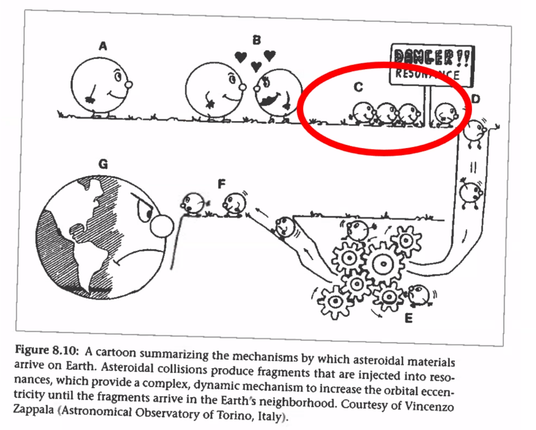
Wow what a cartoon!
Small asteroids end up with gaussian distributions around the family centre.
Daniel Durda (SWRI): Overview talk. The asteroid belt is a fossilized collisional system - the size distribution (particularly waves in size dist) tells us about the past. Dust production is "spikey": lots right after a big collision.
Lots of work on Chicxulub impact, where does debris land? (Back into atmosphere, heating it up, burning everything)
Used Ames gun to smash real meteorites and study dust from them.
I should note that this session (and a at least one other) at #DDA2026 are tributes to Stan Dermott, who wrote the Solar System Dynamics bible, and taught a LOT of students.
I guess I have a 1-degree-removed connection here? The postdoc I first worked with, Beth Holmes, who taught me a lot, when I was a baby undergrad, had just finished her PhD with him. (She died from a heart condition while I was still an undergrad)
Mark Wyatt (U. of Cambridge) talking about dynamical effects of planets on debris disks (I LOVE this stuff). This is true in our own solar system, zodiacal dust is affected by our planets' orbits.
Ooo Fomalhaut, my favourite disk system! The brightness variations in the disk place constraints on the forced eccentricities resulting from unseen planets in the system.
Fom b is a dust cloud, not a planet, which I am incredibly proud I wrote about years ago! Now proven from JWST images!
J.-C. Liou (NASA Chief Scientist for Orbital Debris!!) Overview of his career work: started with work on zodiacal dust dynamics, with PR drag and resonances. Showed how outer asteroid belt is depleted by Jupiter MMR sweeping. Then dynamics of cometary dust collected from high altitude aircraft, and Kuiper Belt dust structures.
Now works on distribution of human-made debris pieces in orbit. Now at point where collisions dominate debris creation. Active removal required for long-term.
Ashley Espy Kehoe (Embry-Riddle Aeronautical University)
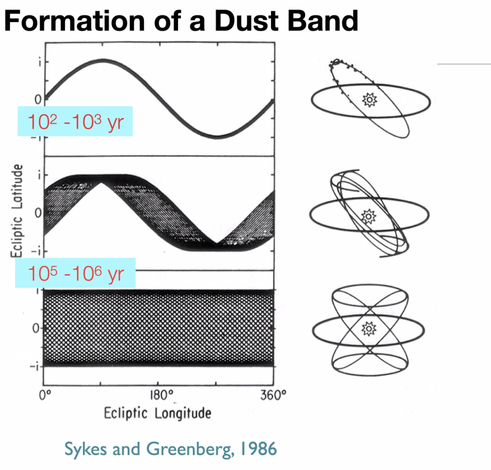
Recurring theme for Stan Dermott memorial talks: plots are IMPORTANT! (totally agree) So here's a beautiful plot she showed from 1986, that shows how dust bands are created in Solar System (orbital caustics!)
Dust bands tell us about asteroid collisional families. Takes millions of years for full band to form, partial bands give timescales since major collisions, COOL. Dust band structure was confirmed by WISE data.
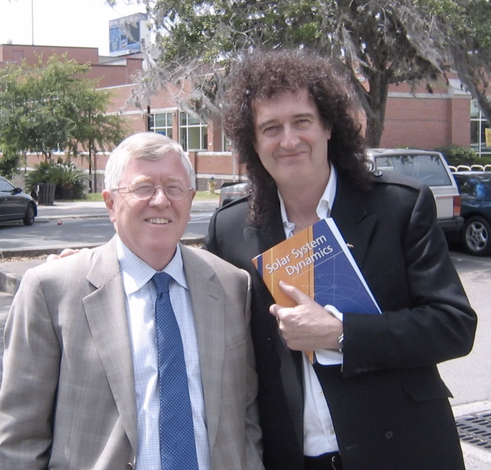
Great way to end the session with a shout-out to Brian May, who started his PhD, took a decades-long break to be a rock star, then finished his PhD, on zodiacal dust, with some help from Stan Dermott. #DDA2026
 matthew green
@sundogplanets i am loving your summary of these presentations. thank you.