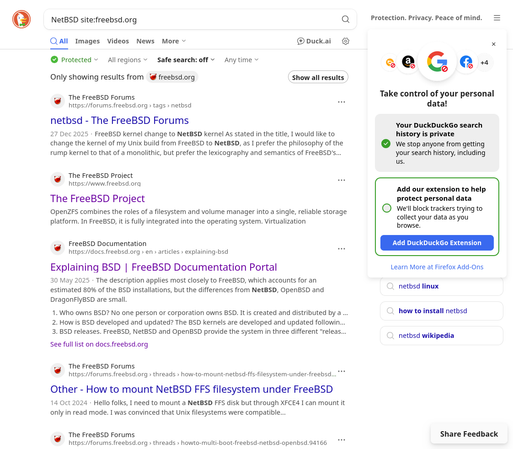
Why is the FreeBSD Project home page the top result when using DuckDuckGo to seek NetBSD in the freebsd.org domain?

<https://duckduckgo.com/?ia=web&t=h_&q=NetBSD+site%3Afreebsd.org>

There's no mention of NetBSD at the home page, or about FreeBSD:

<https://www.freebsd.org/>, <https://www.freebsd.org/about/>

Google Search results are less confused than DuckDuckGo:

<https://www.google.com/search?q=NetBSD+site%3Afreebsd.org&udm=14>

#DuckDuckGo #Google #FreeBSD #NetBSD

@grahamperrin

I don't understand your question.
You limit the results to come from freebsd.org and wonder that they come from freebsd.org. Do I get this right?

@dexternemrod seeking the word "NetBSD" should not prioritise a page that does not mention NetBSD.
@grahamperrin
You asked DDG to only search freebsd.org. So how should it find/present other sites?

@dexternemrod I don't want it to present other sites.

I want DuckDuckGo to not make an irrelevant page the top result.

@grahamperrin

Ah, you want to see freebsd.org/pagewithNetBSDmentioned

Instead of freebsd.org/pagewithoutFreeBSSmentioned at a top result?

@grahamperrin because web search sites are designed to figure out what might be useful to you based on a ton of different heuristics.

"exact word match" is rarely what people want by default, because the source material and the search itself can have misspelling, alternate spellings, and inflections.

in this case, my guess is that "net" and "bsd" get split out into separate search terms. at least part of that guess was based on seeing a link to some .NET stuff on the first page of results

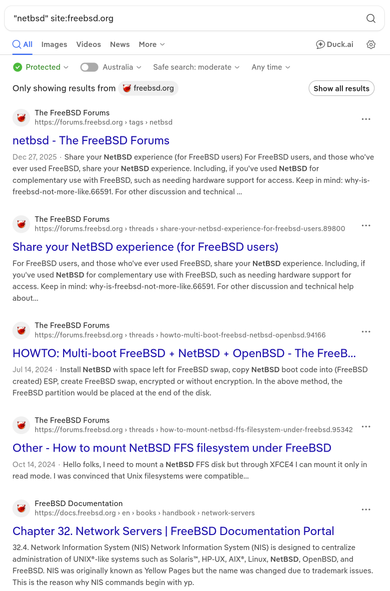
fortunately, you can request an exact match by quoting the term: "netbsd" site:freebsd.org seems a lot closer to what you want?

@robn true, thanks.

Where <https://duckduckgo.com/?ia=web&t=h_&q=NetBSD+site%3Afreebsd.org> (without quoting) fails, <https://duckduckgo.com/?ia=web&t=h_&q=%22NetBSD%22+site%3Afreebsd.org> succeeds.

It's remarkable that Google Search succeeds without quoting.

Also, weird that 'Explaining FreeBSD' with the word 'NetBSD' disappears from the first page when I'm more exact about "NetBSD".

@grahamperrin it's really not that weird. different systems, different methods, different rules.

simplest answer for the differences I can imagine is to split terms first, then search vs search without splitting first, then splitting and retrying if you don't get good results

it won't be anything that simple, but that's a way to understand it

(fwiw simple term matching was like v1 of internet searching; hasn't been that simple since like 1995)

@robn yeah, I'm just so accustomed to StartPage (for results from Google), I find myself jumping through hoops with DuckDuckGo.

Lesson learnt, for the nth time: don't use the search box at <https://www.freebsd.org/> ;-)

The FreeBSD Project

FreeBSD is an operating system used to power modern servers, desktops, and embedded platforms.

The FreeBSD Project
@grahamperrin As of a few minutes ago, it's not for me, when clicking on your DDG search link. The top result is https://forums.freebsd.org/tags/netbsd/ with https://www.freebsd.org/ being the second. (I don't know why it's there at all, though.)
netbsd

The FreeBSD Forums

@pauamma thanks. Results seem to be unpredictable.

I guess that popular clicks on an irrelevant page will cause the irrelevant page to remain at, or near, the top.

A few hours ago (originally pictured), the irrelevant FreeBSD Project page was uppermost.

A few minutes ago, the same result was uppermost, and the summary for 'Explaining BSD' had two matches for NetBSD in the first paragraph. In the first screenshot here:

"NetBSD uses a slightly different naming scheme and appends a single-letter suffix which indicates changes in the internal interfaces, for example NetBSD 1.4.3G."

Also a few minutes ago, the irrelevant page was in second place and 'Explaining BSD' had a quite different summary with only one match for NetBSD. In the second shot here:

"The description applies most closely to FreeBSD, which accounts for an estimated 80% of the BSD installations, but the differences from NetBSD, OpenBSD and DragonFlyBSD are small."

#DuckDuckGo