 Schuetze
 Tuta
TutaEuro-Office just launched its first stable version 🇪🇺🔥
We're excited to be part of this movement to bring digital sovereignty to Europe and beyond with @nextcloud @xwiki @openproject @soverin #Eurostack 🎉
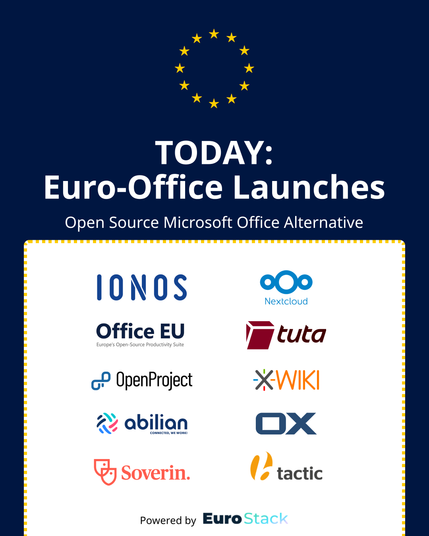
Euro-Office just launched its first stable version 🇪🇺🔥
We're excited to be part of this movement to bring digital sovereignty to Europe and beyond with @nextcloud @xwiki @openproject @soverin #Eurostack 🎉

Dear office suite users, In recent days you will have read various articles announcing the arrival of Euro-Office, which is being “marketed” as the first open-source office suite developed in Europe. We feel compelled — reluctantly, since open source should rest on transparency, not deception — to correct this claim. The first open-source office suite developed in Europe was OpenOffice.org in 2001, based on StarOffice’s source code, followed by LibreOffice from 2010. These are two genuine open-source office suites, built from source code that originated in Europe. They are not a freeware clone of MS Office whose code provenance is undisclosed, nor a product that has rebranded itself out of pure opportunism to ride today’s wave of Digital Sovereignty. It is worth remembering that many of those who champion Digital Sovereignty today were silent back in 2006, when the open ISO/IEC ODF standard — the pillar of Digital Sovereignty — was announced: not only did they not listen to us during all these years, but in some cases they greeted us with a condescending smile. If we can speak of Digital Sovereignty in Europe today, it is thanks to The Document Foundation and LibreOffice community members at large, who kept
RE: https://mastodon.social/@Tutanota/116720475387018053
Digital Sovereignty  while hosting it on Github !
Make it make sense !
@Natanox @xwiki @angelo they couldn't host it on Codeberg for legal reasons, they'll probably switch in the future tho
There's an issue in there which talks about it: https://github.com/Euro-Office/DocumentServer/issues/14
Look at:
https://github.com/Euro-Office/DocumentServer/issues/14#issuecomment-4161034493
And
https://github.com/Euro-Office/DocumentServer/issues/14#issuecomment-4162066119
Which states
Regarding the specific matter of any potential takedown request against this project if it were to move to Codeberg: It is still possible that the law would require us to take down the project if a takedown notice were to [...]
@ZiClaud @xwiki @angelo Not sure in what way around you start your projects, but in this case my first instinct would be to create the platform to work on first. I.e. host a Forgejo instance (if there wasn't a team member like Codeberg or another EU git provider) since it's about independence. 🙃
Just a really weird way to do things. Now they created tech debt for themselves, right in the middle of their workflow.
Dear office suite users, In recent days you will have read various articles announcing the arrival of Euro-Office, which is being “marketed” as the first open-source office suite developed in Europe. We feel compelled — reluctantly, since open source should rest on transparency, not deception — to correct this claim. The first open-source office suite developed in Europe was OpenOffice.org in 2001, based on StarOffice’s source code, followed by LibreOffice from 2010. These are two genuine open-source office suites, built from source code that originated in Europe. They are not a freeware clone of MS Office whose code provenance is undisclosed, nor a product that has rebranded itself out of pure opportunism to ride today’s wave of Digital Sovereignty. It is worth remembering that many of those who champion Digital Sovereignty today were silent back in 2006, when the open ISO/IEC ODF standard — the pillar of Digital Sovereignty — was announced: not only did they not listen to us during all these years, but in some cases they greeted us with a condescending smile. If we can speak of Digital Sovereignty in Europe today, it is thanks to The Document Foundation and LibreOffice community members at large, who kept
@angelo @Tutanota @nextcloud @openproject @soverin @soverin
The below article says self-hosting *should* be feasible starting today, so hopefully blog posts clarifying self hosting setups will pop-up soon.
For managed hosting the article says IONOS managed Nextcloud will be the first to offer Euro Office document editing, with other partners rolling out over 2026.
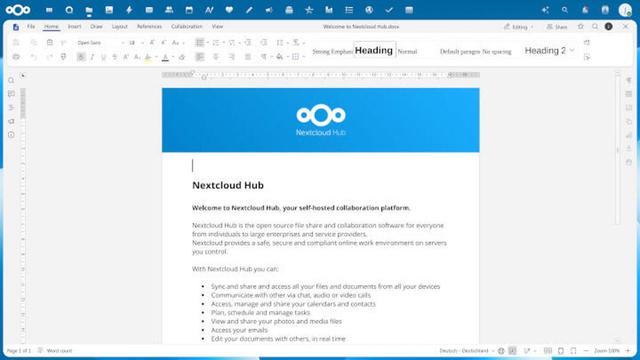
European tech firms will ship the first stable release of Euro-Office next month, giving governments and businesses worldwide a ready-to-run, sovereign alternative to Microsoft Office and Google Docs.
@angelo @Tutanota @nextcloud @openproject @soverin @soverin
Oh, cool!
This is a start. I'm glad Nextcloud had the foundation built and ready for this moment.
I'm curious to see Tuta integration plans.
Would love open solutions to become the status quo.
Dear office suite users, In recent days you will have read various articles announcing the arrival of Euro-Office, which is being “marketed” as the first open-source office suite developed in Europe. We feel compelled — reluctantly, since open source should rest on transparency, not deception — to correct this claim. The first open-source office suite developed in Europe was OpenOffice.org in 2001, based on StarOffice’s source code, followed by LibreOffice from 2010. These are two genuine open-source office suites, built from source code that originated in Europe. They are not a freeware clone of MS Office whose code provenance is undisclosed, nor a product that has rebranded itself out of pure opportunism to ride today’s wave of Digital Sovereignty. It is worth remembering that many of those who champion Digital Sovereignty today were silent back in 2006, when the open ISO/IEC ODF standard — the pillar of Digital Sovereignty — was announced: not only did they not listen to us during all these years, but in some cases they greeted us with a condescending smile. If we can speak of Digital Sovereignty in Europe today, it is thanks to The Document Foundation and LibreOffice community members at large, who kept
@geolaw @IGVazquez @Tutanota @nextcloud @xwiki @openproject @soverin @soverin I am very thankful for the work Libreoffice contributors have done. At the same time:
Any non-techy friends that try LibreOffice hate it. I use it, I notice and work around the jank, and I remain thankful for the existance of this suite.
But unless LibreOffice receives fundamental modernizations, I doubt the mainstream would adopt it
OnlyOffice is a modern base to build upon, though I prefer .odf as default too
@karlggestd @librico @geolaw @IGVazquez @Tutanota @nextcloud @[email protected] @openproject @soverin @soverin
TDF is also restarting development of LibreOffice Online. Having options is great.
IONOS has a whole U.S. division now, so it is not exclusively a European company and is subject to U.S. jurisdiction.
Just a heads up for anyone who reads this and presumes everyone on the list is 100% European Digital Sovereignty.
@Tutanota @nextcloud @xwiki @openproject @soverin
f*ck ooxml
@Tutanota @nextcloud @xwiki @openproject @soverin
Euro Office,
Commercial threat to LibreOffice and using Proprietry Microsoft Document formats.
NO THANKS
@Natanox @Tutanota @nextcloud @xwiki @openproject @soverin
@Kerplunk @Tutanota @nextcloud @xwiki @openproject @soverin …LibreOffice also uses docx. You don't have to though. Not sure what your issue is.
Libreoffice standard is ODF.
Not a deliberately flawed microsoft format, it is also a non commercial project which should be supported more.
EU should be using Tax Payers Money wisely, not funneling it in to fashionable expensive, new online office suites, in this case actually a fork
@Natanox @Tutanota @nextcloud @xwiki @openproject @soverin
In Euro Office, Full ODF Output is not implemented
On top
OOXML is a specification Microsoft controls and that has historically contained references to undocumented legacy behaviors from earlier Microsoft Office versions. Any office suite that treats OOXML as its primary format remains dependent on Microsoft's decisions about how that format evolves. ODF, by contrast, is an ISO standard
= It is not, as claimed fully open source
@Tutanota @nextcloud @xwiki @openproject @soverin
Unethitical marketing statements, Microsoft proprietary data format as default, download from a Microsoft owned platform ...
While I generally appreciate the Euro Office initiative, sadly there are several major 'opportunities' for improvement.
For the time being I will steer clear of #eurooffice
@Tutanota @nextcloud @xwiki @openproject @soverin
You really do use microsoft's github?
Really?
Is this foolsday?
Dear office suite users, In recent days you will have read various articles announcing the arrival of Euro-Office, which is being “marketed” as the first open-source office suite developed in Europe. We feel compelled — reluctantly, since open source should rest on transparency, not deception — to correct this claim. The first open-source office suite developed in Europe was OpenOffice.org in 2001, based on StarOffice’s source code, followed by LibreOffice from 2010. These are two genuine open-source office suites, built from source code that originated in Europe. They are not a freeware clone of MS Office whose code provenance is undisclosed, nor a product that has rebranded itself out of pure opportunism to ride today’s wave of Digital Sovereignty. It is worth remembering that many of those who champion Digital Sovereignty today were silent back in 2006, when the open ISO/IEC ODF standard — the pillar of Digital Sovereignty — was announced: not only did they not listen to us during all these years, but in some cases they greeted us with a condescending smile. If we can speak of Digital Sovereignty in Europe today, it is thanks to The Document Foundation and LibreOffice community members at large, who kept
@Tutanota @nextcloud @xwiki @openproject @soverin
Can we expect it to be integrated into Tuta Drive at launch?
 angelo
 XWiki SAS
 thecymon
 dunklecat
 Natanox 🇺🇦🇵🇸
 ☭ Father Hardstone
 ZiClaud
 Dec [{(
 )}]
)}]
 Maya
Maya
 la_rosa
 juno
juno O Iago

 geolaw
 Librico (Any/All) ☎️ 3792
 karlggest
 Kim
Kim Conny Nasch
 Just Ice
 Linux and BSD are best 🐧😈
 panu
panu Toni
Toni mrjive
 guteIT
 oatmeal
 Islam Hamouda
 ed 🏳️🌈🏳️⚧️🦒🇪🇺
 Frank
Frank Void & Cozy