 debutniverse
I've been exploring how the word "episode" came to have its present-day meaning. It first entered English with the meaning of an incident or digression in a poem or narrative that is separable from the main subject but may shed light on the characters or events. Think of the Tom Bombadil bit in Lord of the Rings, for example, as opposed to more integral parts like meeting Gollum. It gradually evolved to mean an incident from a larger series of events, like a part of someone's life or one battle in a war. But I was interested in finding out when it specifically came to mean "an instalment in an ongoing narrative", like the way we use it for TV shows. There is a clear jump there where it loses the implication of it being incidental or non-integral. I can find earlier examples of a particular chapter in a story happening to have "episode" in their title, for instance, and those are clearly meant to mean that this chapter is a digression from what's going on around it - the word that's being used to mean "instalment" is still "chapter", not "episode".
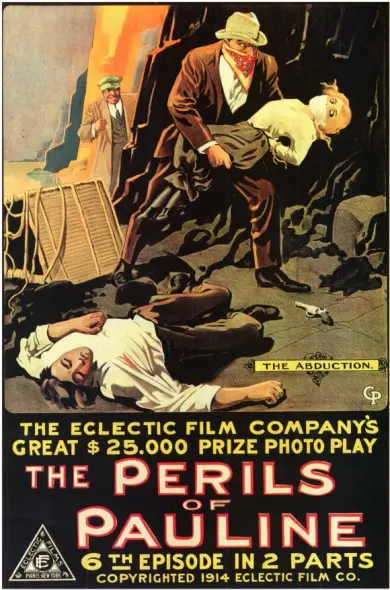
The earliest usage I've been able to find with what I'm calling the modern meaning is the 1914 film serial "The Perils of Pauline". Each instalment is referred to on-screen as an "episode" and advertising for it does the same (see attached). All earlier film serials I've found use words like "chapter" or "story". And this series basically became synonymous with the cliffhanger serial genre that exploded in popularity at this time. Like, if you've ever seen clips of a woman tied to train tracks and having to be rescued, that doesn't actually happen in this series, but it's the same vibe. So my current theory is that this series rather randomly chose to use "episode", and its influence popularised the term. But if anyone can find an instance of "episode" being used in this exact sense earlier, I'd love to hear about it!
#linguistics #etymology #language #episode