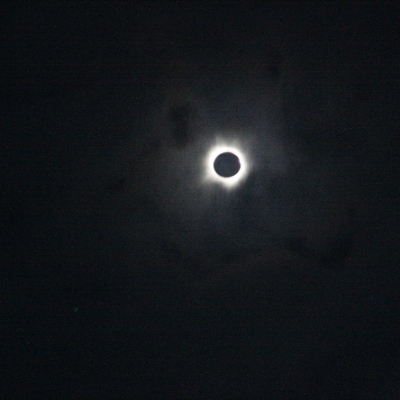
in many Indigenous cultures, there is no precise word for "nature", because you can't separate what was never divided; at least in the way modernity did. western modernity drew a hard line: humans on one side, all the rest on the other. one has reason the other doesn't. one has rights, the other has value. one is subject, the other object. this split made colonialism, industrialism and ecological destruction thinkable.
@kupaye

Never thought about this. In Chinese 自然 means "naturally". It's like saying "of course". Things that a given that don't need saying.

"Will you promise not to tell anyone?"
"自然"

Nature is "big 自然".

Things that are a given but on a big scale.

@chu @kupaye same in Japanese. I wanted to study that religious/linguistic link in grad school

@chu @kupaye Wanted to also mention the first character im 自然 also contains the character for self, Wikitionary is saying the earliest use was in Tao Te Ching to refer to something that is what it is (in and of itself)

https://en.wiktionary.org/wiki/%E8%87%AA%E7%84%B6#Chinese

自然 - Wiktionary, the free dictionary

Wiktionary

@flowrot @chu @kupaye In Japanese, this could be read as "self" and "sort of thing" which isn't too far off the original Chinese (source: the wiki page you linked).

Just chiming in to compare the Taoist view there (esp. the idea of "being itself, what it is) with later Zen thought (possibly inspired by Taoism) such as ultimate reality or Buddha nature being "the self selfing the self."

Also, nearly half way across the world, we have Heracles expressing similar ideas, esp. as referenced centuries later in the the poem "That nature is a Heracletian Fire...": https://www.poetryfoundation.org/poems/44397/that-nature-is-a-heraclitean-fire-and-of-the-comfort-of-the-resurrection

Which, long way round, brings me to mention that the second character, when given an extra fire radical becomes 燃える in Japanese, to burn. Interesting to think that they might be similarly related in terms of philosophies or views of the world..., perhaps a case of convergent evolution?

That Nature is a Heraclitean Fire and of the comfort of the…

Delightfully the bright wind boisterous | ropes, wrestles, beats earth bare Of yestertempest's creases; | in pool and rut peel parches Squandering ooze to…

The Poetry Foundation
@muddle @flowrot @chu @kupaye I would assume 燃 is because it's a homophone for 然 in Mandarin (and presumably earlier Chinese languages) so you slap on an extra fire to mean "the burning one", alas
@chu @kupaye And insanity is when your mental-behavioral state contradicts nature/ reality/ the givens. Infinite economic growth is insanity. Expecting to consume fossil fuel without ever running out is insanity