1/n

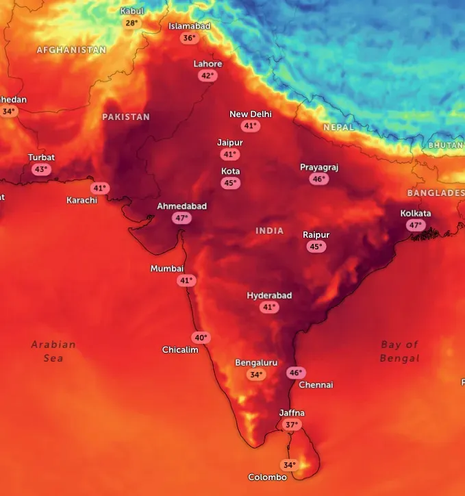
I saw this heat wave map of India and immediately found myself wondering what would the equivalent for late May have been like for my mother and aunt growing up as young girls in India in the 1930s.

I’ll get to some hints of answers in a bit, but first just wanted to note the cognitive surrender being fed by LLMs (next post)
https://mstdn.ca/@dbattistella/116649502661415044

DB 🌱💦 (@[email protected])

Attached: 1 image Ever since reading Kim Stanley Robinson's The Ministry for the Future, I've been dreading the arrival of heatwaves like this one. The opening chapter of that book is truly terrifying. #India #GlobalWarming #Books


Mastodon Canada

…2/n

I have an old iPhone, so although I use DuckDuckGo I have no means to default its search to noai.duckduckgo.com, and although I tell DDG I want no LLM summaries, when the cookie for that expires I get them anyway.

Which is how I come to note how confidently the ‘AI Assist’ reports temperatures in the 1930s based on essentially nothing. I followed its cited sources, where there is nothing whatsoever about any temperature data at all prior to the 1980s

…3/n

What a fucking shit show. Absolute bollocks being spewed on the basis of nothing. Just making shit up and misleading people.*

(Edit: *more measured thoughts in posts 10-12 below.)

It’s automated Trumpism.

Anyway, I’ll get somewhere close to some actual answers about 1930s Indian temperatures later today, by putting some actual work in with a semblance of diligence and discernment.

While the web still has an uncountable number of documents that aren’t distilled bullshit

…4/n

My mum was born in Quetta in 1932 – then India, now Pakistan. Her dad had poor heart health from the mid 1930s onwards, retired from the (Raj) Army to the UK, but was then called up again in 1940.

My mum, her sister and mother followed him back out to India later that year.

But in Indian heat, his heart could not maintain his utility to the war effort. He was re-retired and the family moved to the Nilgiri Mountains of Tamil Nadu, for its temperate climate, to see out the war

…5/n

The May 2026 temperature snapshot of India at the top (repeated here) portrays a 13°C spread, with Ahmedabad and Kolkata the hottest at 47°C (’kinell) and Bengaluru the coolest at a mere 34°C.

My guess is that the Nilgiri Mountains would be a lot less than that 34°. (They’re where my mum’s family would have been in the mid 1940s).

But as the context here is temperature extremes, I’ll go down a Kolkata rabbit hole https://mstdn.ca/@dbattistella/116649502661415044

DB 🌱💦 (@[email protected])

Attached: 1 image Ever since reading Kim Stanley Robinson's The Ministry for the Future, I've been dreading the arrival of heatwaves like this one. The opening chapter of that book is truly terrifying. #India #GlobalWarming #Books

Mastodon Canada

…6/n

My thought at the top was roughly “What was the temperature in India like in the 1930s?”

I’ve not found a source for that, but https://data.opencity.in/dataset/daily-temperature-70-years-data-for-major-indian-cities provides data for 8 major Indian cities back to 1951.

From its CSV source, the average of average daily temperatures in Kolkata for the 7-day period from 21 to 27 May, from 1951 to 1955 was:

1951: 34.7°
1952: 34.6°
1953: 35.4°
1954: 34.5°
1955: 34.3°.

So across those 5 years the average was 34.7°C.

This week, it’s been 37.3°C

Daily Temperature - 70 years Data for Major Indian Cities - CKAN

Daily Temp - max, min in Degree Celsius for 1951-2024 for Major Indian Cities: Delhi, Kolkata, Mumbai, Chennai, Bengaluru, Ahmedabad, Hyderabad and Pune

…7/n

Intriguingly, there’s no source for the map above which took me down this rabbit hole, and although it cites 47°C for Kolkata, that might be a *forecast* because the data from which I derived this week’s average of “37.3°C” is at https://www.easeweather.com/asia/india/past#day=21&month=5.

And the highest Kolkata temperature which it cites for the past week is 45.3°C.

Anyway, in the data I looked at, 2026 Kolkata seems to be something like 2.6°C hotter than early 1950s Kolkata, which perhaps highlights something else…

Historical Weather Data for India - Trends and Yearly Records

Explore comprehensive historical weather data for India, featuring detailed yearly trends and records. Access past weather information for India, including temperature, precipitation, and more.

Ease Weather

…8/n

The **FFS don’t go above 1.5°C of global heating** we’ve been telling ourselves is a *global* average and most of the Earth is covered in water.

The heating on land – where humans live – is roughly twice that average.

And the 2.6°C difference that’s cited in the previous post – which spans 70 years – is in the region of twice the +1.47° global increase – which spans 270 years – that we’re hovering around now.

But I was only looking narrowly at one week for 15 million Indians in Kolkata

…9/n

The thing is, if you expire in an unbearable and unsurvivable heat spike, it doesn’t really matter what the average temperature was or is or will be 🤷‍♂️ 💀

@urlyman I wrote about this five years ago. It's not a pretty scenario, but on our current trajectory it's our almost certain future, and within the lifetime of people now living.

https://www.journeyman.cc/blog/posts-output/2021-11-15-the-everyone-dies-event-class/

The Everyone Dies Event Class

What happens when temperatures exceed the human body's ability to cool itself?

The Fool on the Hill
@simon_brooke @urlyman
Thank you for properly citing the wet bulb revision article - I'd been looking for it. The app "Windy" can show wet bulb temperatures and forecasts. Not jolly viewing.

@yetiinabox @urlyman It horrifies my how casually and wilfully our politicians ignore and evade this issue. We have about a decade to make global drastic change; if we don't, very few people now in primary school, world wide, will live to see old age. This isn't some far future problem that can be put off.

And yet, as a society, we are doing nothing and we will do nothing.

I've just seen a post by @urlyman which is germane.

#ClimateEmergency

https://mastodon.social/@urlyman/116656655687514207

@simon_brooke @urlyman

When one of my kids was about 10 y.o., they got the full impact of these facts. Being autistic, they lack the social restraints that prevent many people from reacting bluntly, and so on the walk to school they would randomly shout at drivers. Why are you driving a car? Do you want all of us to die? It should be a normal response. Removing all government subsidies for motor roads and aeroports should be a normal response. A feeling of intense shame every time you use a car or aeroplane should be a normal response. Yadda yadda. The problem is not the physics; the problem isn't even just capitalism, but it is social and economic. If we can crack that we have a chance.

@yetiinabox @simon_brooke @urlyman My neighbour yesterday - "It's so hot, I think I'll get the dog and drive down to the beach."
(in her 30s, university educated, but doesn't see the connection)
@LaChasseuse @yetiinabox @urlyman She's by no means alone, sadly.

@simon_brooke @LaChasseuse @yetiinabox @urlyman I don't think it's that people don't see the connection, but that people don't know how to opt out.

I look at some of our friends with kids. They live rural. There's no public transport so they have two cars. Older house so it's on an oil boiler. Childcare is expensive. Liz Truss upped their mortgage costs. Two jobs with long commutes and two kids take up most (mental) time.

People know they might need to change, but it's not simple.

@simon_brooke @LaChasseuse @yetiinabox @urlyman fossil fuels underpin every aspect of our societies. Opting out comes with financial, logistical or social costs. And no matter how much *you* do, it'll never be enough until the system as a whole changes.

Not to mention the forces pushing the other way 😞

So I think people do know. And they do care. And they see the connections. But it's not easy to change, especially if you think you're the only one doing it.

@thecasualcritic @simon_brooke @LaChasseuse @urlyman

I disagree. There are systematic forces that prevent people from recognizing the horrors of their present predicament, but the "uselessness of individual agency" is a symptom. If a parent saw their child crawling towards an open fire, they would -- ordinarily -- act. If they were hopelessly intoxicated they might not understand what they were seeing, or lack the capacity to connect their perception and their capacity to act. Humans are social first, before we are ever even aware of ourselves as selves; the nightmarish psychosocial surgery that is required to create compliant subjects severs that fundamental awareness of our connectedness. In fact, the same process of creating "individuals" that allows capitalism to commodify people (and causes these new individuals to commodify themselves) is at work when we see the learned helplessness of individuals.

If you understand that we are all connected and responsible, then your instinct on seeing harm underway is to act, whether it's giving water to a stranger, blocking runways with your body, or sabotaging destructive oligarchies.

@yetiinabox @thecasualcritic @simon_brooke @LaChasseuse @[email protected]

People don't care ENOUGH. They care, in the sense of "oh we definitely should be doing better" but the problem and its solution are far too abstract to produce action from most people.

Unlike, say, a child crawling towards an inferno.

This is the fundamental psychological mechanism of frog-boiling. By the time the problem is manifest enough to spur action, it's too late to do much about it.

@AlexanderVI @yetiinabox @simon_brooke @LaChasseuse I'm not convinced that it is either true that people don't care enough or don't see the connections, or that it is a useful lens.

We know from surveys that the majority of people are concerned about climate change and want governments to do more. Eco-anxiety is rising as people struggle to keep the cognitive dissonance up. But what climate change is structurally an incredibly difficult problem for people to engage with.

@AlexanderVI @yetiinabox @simon_brooke @LaChasseuse As Alexander says, unlike with a child in a fire 'right here, right now', the consequences of climate change are far away (in time and space), whereas the costs are immediate and there is a massive collective action problem if people don't see other people take action as well.

Plus, mainstream media will give the illusion that action is being taken (Net Zero) and that the consequences may well be manageable.

@AlexanderVI @yetiinabox @simon_brooke @LaChasseuse Add up that there are lots of other things going on (War! Cost of Living! Childcare! Fascism!) and people have busy lives, and you create a situation where people are willing to do things, and will do things, but maybe not what is necessary because there isn't a structure to enable that.

Say my parent-of-two blocks a runway? What will happen. At best, a marginal impact on climate. At worst, they'll lose their job.

@AlexanderVI @yetiinabox @simon_brooke @LaChasseuse Anyway, sorry for the list of replies (I don't know how to do long replies or my server doesn't support it). But this is why I don't think the solution is to make people care more, or feel more connected, or give them more info. The solution will have to be to change the system / structures of society to make action progressively easier, *and* to take very visible action against bad actors (fossil fuel companies, private jets, etc.).

@thecasualcritic
For me, that's the whole thing. You need to not only change, you need to loudly, visibly change and invite people along. Not everybody can make all the changes, but your friend, neighbor, whatever, might be able to make different ones than you, or together you might be able to find a really nice way to do something that you hadn't even thought of.
I think this is a particularly important way to think of the problem because it's a global system so the changes that work in Scotland and the changes that work in California are going to be different, but they both need to change right?
Like we can't wait for the system to change, because it's a bunch of moving parts that we need to keep moving, so we have to figure out how our parts can change first.

@simon_brooke @LaChasseuse @yetiinabox @urlyman

@thecasualcritic @LaChasseuse @yetiinabox @urlyman I acknowledge it's not simple, but they still have to change or those children (probably) will not live to see old age.

The problem is, those children will probably not live to see old age unless everyone else changes, too, but we still have to start from where we are.

#ClimateEmergency
#ThereIsNoEconomyOnADeadPlanet