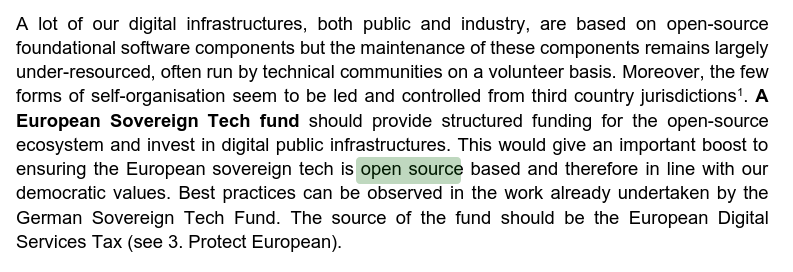
The Greens in the European Parliament have published a paper on ‘European Tech Sovereignty Policy’ with many sensible proposals:
https://extranet.greens-efa-service.eu/public/media/file/1/9255

But when it comes to software, we should offer a better response than protectionism. And that better response is open source.

The European Greens are calling for “the development of a full European digital stack”. I hope they don’t mean it quite as it’s written there. We don’t need to develop the software all over again. From the Commission down to local authorities, should simply stop paying for licences.
The approach proposed is expensive and complicated: “… non-European providers should be…, subject to a formal justification process”. That sounds like pointless bureaucracy. It is complicated for the purchaser to verify a provider’s exact ownership structure. And it is pointless, because a European provider could be sold next week.
In contrast, it is simple to require the provider to ensure that all software supplied must be open-source.

@ingo_wichmann
The link does not work, it throws a 404.
@ingo_wichmann public money, public code (the link is 404)

@ingo_wichmann

Looks like open source is the preferred option (p.4)....

@ReggieHere software that is open source based is our status quo. When did anybody here write software in a language (compiled or interpreted) that is not open source?

Lobbyists from Databund to Bitcom demand "Buy European" built on that foundation. But they still want to continue their proprietary business models. That's the trap our governments should not continue to fall into.

@ingo_wichmann

Don't disagree, navigating corporate ownership would be onerous.

@ingo_wichmann

I don't think it is enough to call for just open source at this point. Big Tech is built on open source and LLMs wouldn't be what they are today without open source.

We need FOSS that (in-the-large, emergent) responsibly contributes to societal progress, and the starting point for that is that proper healthy environments exist to give the extra amount of attention and detail to focus on the entire supply chain and software lifecycle. It is not enough to just do the coding, create the tech, and dump it into society. Externalities must be better addressed.

For all that to be possible the conditions must be created where people can sustainably work on FOSS, eek out a living in it if they want to. Right now FOSS is inherently unsustainable except for the privileged who can spare the time and money to work on it, and a happy few who have a job in it.

Call should not just be "use FOSS" but "adopt FOSS and help sustain responsible FOSS ecosystems".

https://social.coop/@smallcircles/116316524763055082

@smallcircles look at how much money the governments spend today on proprietary software. Look how much it spends on funding the foss ecosystem. Without checking my guess would be, it spends less than 1% to funding.

I don't think we're able to shift that. That's why I think, we should redirect the money that governments spend for its own needs into the right direction.

@ingo_wichmann

Yes. For me the results of a Harvard study into what open source contributes to the global economy versus what its creators earn in return, is quite eye-opening. See..

https://www.heise.de/en/news/Harvard-study-Open-source-has-an-economic-value-of-8-8-trillion-dollars-10322643.html

If FOSS contributes 9 trillion dollar, it should be possible for FOSS creates to retain even the slightest additional sliver of that value to get into much better, healthier territory.

The big question is then, why can't we achieve that?

This, among others, fascinates me a lot, and I made it part of my explorations into Social experience design (SX), see..

https://coding.social

Harvard study: Open source has an economic value of 8.8 trillion dollars

Open source software is worth trillions to the economy. However, researchers warn that companies contribute too little to the development of open source tools.

heise online
GDMR: this one simple regulation could end surveillance capitalism in the EU

GDMR: The regulation EU citizens deserve. No, you didn’t misread it and, no, it’s not a typo. GDMR – the General Data Minimisation Regulation – can end surveillance capitalism in the EU. The problem is that no such regulation exists. So, let’s change that, starting now. To be effective, GDMR must be succinct and precise. The essence of it can be expressed in a single article with two paragraphs:

Aral Balkan

@ingo_wichmann
In it’s upcoming Cloud and AI Development Act the European Commission must ensure the build-out of data centre capacity.

...

We call for a robust expansion of High Performance Computing (HPC) and AI development within the Union

WHY ?? What is this?

@gert @ingo_wichmann

What is this?

FOMO, unhindered by actual knowledge.