1/n

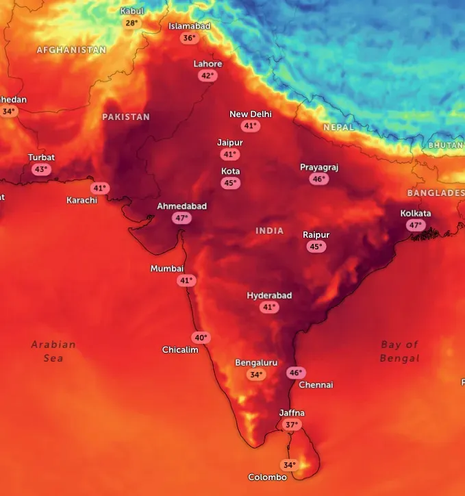
I saw this heat wave map of India and immediately found myself wondering what would the equivalent for late May have been like for my mother and aunt growing up as young girls in India in the 1930s.

I’ll get to some hints of answers in a bit, but first just wanted to note the cognitive surrender being fed by LLMs (next post)
https://mstdn.ca/@dbattistella/116649502661415044

DB 🌱💦 (@[email protected])

Attached: 1 image Ever since reading Kim Stanley Robinson's The Ministry for the Future, I've been dreading the arrival of heatwaves like this one. The opening chapter of that book is truly terrifying. #India #GlobalWarming #Books

Mastodon Canada

…2/n

I have an old iPhone, so although I use DuckDuckGo I have no means to default its search to noai.duckduckgo.com, and although I tell DDG I want no LLM summaries, when the cookie for that expires I get them anyway.

Which is how I come to note how confidently the ‘AI Assist’ reports temperatures in the 1930s based on essentially nothing. I followed its cited sources, where there is nothing whatsoever about any temperature data at all prior to the 1980s

…3/n

What a fucking shit show. Absolute bollocks being spewed on the basis of nothing. Just making shit up and misleading people.*

(Edit: *more measured thoughts in posts 10-12 below.)

It’s automated Trumpism.

Anyway, I’ll get somewhere close to some actual answers about 1930s Indian temperatures later today, by putting some actual work in with a semblance of diligence and discernment.

While the web still has an uncountable number of documents that aren’t distilled bullshit

…4/n

My mum was born in Quetta in 1932 – then India, now Pakistan. Her dad had poor heart health from the mid 1930s onwards, retired from the (Raj) Army to the UK, but was then called up again in 1940.

My mum, her sister and mother followed him back out to India later that year.

But in Indian heat, his heart could not maintain his utility to the war effort. He was re-retired and the family moved to the Nilgiri Mountains of Tamil Nadu, for its temperate climate, to see out the war

…5/n

The May 2026 temperature snapshot of India at the top (repeated here) portrays a 13°C spread, with Ahmedabad and Kolkata the hottest at 47°C (’kinell) and Bengaluru the coolest at a mere 34°C.

My guess is that the Nilgiri Mountains would be a lot less than that 34°. (They’re where my mum’s family would have been in the mid 1940s).

But as the context here is temperature extremes, I’ll go down a Kolkata rabbit hole https://mstdn.ca/@dbattistella/116649502661415044

DB 🌱💦 (@[email protected])

Attached: 1 image Ever since reading Kim Stanley Robinson's The Ministry for the Future, I've been dreading the arrival of heatwaves like this one. The opening chapter of that book is truly terrifying. #India #GlobalWarming #Books
Mastodon Canada

…6/n

My thought at the top was roughly “What was the temperature in India like in the 1930s?”

I’ve not found a source for that, but https://data.opencity.in/dataset/daily-temperature-70-years-data-for-major-indian-cities provides data for 8 major Indian cities back to 1951.

From its CSV source, the average of average daily temperatures in Kolkata for the 7-day period from 21 to 27 May, from 1951 to 1955 was:

1951: 34.7°
1952: 34.6°
1953: 35.4°
1954: 34.5°
1955: 34.3°.

So across those 5 years the average was 34.7°C.

This week, it’s been 37.3°C

Daily Temperature - 70 years Data for Major Indian Cities - CKAN

Daily Temp - max, min in Degree Celsius for 1951-2024 for Major Indian Cities: Delhi, Kolkata, Mumbai, Chennai, Bengaluru, Ahmedabad, Hyderabad and Pune

…7/n

Intriguingly, there’s no source for the map above which took me down this rabbit hole, and although it cites 47°C for Kolkata, that might be a *forecast* because the data from which I derived this week’s average of “37.3°C” is at https://www.easeweather.com/asia/india/past#day=21&month=5.

And the highest Kolkata temperature which it cites for the past week is 45.3°C.

Anyway, in the data I looked at, 2026 Kolkata seems to be something like 2.6°C hotter than early 1950s Kolkata, which perhaps highlights something else…

Historical Weather Data for India - Trends and Yearly Records

Explore comprehensive historical weather data for India, featuring detailed yearly trends and records. Access past weather information for India, including temperature, precipitation, and more.

Ease Weather

…8/n

The **FFS don’t go above 1.5°C of global heating** we’ve been telling ourselves is a *global* average and most of the Earth is covered in water.

The heating on land – where humans live – is roughly twice that average.

And the 2.6°C difference that’s cited in the previous post – which spans 70 years – is in the region of twice the +1.47° global increase – which spans 270 years – that we’re hovering around now.

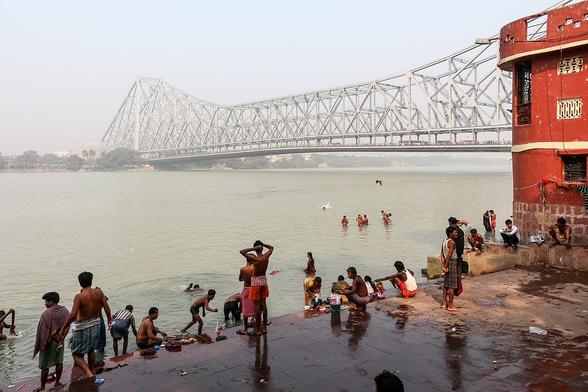
But I was only looking narrowly at one week for 15 million Indians in Kolkata

…9/n

The thing is, if you expire in an unbearable and unsurvivable heat spike, it doesn’t really matter what the average temperature was or is or will be 🤷‍♂️ 💀

…10/n

To revisit what the DuckDuckGo LLM said when it butted in.

My original search phrase was “calcutta may temperatures 1930s”.

With hindsight, the answer it gave was not in fact the “absolute bollocks” I characterised it as above (will cite its answer in a minute), but in my defence what I was flailing about at in frustration was not so much what it said but what it pointed to and where that left me

https://mastodon.social/@urlyman/116650888351592188

…11/n

What DDG Search Assist said was:

“In the 1930s, May temperatures in Kolkata (formerly Calcutta) often exceeded 40°C (104°F) during heat waves, typical of the hot and humid summer season. The average high for May was around 95°F (35°C), reflecting the intense heat of that period.”

But it pointed to https://en.wikipedia.org/wiki/Climate_of_Kolkata and https://weatherspark.com/y/111532/Average-Weather-in-Kolkata-West-Bengal-India-Year-Round#google_vignette, neither of which have any reference to… edit: the 1930s except for one vague reference in the Wiki page to a dataset starting at “1939”

Climate of Kolkata - Wikipedia

…12/n

Aside from the the fact that LLMs are helping to accelerate global heating itself, what I find objectionable is this citing of sources which don’t even provide the backdrop to what has been confidently said.

It invites and actively feeds cognitive surrender

https://mastodon.social/@urlyman/116512028693966685

…13/n

’Cognitive surrender’ is an LLM-induced light end of jeopardy for comfortable Westerners.

Meanwhile, people on the east coast of India are in mortal danger from heat. The following is from a week ago:

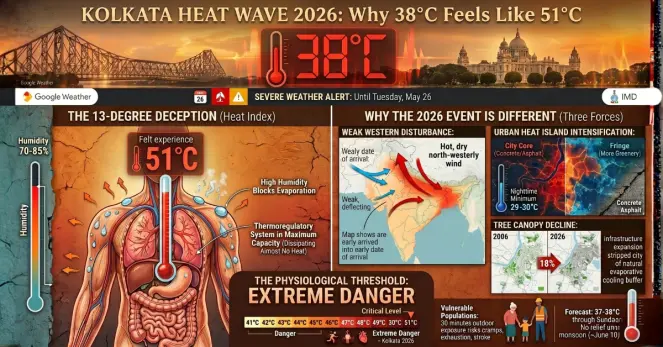
https://womantimes.in/kolkata-heat-wave-2026-why-38c-feels-like-51c/

“The 13-Degree Deception:

The ‘feels like’ temperature of 51°C is what meteorologists call the Heat Index — a composite measure that fuses air temperature with relative humidity to approximate what the human body actually experiences…

Kolkata Heat Wave 2026: Why 38°C Feels Like 51°C

Kolkata's heat index hits 51°C while thermometers read 38°C. A 30-year weather analyst explains the dangerous gap.

Woman Times

…14/n

“In Kolkata’s pre-monsoon window, the Bay of Bengal pumps moisture inland aggressively. Humidity levels routinely breach 70–85% in late May. At those saturation levels, sweat — your body’s primary cooling mechanism — cannot evaporate efficiently. The result: your thermoregulatory system is working at maximum capacity yet dissipating almost no heat.

Your body feels like it is trapped in a 51°C oven, even though a thermometer in the shade reads a comparatively modest 38°C…

…15/n

“Why the 2026 Kolkata Heat Wave Is Different?

3 converging forces are amplifying this event beyond seasonal norms.

1. the Western Disturbance this year has been anomalously weak, allowing a strong northwesterly hot-dry wind pattern to bake the Indo-Gangetic plain weeks earlier than historical averages…

…16/n

“2. urban heat island intensification — concrete and asphalt absorbing solar radiation and re-radiating it as heat at night — means Kolkata’s dense core never truly cools after sunset. Nighttime minimums hovering near 29–30°C across the forecast period deny the body recovery time it critically needs…!

…17/n

“3. Most troubling from an environmental lens, the tree canopy cover in central Kolkata has declined approximately 18% in the last two decades due to infrastructure expansion, stripping the city of its natural evaporative cooling buffer.”

…18/n

Just 2 years ago, in 2024, The Economic Times ran a headline of:

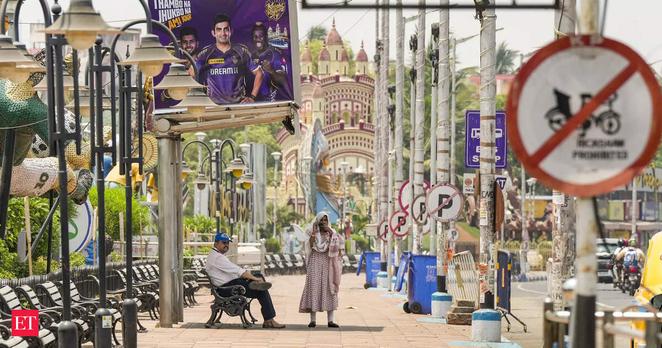
“At 43°C, Kolkata records highest temperature in 50 years”.

This year, Kolkata has already experienced 45.3°C and the implication of the map at the top of this thread are that it’s in line for being subjected to 47°C.

And yet, this is probably one of the coolest summers that Kolkata will be experiencing relative to the years to come 😢

https://m.economictimes.com/news/india/at-43c-kolkata-records-highest-temperature-in-50-years/articleshow/109734960.cms

At 43°C, Kolkata records highest temperature in 50 years

The Alipore observatory in Kolkata recorded its highest temperature in 50 years at 43 degrees Celsius, the Met Department said. Neighbouring Salt Lake recorded a maximum day temperature of 43.5 degrees Celsius, while in nearby Barrackpore in North 24 Parganas district the mercury touched 44.6 degrees Celsius, it said.

Economic Times