From the earliest days of technopolitics, the role of technology in resisting authoritarianism was unclear. On the one hand, there's the indisputable fact that modern cryptography, properly implemented, can deliver a degree of privacy that is proof against all technological attacks.

--

If you'd like an essay-formatted version of this thread to read or share, here's a link to it on pluralistic.net, my surveillance-free, ad-free, tracker-free blog:

https://pluralistic.net/2026/05/28/we-live-in-a-society/#rubber-hose-cryptanalysis

1/

That is to say, if you pull out your distraction rectangle, fire up the camera, and tap the shutter button, in the ensuing eyeblink instant the image you've captured will be scrambled so thoroughly that it could never be unscrambled without the secret key unlocked by your passphrase or biometrics.

2/

Even if every hydrogen atom in the universe were converted into a computer, and even if all those computers spent all the time between now and the end of the universe trying to guess what the key was, we would run out of universe and time long before we ran out of possible keys.

3/

What's more, this extremely robust form of scrambling and descrambling can be combined with other techniques to block tampering with the encrypted data, and to allow parties to reliably identify who scrambled the data and also to restrict who may *unscramble* it. These remarkable technological facts have inspired many excited debates about what they mean for our politics, most notably among a group of people who called themselves "cypherpunks":

https://web.archive.org/web/20151102012232/https://www.wired.com/1993/02/crypto-rebels/

4/

Crypto Rebels

It's the FBIs, NSAs, and Equifaxes of the world versus a swelling movement of Cypherpunks , civil libertarians, and millionaire hackers. At stake: Whether privacy will exist in the 21st century.

WIRED

One cypherpunk faction believed that modern cryptography could enable a kind of technological secession: by allowing ordinary people to communicate, transact and collaborate without the possibility of state interception or control, crypto could make states themselves obsolete.

5/

But another faction pointed out that no amount of mathematics could help you if an agent of the state - or a criminal the state failed to protect you from - tortured you until you revealed the secret passphrase needed to unlock your secrets. This was (ironically) called "rubber hose cryptanalysis" (as in "Tell me your passphrase or I'll hit you with this rubber hose again").

6/

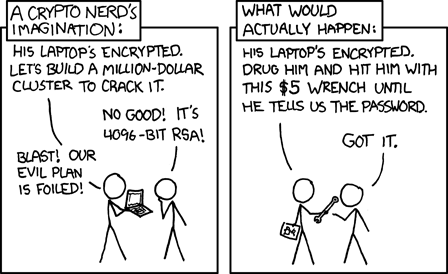
Later, this became known as a "wrench attack" after a famous XKCD comic about $1m worth of security technology being defeated by hitting someone with a $5 wrench until they divulged the password:

https://xkcd.com/538/

Once you stipulate to the problem of wrench attacks and rubber-hose cryptanalysis, it becomes apparent that your cryptography is only as good as your physical defenses.

7/

Security

xkcd

What's more, the most effective physical defenses we have come from a strong rule of law, because even the thickest safe door benefits from the threat of prison for anyone who breaks into the safe, and the most effective tool for preventing a cop from hitting you with a rubber hose is the existence of a judge who can send that cop to prison for abusing your civil rights.

8/

But what do you do if you already live under tyranny? The rule of law is a great defense, but cryptography alone can't bring about the rule of law. What is the role of technology in this foundational struggle?

9/

My technopolitics faction - the faction associated with the Electronic Frontier Foundation, where I've worked for a quarter-century - has an answer: the role of encryption is to provide a measure of privacy and security that is best used to organize *political* struggles to demand the rule of law and respect for human rights.

10/

Encryption isn't proof against rubber hoses, but it *is* effective against many other forms of state repression, and it can provide a *technical* edge for those engaged in a *political* struggle.

Another faction - the faction most associated with bitcoin and subsequent cryptocurrency projects - rejects the role of the state altogether, and seeks to replace states (and state-regulated institutions like courts and banks) with mathematics.

11/

Rather than asking courts to interpret contracts, we can put our trust in self-executing "smart contracts," and rather than asking banks to safeguard our financial integrity, we can use cryptographic software to ensure that money only moves when the person it belongs to tells it to.

This has many problems. Smart contracts are slow, expensive, and unreliable.

12/

The number of people who understand contracts is small, the number of people who understand the software that embodies smart contracts is likewise small, and the Venn intersection of the two is more of a sphincter. What's more, there is irreducible ambiguity in all but the simplest of contracts, which means that even a "self-executing" contract ends up relying on a human adjudicator (an "oracle") who can be bribed or intimidated into cheating:

https://pluralistic.net/2022/02/14/externalities/#dshr

13/

Pluralistic: 13 Feb 2022 – Pluralistic: Daily links from Cory Doctorow

And when it comes to transactions, crypto proves to be unwieldy, expensive and complex, so that nearly all crypto users end up directing an intermediary (like Coinbase) to hold and move their cryptographic assets for them.

14/

The upshot: cryptocurrency mostly replaces banks - imperfect, but heavily regulated and insured - with unregulated platforms with murky ownership and often defective procedures, who may or may not be insured (or even locatable) in the event of a collapse or a breach. Consequently, cryptocurrency has become a scam magnet of unprecedented and unstoppable power, and hardly a day goes by without people being ripped off in the most ghastly ways imaginable:

https://www.web3isgoinggreat.com/

15/

Web3 is Going Just Great

A timeline recording only some of the many disasters happening in crypto, decentralized finance, NFTs, and other blockchain-based projects.

For bitcoin maxis and other anti-state cypherpunks, this is just a skill issue. Anyone who doesn't understand how to manage their own keys and turns to a platform to hold and move their crypto is getting what they deserve. As the maxim goes, "Not your keys, not your wallet," which is cypherpunkspeak for "caveat emptor."

16/

That's where the wrench attacks come in. Because if you are in possession of keys that can be used to irreversibly and instantaneously steal large sums of money and move it to jurisdictions where the perpetrators are beyond any legal or physical recourse (e.g. North Korea), then there is a massive incentive for your adversaries to kidnap you and hit you with a wrench or a rubber hose.

17/

That's precisely what's going on. People with substantial cryptocurrency holdings face grave personal danger, and the physical attacks on their person grow bolder, more violent, and more sadistic by the day:

https://github.com/jlopp/physical-bitcoin-attacks/blob/master/README.md

As crypto critic David Rosenthal writes, this problem is even worse than it seems at first blush:

https://blog.dshr.org/2026/05/wrench-attacks.html

18/

physical-bitcoin-attacks/README.md at master · jlopp/physical-bitcoin-attacks

A list of known attacks against Bitcoin / crypto asset owning entities that occurred in meatspace. - jlopp/physical-bitcoin-attacks

GitHub

For one thing, cryptocurrencies depend on "public ledgers" that indelibly, publicly record every transaction in the network. Cryptocurrency is nothing without these ledgers, and they *have* to be immutable and public to work. This is very bad news for anyone who relies on anonymity as their defense against physical attacks.

That's because "reidentification attacks" (where an anonymous person in a dataset is positively identified) get easier to perform over time.

19/

You might be represented in a database of hospital prescribing activities by a random number, and that number might be hard to associate with your real identity...at first. But with every subsequent release of data - whether in the form of an anonymized data-set or a breach - it gets easier to cross-reference the facts associated with your record with other facts from other records, such that a detailed, identifying picture of you emerges one fact at a time.

20/

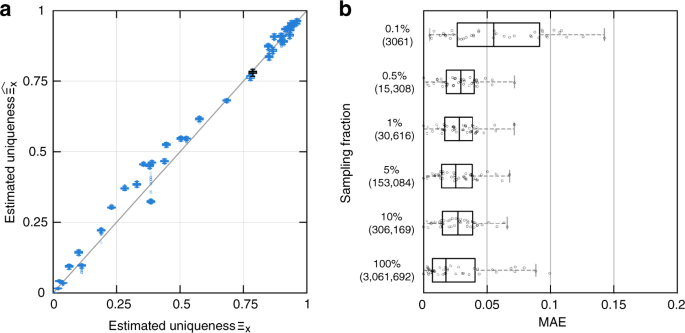
For example, if the taxi company you use suffers a breach that reveals journeys associated with every doctor's appointment at the hospital, now an attacker can pick out the home or work address of the single person who visited the hospital just before you received your prescription. The longer an "anonymized" data-set sits around in public view, the easier it gets to de-anonymize it:

https://www.nature.com/articles/s41467-019-10933-3

21/

Estimating the success of re-identifications in incomplete datasets using generative models - Nature Communications

Anonymization has been the main means of addressing privacy concerns in sharing medical and socio-demographic data. Here, the authors estimate the likelihood that a specific person can be re-identified in heavily incomplete datasets, casting doubt on the adequacy of current anonymization practices.

Nature

Combine the fact that permanent ledgers make it progressively easier to identify people whom you can torture into revealing their crypto keys with the irreversible, instantaneous nature of crypto transfers and you get some very juicy targets indeed. "Not your keys, not your wallet" means it's "not anyone else's problem" when you get robbed. You can't ask the bank to interdict or reverse the transaction.

22/

Rosenthal provides a litany of the escalating security measures crypto holders are turning to as this problem goes progressively more dangerous and terrifying. There's the guy who splits his keys up in four physical vaults at four separate locations, whose management is instructed to make him wait a minimum of seven days when he asks to retrieve them. Despite all this, he keeps his identity secret:

https://www.bloomberg.com/news/articles/2026-05-19/crypto-conferences-up-security-after-attacks-scams

23/

Rosenthal quotes Nicholas Weaver, who asks what kind of "internet of money" bitcoin can be if it can't be safely stored on a computer connected to the actual internet:

https://doi.org/10.1145/3208095

But an equally valid question is, what kind of escape from tyranny is it that requires you to hide your identity at all times lest you be snatched off the street and brutally tortured?

24/

What kind of "liberty" requires you to spend $860,000 armoring your two top execs' personal vehicles to protect them from gunfire and light artillery?

https://www.ft.com/content/71d7486d-89b5-48ac-8f94-857578c0a03b

It costs $6.2m/year to protect Coinbase's CEO - "more than the combined amount that JPMorgan Chase & Co., Goldman Sachs Group Inc. and Nvidia Corp. spent on their respective CEOs":

https://www.bloomberg.com/news/articles/2025-05-18/crypto-high-rollers-go-big-on-bodyguards-to-deter-kidnappers

25/

Crypto true believers exhort one another to "HODL" (hold on for dear life). Selling your crypto during downturns is considered a moral failing. But now, crypto holders - especially those who manage their own keys - are *literally* holding on for dear life, as they are hunted by crime syndicates and state actors alike.

26/

It's a good reminder of how badly crypto has failed on its own terms, delivering its biggest users into an existence of fear and physical peril that rivals the plight of even the most hunted dissidents in the most repressive societies.

27/

Worse: as cryptocurrency lobbyists have fused crypto with the world's largest, most corrupt governments (especially the Trump regime), crypto now has the exposure to state coercion that made banks so unsuitable, but without the (inconstant, insufficient) protections offered by traditional banking.

And that's before we talk about the energy consumption problems, the scams enabled by crypto, and the rampant human trafficking that those scams necessitate:

https://www.pbs.org/newshour/show/how-human-trafficking-victims-are-forced-to-run-pig-butchering-investment-scams

28

How human trafficking victims are forced to run 'pig butchering' investment scams

An investment scam called “pig butchering” has cost victims around the world an estimated $75 billion in just the last four years, and it's not just the targets who are being harmed. The imposters on the other end of the line are often human trafficking victims forced to run the scheme by large crime syndicates in Asia. Ali Rogin speaks with former prosecutor Erin West to learn more.

PBS News

People in my technopolitical faction have a saying of our own: "'Crypto' means *cryptography*." Cryptography plays a hugely important role in protecting people from crime and state repression. It is no substitute for the rule of law and democracy, but it remains a key tool for securing and defending both:

https://pluralistic.net/2022/03/27/the-best-defense-against-rubber-hose-cryptanalysis/

Cryptocurrency, on the other hand? That's the worst of all worlds.

29/

The Best Defense Against Rubber-Hose Cryptanalysis – Pluralistic: Daily links from Cory Doctorow

My next book is *The Reverse Centaur's Guide to Life After AI*, out next month. Pre-order it now, including as a DRM-free audiobook or ebook, at my Kickstarter, and help me continue to prove that DRM-free isn't just the *right* way to reach an audience, it's also the *best* way to reach them:

https://www.kickstarter.com/projects/doctorow/the-reverse-centaurs-guide-to-life-after-ai

eof/

@pluralistic Nice, an opportunity to tell people where the word 'HODL' comes from. It originated as a typo in the title ("I AM HODLING") of a famous post on Bitcoin Talk during one of the early BTC crashes (this is the post: https://bitcointalk.org/index.php?topic=375643.0). The poster was drunk and couldn't correctly type "HOLDING".

'Hold on for dear life ' is a backronym plausible enough that it has spread all over the place, but I prefer the real origin.

I AM HODLING

I AM HODLING

@pluralistic

Absolutely, we do need better political and legal backing.

But one answer that assumes a dystopian state is something ive seen very little of. And thats #steganography.

If you cant use effective #cryptography without backdoors or not at all, stego is a way to hide real communication inside milquetoast boring communication without anybody else figuring out theres even hidden messages. If there was a text stego, you could even hide it in (ick!) Facebook messages, if thats what you have to use.

I saw some stego tools back around the turn of the millenium, primarily with least significant bit used on images. Aside some work, its dated at best.

Counter to that, stego is being used extensively with very low bandwidth detection in movie copyrighted works, to identify what theater and what show a cam came from. And also the LLM dealers are also starting to mess with stego as well, as a stealth way to detect LLM generated stuff.