
After my infographic about words such as ‘wall’, ‘street’, and ‘kitchen’, which are very early Germanic borrowings from Latin, here’s a second one, this time about food.

While words such as ‘carnivore’, ‘cereal’, and ‘edible’ are late and obvious borrowings from Latin, words such as ‘cheese’, ‘pear’, and ‘wine’ were adopted from that language 2000-1500 years ago, when the Romans occupied the parts of Europe where the ancestor of English was spoken.

Next episode: utensils!

1/
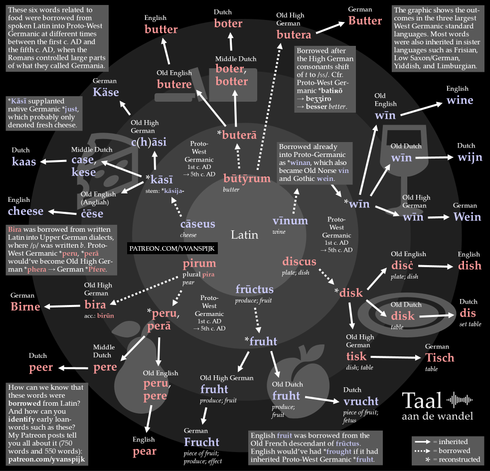
2/

How do we know that the words featured in these infographics were borrowed? Couldn’t they just be the native Germanic cognates of the Latin words? There are several ways we can identify them as borrowings. You’ll learn all about them in the short article below.

https://www.patreon.com/posts/early-latin-food-159376050

@yvanspijk I’m glad that the English don’t have “frought”. Would that be pronounced like “drought” or like “fought”?
@ArtHarg Like 'fought', which comes from 'fuht-', which contained -uht- too. ^^

@yvanspijk You mention Dutch vrucht = fetus. Is that common? Because in German, „Frucht des Leibes“ bzw. „Leibesfrucht“ is oldfashioned for fetus/baby.

I find it fascinating that some words hardly change their meaning while others divert widely.

@fiee It's quite uncommon. I see it almost exclusively used in 'vruchtwater' (amniotic fluid) and 'vruchtje' (the earliest form of the fetus after conception).
@yvanspijk „Fruchtwasser“ ist also the usual name in German, but „Früchtchen“ is a stern address of a misbehaving child. 😁