 Matters of Interpretation
Reflecting on Matthew 28 18-20 and Hebrews 10 22-25
This week we are finishing up our quarter on “social teachings of the church” with a look at the conclusion of Matthew’s gospel (Matthew 28:18-20, “the Great Commission” or as Dallas Willard comments on it, “the Great Omission”) and a fragment of Hebrews, Hebrews 10:22-25 (which starts in the middle of a sentence, but then continues).
The final “social teaching” before us is “fellowship through worship.” We might actually want (or need?) to clear some conceptual ground, to do some thinking and discussing of those two big, basic ideas, to make further exploration possible. What does fellowship have to do with worship, do we think, and how do we have fellowship “through” worship, do we think? [Do we have fellowship through – in the course of, during, as an integral component of – our worship, typically? How? Or … what would need to change for that to happen?] What do we mean by “fellowship” in the first place? What do we mean by “worship”? Do we know what we’re talking about, and if we do, what are we talking about? Where have our ideas about all this come from, anyway?
Then, we probably want to look closely at what these two short texts seem to be teaching us about fellowship, and about worship. Where do we see “fellowship” in these texts? Where do we see “worship”? What relationship between fellowship and worship seems to be sketched or described or pointed to in these texts? And how similar to, or different from, the way we ourselves normally think of fellowship and of worship and of their relationship? Implications – anything we are moved to think about, or to do, differently? What? Why?
If that seems rather abstract, we might want to try focusing on the actual verbs in the text – going into the world, making disciples, approaching, etc. – and asking ourselves whether we think of those verbs as “worship” words, or as “fellowship” words, or as either, or as neither … and maybe, how our ideas about worship and fellowship would change if we did start to think of those words as “worship” or “fellowship” words. What does that exercise bring to our attention?
Some notes on the Matthew text are here; some notes on the verses in Hebrews are here. Here are a couple of additional questions we might want to think about, or to discuss in class:
In Matthew 28:18, Jesus begins by saying “all authority in heaven and on earth has been given to me.” It’s a big statement. What does it mean to us, for us, personally? That is, what does “authority” mean to us, and how does Jesus’ authority factor into our understanding of reality? What impact does Jesus’ authority have on the way we ourselves live our lives?
What does authority have to do with worship?
In v20, who or what are we approaching? Why? Thoughts, feelings about that approach? Why?
Back to Calvin’s questions: what do we learn about God, and what do we learn about ourselves, from these texts?
What about God seems to relate to, or to require, worship? Fellowship? Where do we get that from these texts?
What about us seems to relate to, or to require, worship? Fellowship? Where do we get that from these texts?
[And, if we don’t get our ideas from these texts, where do we get them from, and what seems to be moving us to bring those particular ideas to these particular texts? What do we learn from that?]
Where does this reflection on worship and fellowship and on “fellowship through worship” seem to leave us? Are we ourselves doing what these texts say to do? If not, why not? What would it take to do what these texts say to do? That is, what would need to change – to make it possible – and what would change – once we decided to start doing that, or doing it more routinely? What would we gain, do we think, and what would we lose? How would we feel about all that, do we think? Where do these reflections take us?
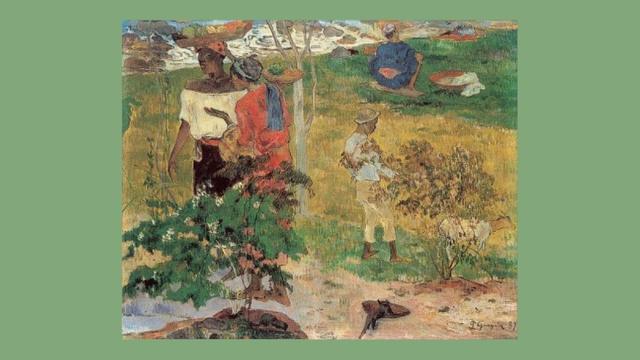
Image: “Conversation Tropiques,” Paul Gauguin, Public domain, via Wikimedia Commons
#BibleStudy #Hebrews101925 #Hebrews102225 #Matthew281820 #meaning #meaningForUs #readingTheBible #thinkingAboutTheBible