x2!
x2!
x2!
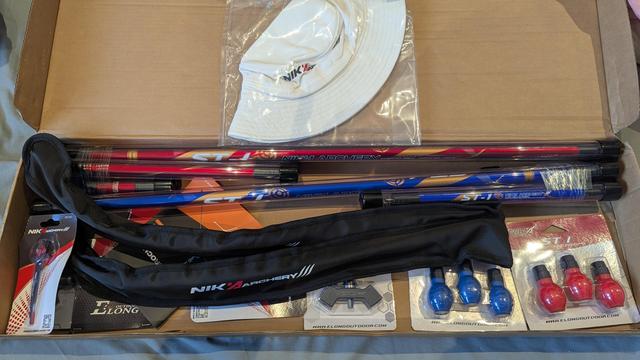
number 1 has arrived, an assortment of archery equipment from Nika Archery.
There are new stabiliser sets for the kid and I, new clickers for us both, and a pair of new, higher draw weight limbs for my bow. Will this make us shoot better? Almost certainly not, at least not yet, but it will increase the level of colour coordination of our equipment, and that's the important thing.
They also decided to throw in a couple of cheap freebies, a branded bucket hat (archers *love* bucket hats) and a pair of recurve bow limb shock absorbers (foam stickers that go on the end of the limbs where the string contacts it).
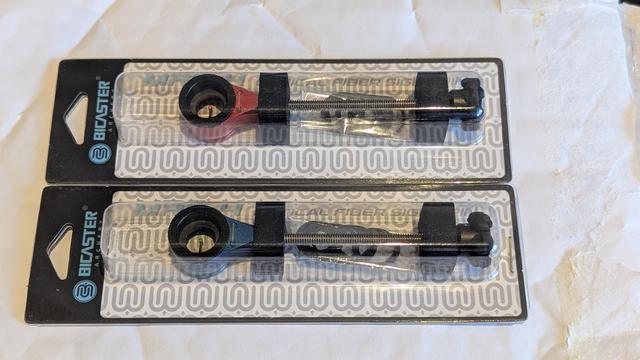
number 2: a couple of Bicaster fibre optic sight pins.
The sight pin that came with my bow's sight got damaged recently, so I figured we'd give these slightly fancier ones a go.
I think these things are ingenious, and also kind of amusing.
It's clear that what some target archers really wanted was a reflex sight, like those used on some firearms, or the red dot finders on some telescopes, or the pre-HUD reflector gun sights in old fighter aircraft, but they're not allowed! The World Archery rules forbid any electric or electronic devices on the bow (no lasers or LEDs for you!), and the rules for recurve bows also ban sights that include any "prism, magnifying lens/lenses, or any magnifying device, level, electric or electronic devices".
So what do you do if you really, really want a glowing coloured dot but you can't have any light sources or optics? You get a piece of coloured "fibre optic" (plastic light guide) and put it in the middle of your sight ring, of course. Some of the ambient light shining in through the side of the fibre gets trapped and is funneled out of the ends, giving you a point of light generated by entirely passive means. It even auto-dims when the amount of ambient light changes!
Some of these just use a short, straight section of fibre held in the middle of the sight ring. The rules allow these to be up to 2 cm long, but the rules also allow longer fibres as long as they bend after 2 cm and exit the line of sight. This sight pin takes that to an extreme by wrapping the fibre three times around the outside of the sight ring to get lots of light gathering length. They're missing a trick by not sticking something reflective on the other end of the fibre though, half of the collected light is pointlessly shining out of the back of the sight. Still, it's pretty bright, brighter than this video makes it look.
@spacelizard forbid devices .. on the bow, eh?
what about passive markings, mocap style, and then an entire separate rig of cameras and calculations and lasers shining at the target though?
@uep Hah, the rule makers really, really don't like electronic devices.
There's actually a blanket ban on any electronic device that attaches to your equipment, not only your bow, along with explicit bans on rangefinders or other aids for adjusting your sights, and communication equipment.
You're allowed smartwatches and fitness trackers, and you can use your mobile phone as an electronic scorecard, but that's about it. There's a series of inconsistent rulings on visual aids for seeing where your arrows hit. Spotting scopes and binoculars? Great. Image stabilised binoculars? They're fine too. Digital spotting scopes with integrated screens? OK. Connecting a tablet to a digital spotting scope for a better view? Absolutely not. Holding your phone camera in front of a spotting scope eyepiece? I don't think so.
Technically this all only applies to international competitions run by World Archery, but most of it does trickle down to national, state and club level competition rules too. Of course if you're just practicing you can do whatever you like.
@spacelizard @uep rangefinders pretty pointless when it comes to marked/known distances. If distances are not known that is the challenge, if rangefinders allowed then the distance might as well be marked to level the field.
A ban on electronic devices at the target only recently lifted, previously maintained to prevent an archer receiving coaching information.
Behind all the rules are competitors trying to get an unfair advantage?
Not hard to conceive that a device connected to a spotting scope could analyse arrow flight and provide real time correction info. The archer says not the official says yes and everybody’s day gets spoiled while it is sorted out.
Just my penny worth.