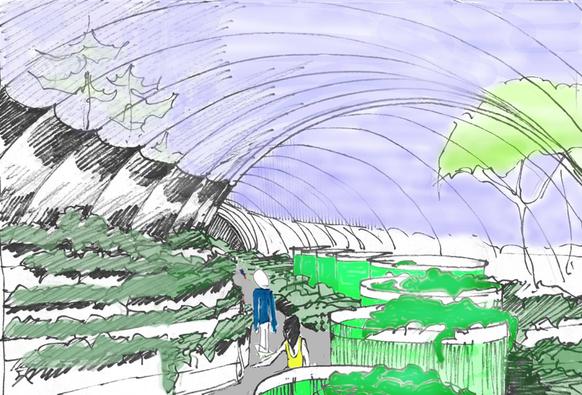
I'm going to try to get at the pith of the idea, the essence of what we have to do to get through this period of time and come out the other side, into a world where we live and work in harmony with nature.

Imagine that you're a climate refugee. That is to say that your home and town have been destroyed by wildfire or floods or just too much heat, and you have to rebuild from scratch (either on the same site or somewhere else.)

If you are not a climate refugee yet, just give it a minute.
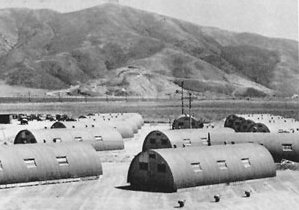
Start with something like a Quonset hut, "a lightweight prefabricated structure of corrugated galvanized steel with a semi-circular cross-section." But much larger, and instead of steel it uses panels of... but I'll come to that in a minute.

https://en.wikipedia.org/wiki/Quonset_hut

Quonset hut - Wikipedia

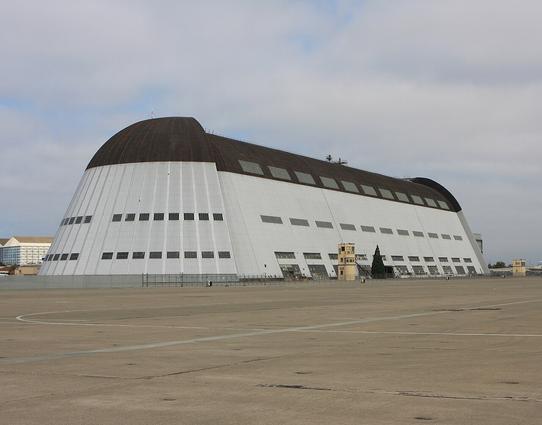
You could imagine that these huts could be quite large, like Hangar One, "one of the world's largest freestanding structures, covering 8 acres (32,000 m2; 3.2 ha)" a huge empty structure for housing airships (blimps, etc.)

https://en.wikipedia.org/wiki/Hangar_One_(Moffett_Federal_Airfield)

Hangar One (Moffett Federal Airfield) - Wikipedia

The point is that there's a kind of protective shell that has some serious space inside it, and that this shell is built somewhere in a factory and then deployed quickly and cheaply. Then inside these protective giant huts there are food gardens and homes. The gardens are ecologically harmonious, more on that in a bit, and the homes are structurally minimal, like tents, but spacious and comfortable.

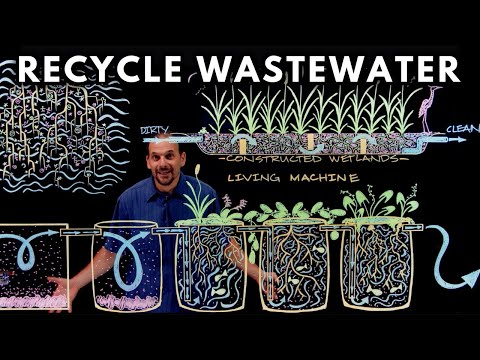
Water is cycled through a system of tanks that purify it using a kind of artificial wetlands, producing plants and fish. Bathrooms and kitchens work the same: faucets with hot and cold potable water, flush toilets, etc. but the water is reused locally and all "waste" reclaimed into the system.

E.g.: https://www.youtube.com/watch?v=f-sRcVkZ9yg

How to Recycle Waste Water Using Plants

YouTube

Now instead of steel and wood these structures use paper made from leaves and reinforced with glue to form structures lighter and stronger than wood. This is a relatively new and under-explored area of construction.

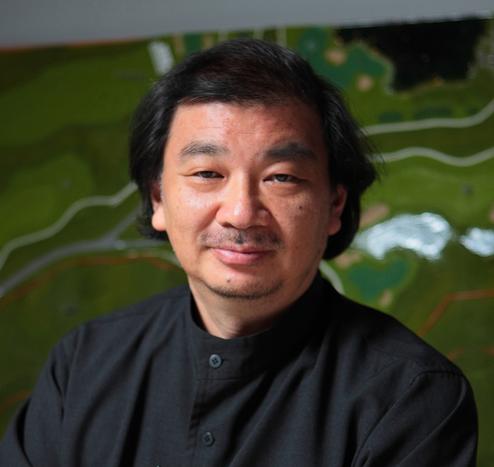
E.g. see the work of Shigeru Ban: https://en.wikipedia.org/wiki/Shigeru_Ban#Use_of_paper_as_a_building_material

Shigeru Ban - Wikipedia

The important thing about this is that it's possible to grow the materials to build more protective huts and homes and other infrastructure within the system. It's self-reproducing because it's all constructed of self-reproducing plants and animals. This recursive nature allows for exponential growth of the ecologically harmonious mode of civilization, which is what we need if we're going to correct our course in time to avert the worst of the disasters we're facing.

In re: ecologically harmonious food gardens we have an example of a minimal system that produces a complete diet and regenerates the soil in Jeavons' GROW BioIntensive system. It requires about two tennis courts of space per adult. That serves as a lower bound for how much space per adult is needed.

https://www.growbiointensive.org/

Ecology Action: Home

Ecology Action is a 501(c)(3) non-profit organization. Using the GROW BIOINTENSIVE method, we have been teaching people better feed themselves while building and preserving the soil and conserving resources for 40 years. Explore our website and find information on GROW BIOINTENSIVE projects, workshops, tours, books, videos, free learning tools, and more!

If you're reading this toot you've probably already heard of Permaculture, Syntropic agriculture, etc. We know what to do to grow our food in ways that contribute to the life of the Earth rather than wear it down, eh?

"Treating the Farm as an Ecosystem"
https://www.youtube.com/watch?v=uUmIdq0D6-A

Treating the Farm as an Ecosystem with Gabe Brown Part 1, The 5 Tenets of Soil Health

Auf YouTube findest du großartige Videos und erstklassige Musik. Außerdem kannst du eigene Inhalte hochladen und mit Freunden oder mit der ganzen Welt teilen.

YouTube

Connect these together in neighborhoods. E.g.:

> Greenway is a vision of an ecological neighborhood, where basic needs – food, water, shelter, transport, communications – are provided in ecologically sustainable ways with renewable energy. It’s a network of homes, greenhouses, garden, and businesses, connected by sheltered corridors. Housing is integrated with agriculture. Biology is integrated with technology. People are integrated with the cycles of the Earth.

https://newalchemists.net/2020/09/07/greenway/

Greenway

Greenway (Animated by Lily Ericsson) There is a world in which humans integrate into the water-nutrient cycle. Welcome to Greenway, an achievable, sustainable vision from Earle Barnhart and Hilde M…

The Green Center

So there it is. Build large protective greenhouse huts, and inside those build low-cost ecologically integrated neighborhoods.

Then in these eco-neighborhoods grow and produce the materials for building more, so that the process is exponential.

Now I've managed to get twenty acres of land in northern California on which to start this process. Unfortunately I lack "spoons", that is to say, I don't seem to be making much progress.

Then it got too hot too soon. My family are already kind of climate refugees. We are literally in refuge at a local cheap (but quality) hotel due to excessive heat (95℉ or 35℃) hitting our area before we were ready for it. Locals have been heard to complain that "we didn't get winter this year"!