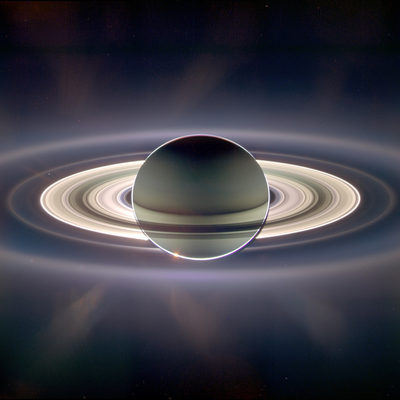
Fountains of Enceladus - Image #2

Recent Cassini images of Saturn's moon Enceladus backlit by the sun show the fountain-like sources of the fine spray of material that towers over the south polar region. The image was taken looking more or less broadside at the "tiger stripe" fractures observed in earlier Enceladus images. It s...

More: https://images.nasa.gov/details/PIA07759
Credit: NASA/JPL/Space Science Institute

#enceladus #cassini #cassinihuygens #astrodon #astronomy #astrophotography #astrophysics
@astropic

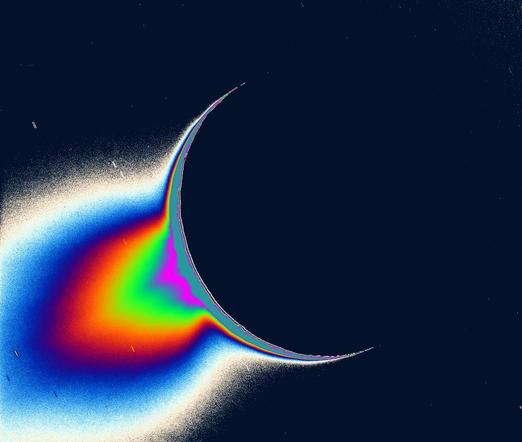
This specific, dramatic image from the Cassini spacecraft uses a technique called false-color enhancement (often using an intensity/density map) to solve a major data problem: the extreme difference in brightness between Enceladus itself and its faint icy plumes.

Here is exactly what that vibrant rainbow of color is revealing to planetary scientists:

#astrophotography
#Enceladus

@astropic
2/
1. Mapping Density and Thickness
In the original raw image, the plumes just look like a faint, uniform white haze spraying into the blackness of space. By mapping different levels of light intensity to specific, high-contrast colors, scientists can instantly see the "plumbing" of the plumes.

#astrophotography
#Enceladus

@astropic
3/
The hot magenta and bright pink zones right at the moon's crescent edge show the absolute highest density—the specific fractures (called "tiger stripes") where the sub-surface ocean is violently venting the most material.

As the colors transition out into red, green, and blue, the material is thinning out and spreading into space.

#astrophotography
#Enceladus

@astropic
4/
2. Spotting the Faintest Particles

Human eyes are terrible at distinguishing subtle gradients of dark grey and white against a pitch-black background. By shifting the data into a high-contrast rainbow spectrum, scientists can track the ultra-faint outer edges of the plume (the blue and white fuzzy boundaries on the far left). This tells them exactly how far the ice grains are traveling and how much of that ocean material is escaping to form Saturn's E-ring.

#astrophotography

@astropic
5/
Preventing Data "Washout"

If Cassini had taken an exposure long enough to make those faint outer plumes visible to a standard camera, the brightly lit crescent of Enceladus itself would have turned into a giant, blown-out blinding white smear, destroying all the data near the surface. False-color processing allows scientists to look at the brightest areas and the dimmest areas at the exact same time without losing details to glare or shadow

#astrophotography
#Cassini
#Enceladus

@astropic
6/
It transforms a beautiful but vague snapshot into a highly precise, readable map of a cryovolcano in action!

#astrophotography
#Cassini
#Enceladus
#cryovolcano

@astropic

Enceladus is essentially the solar system's ultimate mirror. Because those giant geysers constantly spray fresh, ultra-pure water ice all over its surface, it reflects about 99% of the sunlight that hits it. It's like a planet-sized, freshly polished ski resort.

#Enceladus
#albedo

@astropic
2/
Earth, on the other hand, averages a much darker reflectivity (albedo) of only about 30%. We are freshly out of the 2026 winter freeze, and the data shows Arctic winter sea-ice has effectively tied the record lows of last year. When that bright, white sea ice melts away, it exposes the dark Arctic ocean beneath, which acts like a giant black t-shirt, absorbing all that solar heat instead of bouncing it back into space.

#Earth
#Arctic
#albedo