For this #ThrowbackThursday, we will look at #ACSAC2025's first System Security session. The links in this thread will lead you to the paper pdfs and the slide decks, so be sure to check them out! 1/6
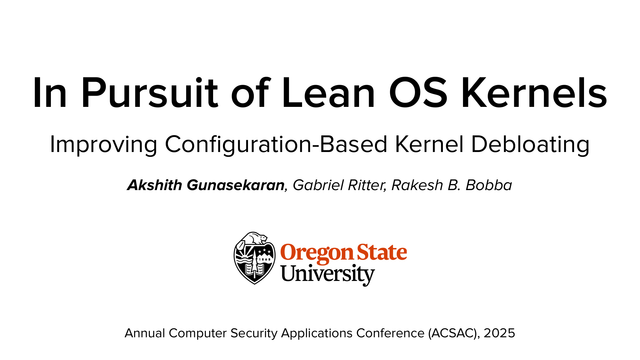
First up in the session was Gunasekaran et al.'s "In Pursuit of Lean OS Kernels: Improving Configuration-Based Debloating," introducing TRACIE and DICE to trim kernel attack surface, code size, and CVEs. (https://www.acsac.org/2025/program/final/s295.html) 2/6
#KernelSecurity #Debloating
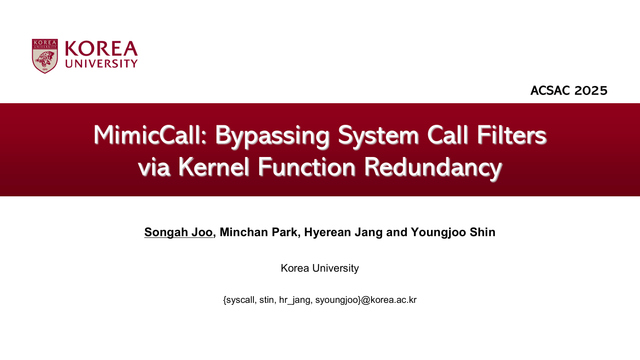
The second paper in this session was Joo et al.'s "MimicCall: Bypassing System Call Filters via Kernel Function Redundancy," showing allowed syscalls can still reach vulnerable kernel code. (https://www.acsac.org/2025/program/final/s452.html) 3/6
#KernelSecurity #SystemCalls
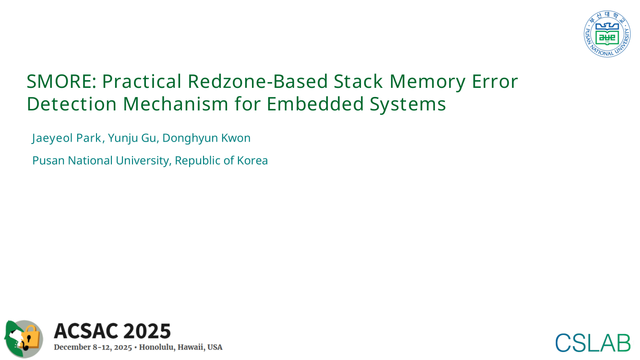
The session continued with Park et al.'s "SMORE: Practical Redzone-Based Stack Memory Error Detection Mechanism for Embedded Systems," showcasing hardware-assisted redzones for low-overhead stack error detection. (https://www.acsac.org/2025/program/final/s455.html) 4/6
#EmbeddedSystemsSecurity
Fourth in the session was Kang et al.'s "ELK: Effective Lock-and-Key Technique for Temporal Memory Safety on Embedded Devices in ARMv8-M" introducing efficient pointer-embedded keys for temporal memory safety on ARMv8-M MCUs. (https://www.acsac.org/2025/program/final/s457.html) 5/6
#EmbeddedSystemsSecurity
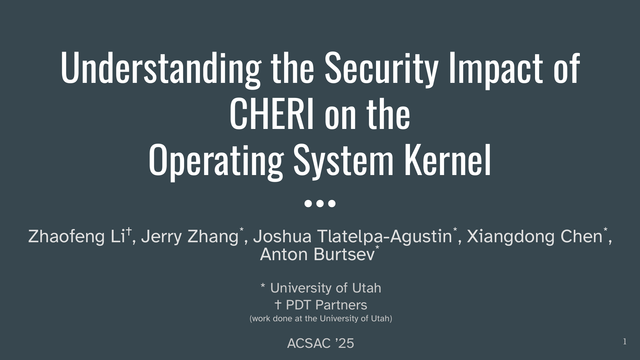
Concluding the session was Li et al.'s "Understanding the Security Impact of CHERI on the Operating System Kernel," showing CHERI can block many severe kernel flaws with modest effort. (https://www.acsac.org/2025/program/final/s464.html) 6/6
#KernelSecurity