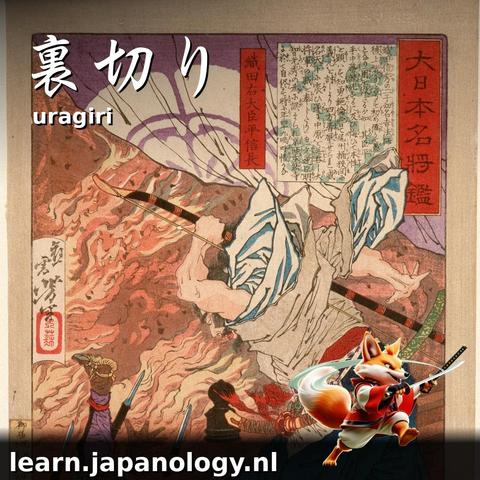
Your kanji app told you 裏切り (uragiri, betrayal) is a lid on a village you kick over, plus seven swords you swing around. None of it is real.
The ura half, 裏, is not "a lid on a village. " It is the LINING of a garment. 衣 (i, clothing) splits at top and bottom, and 里 (ri) drops between, a village: 田 (field) over 土 (earth), grid of paths between paddies. Traditional lining cloth was striped, like that field seen from above. The giri half, 切, is not "seven swords. " It is a knife (刀) plus 七 (shichi), whose oldest shape is a BONE at its joint.

The Shijing line 如切如磋, "as if cut, as if polished," gets glossed in the Mao commentary as 骨謂之切, "to work bone is called 切. " Cutting where the thing wants to part. Uragiri names the geometry of trust before the wound. You only cut a lining if someone lets you near; you only cut at the joint if you know where it is. The print above is the textbook uragiri: the Honnō-ji incident of 1582, when Akechi Mitsuhide cut down his master Oda Nobunaga at the moment of greatest trust. 例: 友達に裏切られた。
(tomodachi ni uragirareta. I was betrayed by my friend. ) Practice this kanji and thousands more on learn.japanology.nl. In the Netherlands? Our Leiden beginner class starts now: japanology. nl. #Japanese #Kanji #LearnJapanese #JLPT #WordOfTheDay #Japanology #Etymology #Betrayal #Honnoji