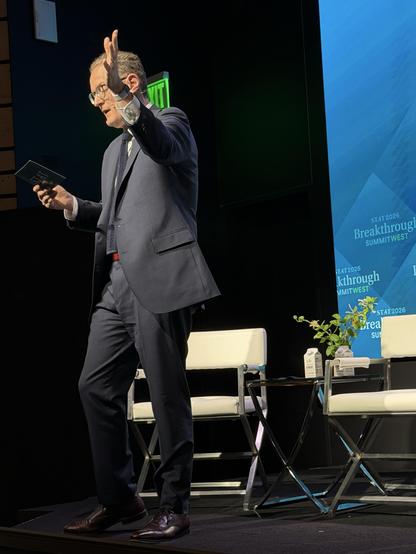
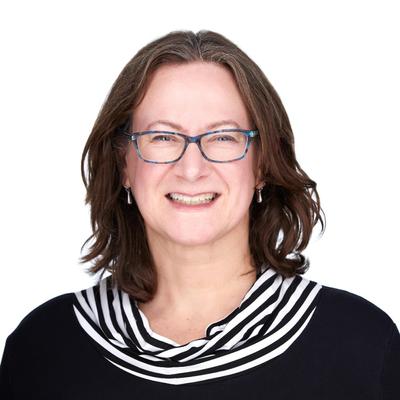
 Elisabeth Bik
MTL: I sent several emails asking for corrections were lost by the journal, and I could have done better following up.
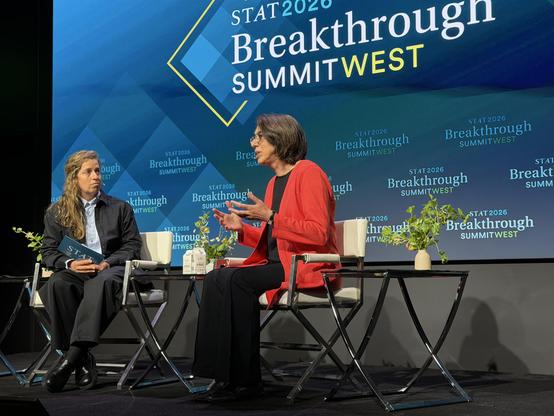
MH. Theo Baker’s book came out today. I will read some paragraphs.
#STATBreakthrough
MH reads some paragraphs from Theo Baker’s book, about the board of trustees with a not very flattering description about MTL’s conduct by anonymous persons.
MTL: I can be firm but I try to be fair. I need to be mindful that I can come across as strong.
#STATBreakthrough
MH: how prepared are you to deal with the public trusting you r company?
MTL (sounding relic that we moved on to a different topic): we have to earn this trust.
China is making stunning progress in new molecule development. We are more guarded in releasing new information.
#STATBreakthrough
MH is you could go back to 2022, what would you tell yourself?
MTL: I would like to go back to 2015 and pressed harder to correct those papers. I have been corporative with the investigation panel.
MH. Would you have skipped the whole Stanford thing?
MTL: No, I am proud of it.
#STATBreakthrough
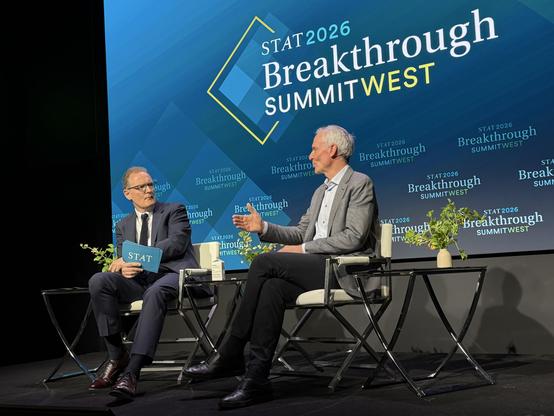
* If you could go back
Amazing view of the Bay Bridge from the Commonwealth Club in San Francisco, where we are having lunch break.
#STATBreakthrough

Back from lunch with ‘Gene Therapy's Next Horizon: The Womb’ with Tippi Mackenzie @ UCSF, interviewed by Megan Molteni.
Can genetic editing and fetal surgery become standard of care?
#STATBreakthrough
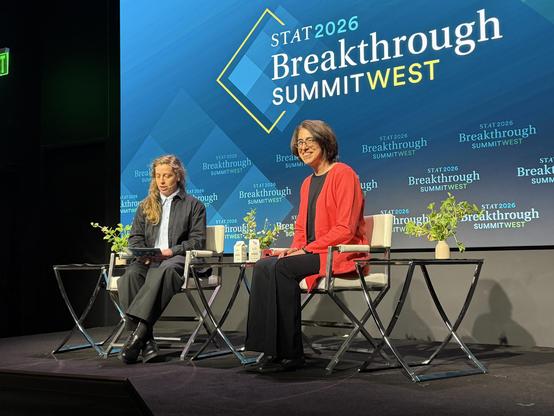
TM tells about how she got interested in fetal surgery and is now delivery mole therapy to a fetus developing in the womb. This could be anatomical problems or genetic issues, which we can now treat with gene therapy or stem cell transplants.
#STATBreakthrough
TM: We had to wait until those techniques were developed in adult. Some diseases develop during the fetal stage so treating them after birth has only limited effects.
MM: Do patients really want this? TM: Not all, some terminate pregnancy. You have 2 patients: mother and fetus.
#STATBreakthrough
TM: There are all kinds of ethical issues, such as unknown risks and complications. There has to be a big clinical improvement such as fixing a CNS disease. We have to walk a fine line between risks and benefits. We need more biomarkers to monitor fetal responses.
#STATBreakthrough
TM: we do a lot of basic research but need more awareness to discuss issues that gene therapy could address.
MM: where are we going to be 5 years down the road?
TM: hard to answer! we need to learn by doing, experience the bottlenecks and move through them.
#STATBreakthrough
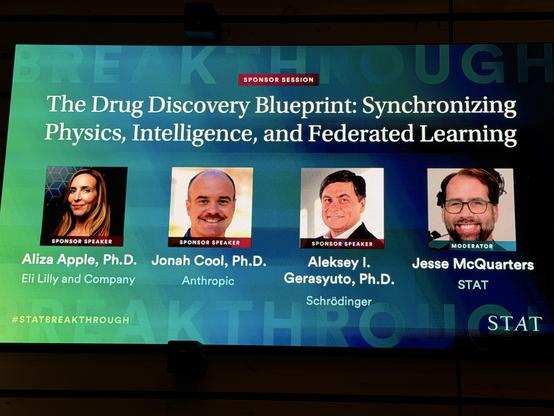
Next: The Drug Discovery Blueprint: Synchronizing Physics, Intelligence, and Federated Learning
* Aliza Apple, Eli Lilly
* Jonah Cool, Anthropic
* Aleksey Gerasyuto, Schrödinger
* Jesse McQuarters, moderator
Single scientists can now work with teams of AI tools.
#STATBreakthrough
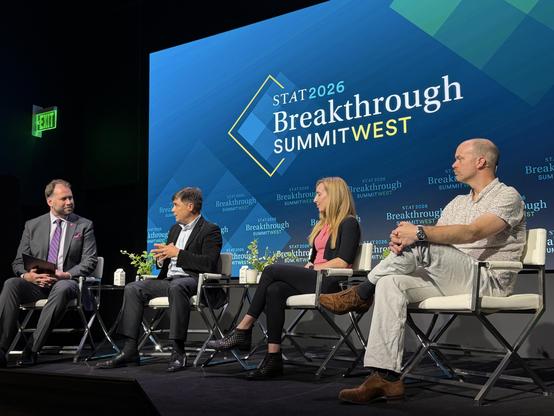
AA: we launched TuneLab, derived from Lilly’s research and make this available to biotech companies.
investor.lilly.com/news-release...
JC: a scientist should understand what the agent did. You should be able to reproduce it. The models should look it up, not make it up.
#STATBreakthrough
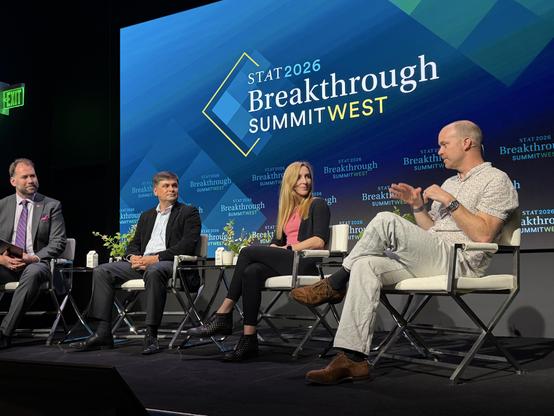
AG: patient safety is important. Drug molecules might already be optimized for efficacy and it would be time consuming to change the drug molecule at a late stage to incorporate patient safety.
AA: Not just providing predictions, but also confidence intervals.
#STATBreakthrough
AA: We can now get to clinical compounds in two years. It does not take the human scientist out of the equation.
JC: if we need to get one thing right with AI models, it is health and medicine.
#STATBreakthrough
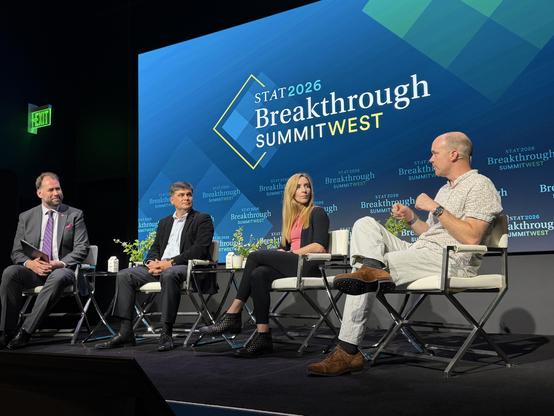
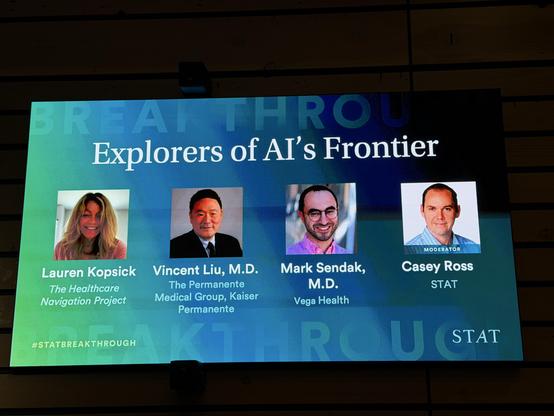
New panel: Explorers of AI’s frontier.
* Lauren Kopsick, Healthcare Navigation project
* Vincent Lou, Permanente Medical Group
* Mark Sendak, Vega Health
* Casey Ross at STAT, moderator
LK: there is still some friction. We don’t always know why AI takes certain decisions.
#STATBreakthrough
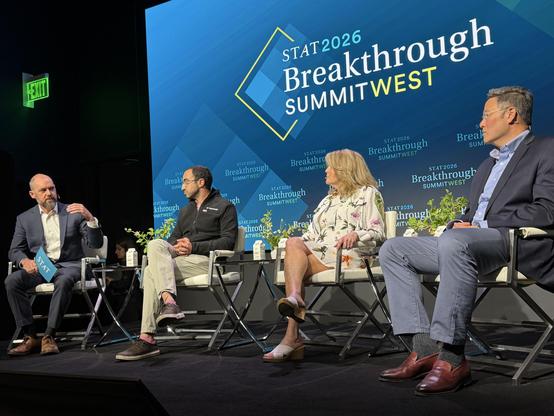
MS: a void of capacity to interpret technologies. It is moving incredibly fast.
CR: are patients involved enough?
VL: with the pace we are moving, patients need to be involved. AI might be a wedge that drives patient/doctors apart. That might not be archieve better health.
#STATBreakthrough
LK: Doctors are very frustrated with all of this. The process is breaking down with AI. I love AI, but staff, doctors, and patients need more education.
Q: how do you educate patients?
VL: Ambient is Kaiser’s AI scribe tool to record conversations; saves MDs lots of time.
#STATBreakthrough
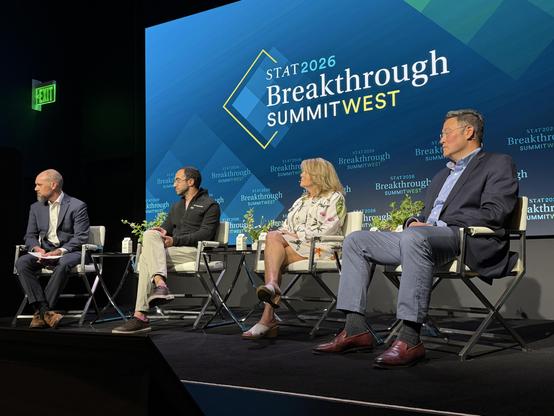
VL: Human/AI handoff. 1) AI is great but can get it wrong. 2) Protect our patients’ data. 3) Always allow feedback. We need to keep on training the AI.
MS: Organizations need to implement new technology but trust is needed too.
#STATBreakthrough
Next: Lison Joseph interviews Christine Lemke at Evidation.
CL: I have autoimmune disease most often diagnosed in white men of a certain age. It might take years to diagnose a disease if you don’t fit the standard presentation. If we could all monitor ourselves earlier diagnosis.
#STATBreakthrough
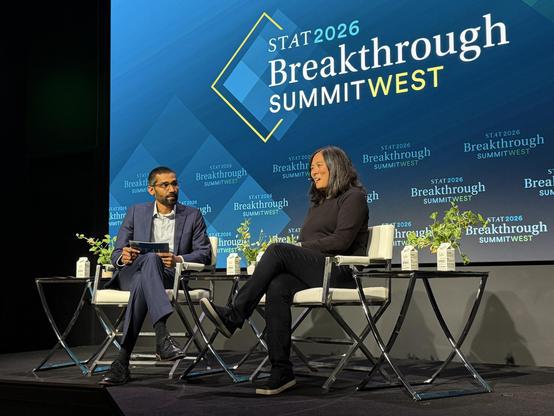
CL: Wearable devices can send signals before a flare up, create large amounts of data.
AI can eat into every layer of a company. Lots of people think that AI is going to take their jobs. As a CEO, keeping people motivated is one of my concerns.
#STATBreakthrough
Next: The wearables revolution, with:
Ricky Bloomfield of Oura
Alex Vannoni of WHOOP
Moderated by Katherine MacPhail of STAT, who asks the audience who is wearing a wearable - most of us!
#STATBreakthrough
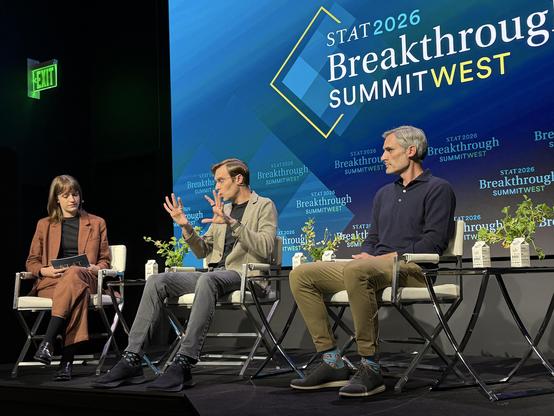
AV: if we add blood work to wearables, our members can pick up lots of additional biomarkers.
It is opt in, 4 times per year
KMP: isn’t that creating too much data and creating anxiety?
AV: it is to create a base line and act on it.
#STATBreakthrough
RB: lots of people do not trust the traditional health system. If they avoid regular screening, this might be a way to get people treated.
AV: we see this a complimentary to the current system. Human experts are not going away. It is a system that builds, rather than competes.
#STATBreakthrough
RB: If we want to improve people’s health, we need to measure data.
AV: we can reach new cohorts, new partnership with Medicare.
www.whoop.com/us/en/press-...
Great sock game going on!
#STATBreakthrough
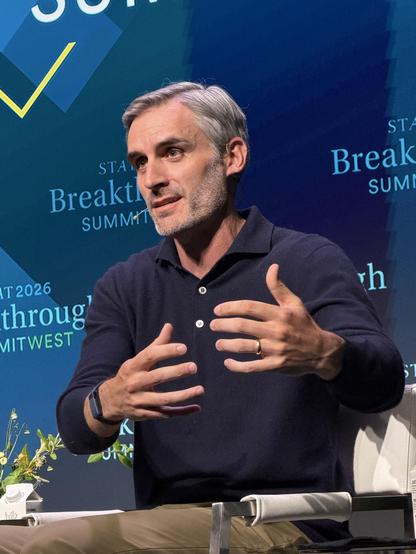
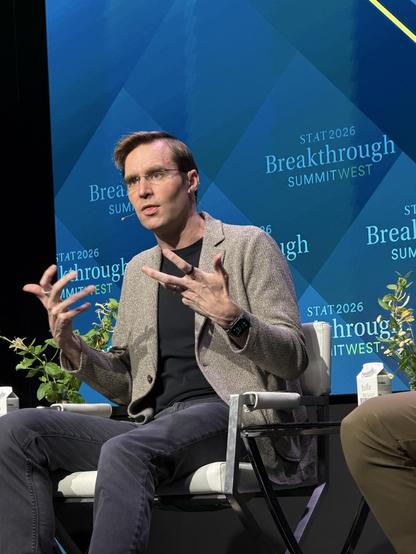
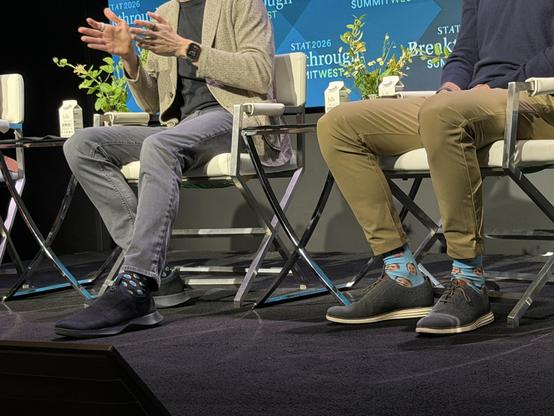
AV: the FDA and other regulators are more open now to use wearables as medical devices (eg, blood pressure, arythmia) and we are very open to regulation.
RB: new FDA guidance is a welcome update, Wearable can not diagnose but can monitor and connect to health provider.
#STATBreakthrough
Coffee break time!
#STATBreakthrough
Next: Anne Wojcicki @ 23andMe with ‘Anne Wojcicki won’t give up’, moderated by @[email protected]
MH: The company has been through a lot, FDA regulation, and recently bankruptcy. You also went through lots of family loss.
#STATBreakthrough
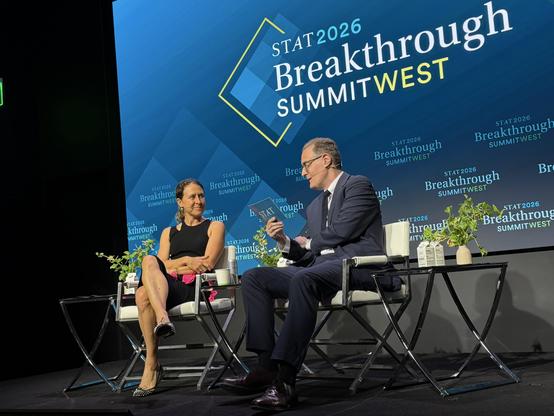
AW: we wanted to give people direct access to their DNA, so we started a direct-to-consumer company. How can we combine this with medical records? You can now upload your medical record.
The combination plus AI tools will help with diagnosis.
#STATBreakthrough
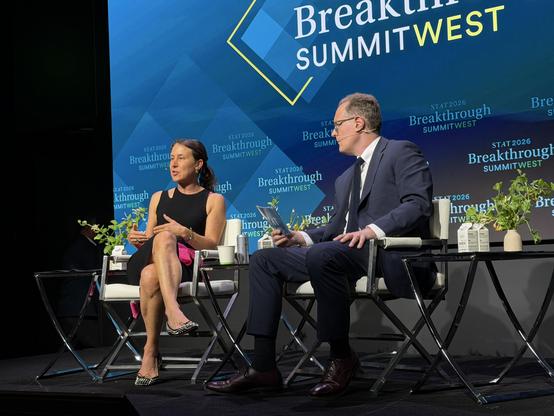
AW: self-reporting is not always reliable (think Alzheimer’s), so combining medical records with genetics will fill some gaps.
Can we predict diseases in the future?
The bankruptcy was not my choice,
I I felt awful. But employees were ok: they focused on the mission.
#STATBreakthrough
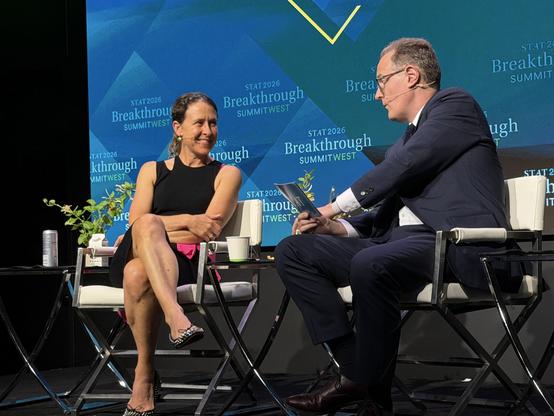
AW: so I decided to make a bid to buy the company with my foundation.
MH: a lot of people were very worried about privacy when the company went bankrupt and when there was a data breach.
AW: we communicated with millions of our customers - lots of people wanted to sue us.
#STATBreakthrough
I
AW: That was devastating for us. We tried so hard to earn customer trust. We ask people to opt in. We let people delete their account - and 2 million people did that. It was painful, but we honored that.
#STATBreakthrough
Audience question: there likely will be a new data breach. How do we safeguard data? Insurance companies might get their hands on it, and raise premiums.
AW: we now mandate two-factor authorization and log you out quicker. There is always a risk.
#STATBreakthrough
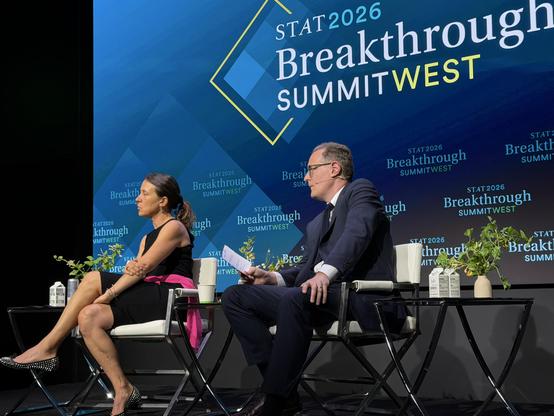
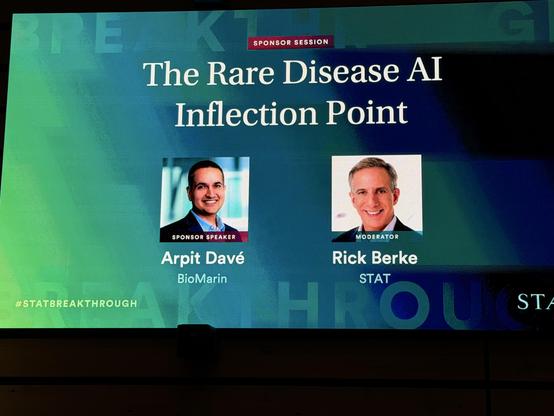
Next: The Rare Disease AI Inflection Point, with
Arpit Davé at BioMarin.
Moderated by Rick Berke.
AD: BioMarin focuses on rare diseases. Our North Star is to bring therapies to patients who need it the most. AI can help with this.
#STATBreakthrough
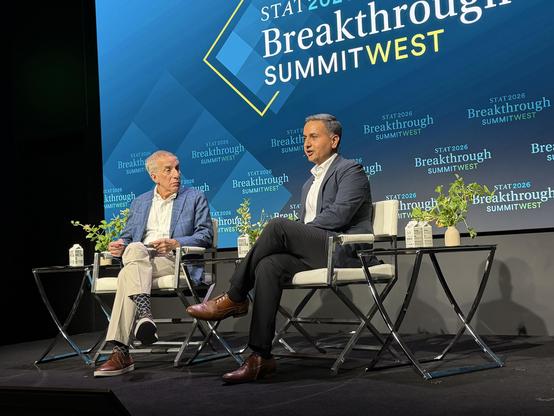
AD: many rare diseases do not have their own ICD (International Classification of Diseases) code or are binned together, making it hard to analyze data. LLMs are good at reading human language so can look in more detail.
#STATBreakthrough
AD: these tools only get better if we use it every day. But human in the loop is important! At BioMarin, we award crowns (King or Queen of AI) at the end of the day if your work contributed to patient health.
#STATBreakthrough
Next: The Rough Math of Rare Disease
Panel with
* Ted Love, BIO; Global Blood Therapeutics
* Holly Gernandez Lynch, Uni of Pennsylvania
* Yael Weiss, Mahzi Therapeutics
* Jason Mast, moderator
TL: some very recent FDA views go against loosening rules to allow more innovation.
#STATBreakthrough
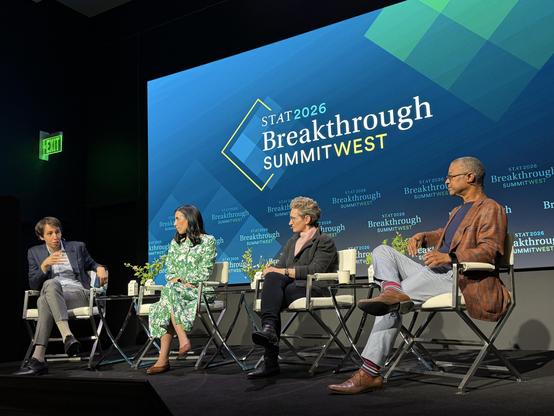
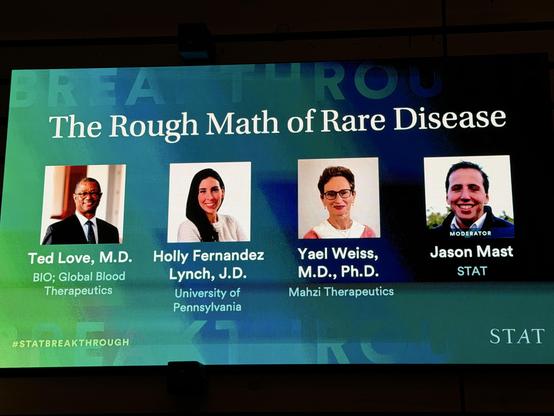
YW: it is a roller coaster. Representing a therapeutic company I worry about the recent and continuing changes at FDA. Lack of consistency.
HFL: We don’t want all drugs approved, but we also don’t want good drugs to not be approved over quibbles about study design.
#STATBreakthrough
Audience question: should research into drug development and gene therapy not be socialized? Companies might not want to focus on those.
YW: it is also an incentive: those people will be very motivated to pay!
TL: in many countries those patients take would not be treated.
#STATBreakthrough
TL: many biomedical innovations such as CRISPR come from the US.
HFL: the ethics of sham surgery trials: they might be needed if we do not know if the treatment works. The UniQure example was handled terribly.
www.statnews.com/2026/03/02/u...
#STATBreakthrough
UniQure plans to seek approval...
UniQure plans to seek approval...
A very long audience question that is more like a monologue.
People are starting to shout.
It is the end of the day and cocktails on the rooftop terrace might be in the near future.
#STATBreakthrough
Closing remaks by Dana Spencer from Genentech
Ai is like an adolescent child; you can give it some rules but it is going to test the boundaries.
What feels natural for us might be overwhelming for patients. We need to earn trust. Trust happens at the speed of understanding.
#STATBreakthrough
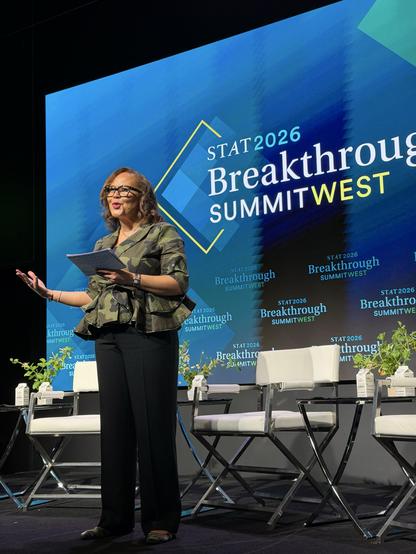
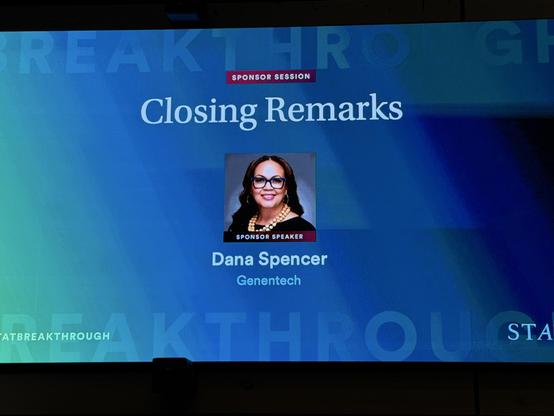
We need systems that connect. We have tools never had before, and can intervene earlier and at scale. Science keeps on moving but we need trustworthy tools that patients trust. Did they study this in people like me? Can I afford it? Will it be available to me?
#STATBreakthrough
Matthew Herper closing the event and inviting us for cocktails and mocktails at the rooftop terrace.
#STATBreakthrough