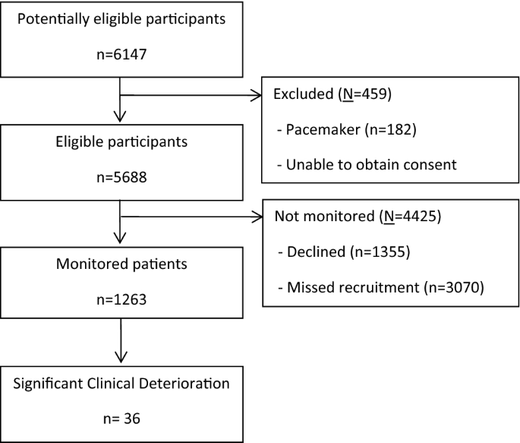
To assist in the early warning of deterioration in hospitalised children we studied the feasibility of collecting continuous wireless physiological data using Lifetouch (ECG-derived heart and respiratory rate) and WristOx2 (pulse-oximetry and derived pulse rate) sensors. We compared our bedside paediatric early warning (PEW) score and a machine learning automated approach: a Real-time Adaptive Predictive Indicator of Deterioration (RAPID) to identify children experiencing significant clinical deterioration. 982 patients contributed 7,073,486 min during 1,263 monitoring sessions. The proportion of intended monitoring time was 93% for Lifetouch and 55% for WristOx2. Valid clinical data was 63% of intended monitoring time for Lifetouch and 50% WristOx2. 29 patients experienced 36 clinically significant deteriorations. The RAPID Index detected significant deterioration more frequently (77% to 97%) and earlier than the PEW score ≥ 9/26. High sensitivity and negative predictive value for the RAPID Index was associated with low specificity and low positive predictive value. We conclude that it is feasible to collect clinically valid physiological data wirelessly for 50% of intended monitoring time. The RAPID Index identified more deterioration, before the PEW score, but has a low specificity. By using the RAPID Index with a PEW system some life-threatening events may be averted.

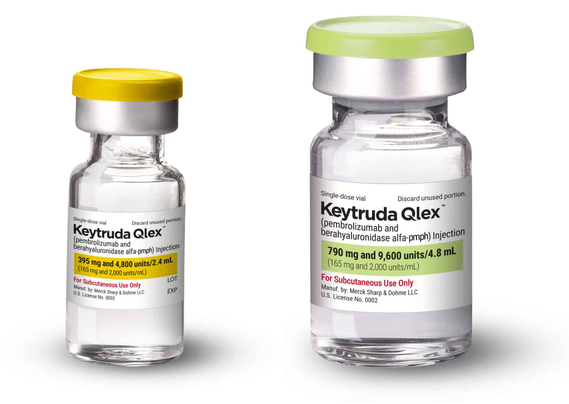
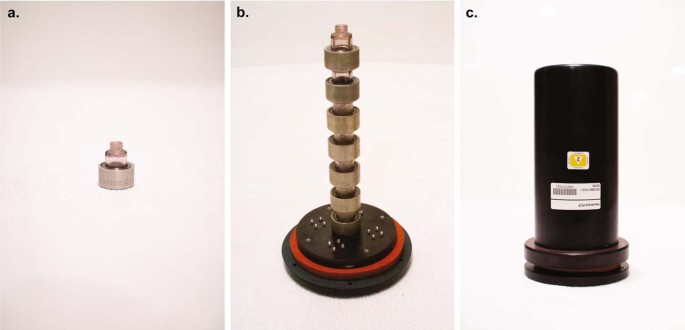
Crystallization processes have been widely used in the pharmaceutical industry for the manufacture, storage, and delivery of small-molecule and small protein therapeutics. However, the identification of crystallization processes for biologics, particularly monoclonal antibodies, has been prohibitive due to the size and the flexibility of their overall structure. There remains a challenge and an opportunity to utilize the benefits of crystallization of biologics. The research laboratories of Merck Sharp & Dome Corp. (MSD) in collaboration with the International Space Station (ISS) National Laboratory performed crystallization experiments with pembrolizumab (Keytruda®) on the SpaceX-Commercial Resupply Services-10 mission to the ISS. By leveraging microgravity effects such as reduced sedimentation and minimal convection currents, conditions producing crystalline suspensions of homogeneous monomodal particle size distribution (39 μm) in high yield were identified. In contrast, the control ground experiments produced crystalline suspensions with a heterogeneous bimodal distribution of 13 and 102 μm particles. In addition, the flight crystalline suspensions were less viscous and sedimented more uniformly than the comparable ground-based crystalline suspensions. These results have been applied to the production of crystalline suspensions on earth, using rotational mixers to reduce sedimentation and temperature gradients to induce and control crystallization. Using these techniques, we have been able to produce uniform crystalline suspensions (1–5 μm) with acceptable viscosity (<12 cP), rheological, and syringeability properties suitable for the preparation of an injectable formulation. The results of these studies may help widen the drug delivery options to improve the safety, adherence, and quality of life for patients and caregivers.