 calops
 zimward
 Ity Kitty
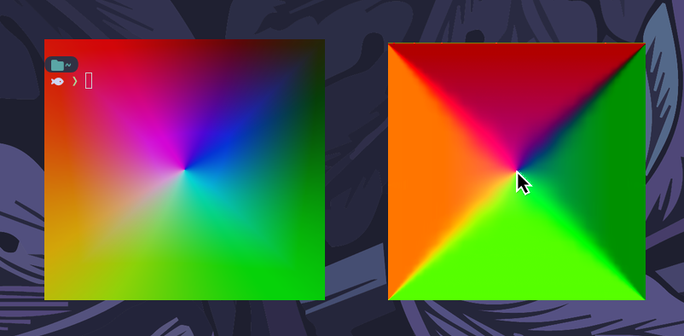
Very well, have at it. Let me illustrate.
On the left is a "perfect" vector field in a square, generated analytically. All vectors point directly towards the center of the square (or rather, the intersection of the closest Voronoi boundaries).
On the right is my own heuristic attempting to produce a similar vector field on an arbitrarily shaped region, from a pixel mask input. As you can see, the Voronoi boundaries are still visible despite my best attempts.
Are you computing a vector field from random points (aka voronoi) and thus have to compute the distance to several points and find the min?
I'm having trouble what you're optimizing here for
Ah but that's the thing, I don't have that point. All I have is a matrix of 1s and 0s defining "regions". The square here is a special case that I'm trying to have render properly, but the goal is to support any arbitrary shape (as shown in the video above).
The spec for the vector field is just "point towards the interior", with a loose definition of "interior". The left square does what you suggest: a very cheap "point towards that point" vector generation.
I guess an interesting approach would be to find a strategy to define some kind of centroids towards which vectors should point. If we can do that, we can generate the vector field with the easy and cheap analytical version once again.
No idea if that's a good direction to explore.
 Linnea
SDF is pretty much what I'm doing in the left square already. But it' requires analytical knowledge of the boundaries of your region. Here we don't even have the concept of a region, just a plain binary mask.
JFA is already what I use as the first step of my heuristic. It produces a smooth distance field, but that's just distances. To derive the vectors from that I need to follow the gradient of that field and that's how you get these Voronoi artifacts in the first place. Even after a bunch of blur passes, it's not smooth enough.
It would give some kind of texture to the glass but the overall shape of the effect wouldn't change. It's exacerbated by the fact that there's a dynamic light source casting highlights and shadows in there (yes I know).