Today's gentle side project, because I'm at home sick, is finally killing off my Twitter account. Not because I've remained active over there all this time - god no, I functionally bailed on that dumpster fire years ago - but because that task is so relatively unimportant it's been waiting for a low-energy, low-stakes day like today to happen.

There's a few threads to come over, a few dangling anchors around the internet to update. Some fun stuff will get posted in the coming few days.
One meta-thing to come over is the realisation I had that paying a regular subscription to use a service is actually the right thing to do. If your Mastodon server admin has a link somewhere to throw them a few bucks a month in return for being there, please do it.

"If the service is free, you're the product" works both ways - if you directly support the things you use, they are less likely to resort to extracting value from you as a means to survive.

Have you ever walked around your home town, early in the morning on new year's day? You might see one or two cars on the road, you might pass a sweaty jogger thumping by, but by and large it's an eerie ghost town sort of experience.

That's Twitter, today, looking through my post history for nuggets to bring across. Half the accounts I've interacted with or boosted are long gone. My last post was quoting someone else posting about Twitter's anti-trans stance; that account is now suspended.

Nothing on the internet is forever.

Oh sure, you might toot something funny that gets pasted all over Reddit and Threads and achieves some level of semi-permanence. But Reddit is well into the private equity value extraction phase, and I don't actually know anyone who even uses Threads.

Like Twitter, every website you use today was made by somebody, and like Twitter, every website will go functionally extinct some day. It's transient data on computers made by people, and those fail, in time.

Putting my stuff on more decentralised networks, owned by people like me, seems like the better bet. I doubt digipres.club will hit the PEVE phase any time soon, so it's pretty safe. But it's still run by (lovely) humans, and the fact I moved here after initially landing on Fosstodon says something about the transient nature of websites and people.

I still stand by my strategy for picking a Mastodon server - find one aligned with your interests that has a long-term financial plan.

So: I don't concern myself anymore with the task of preserving my work for future generations. I'm not playing old games and analysing old gamepads for people born next decade - I'm doing it for me, in the here and now, because making stuff about stuff I like makes me happy. If Gravis or their digital protocols or whatever become particularly interesting in future, I hope my work survives to inform that research; but it's not up to me to decide what stuff makes it into the future or not.

There's other lessons to be learned, basic traps to avoid in order to prevent huge swathes of your stuff becoming suddenly and unexpectedly unavailable or offline.

Don't fall into the engagement trap of posting in one place, but linking to another you hope people visit more. One of my tasks today is to more verbosely explain something I uploaded to the Internet Archive, *on* its page on IA, rather than linking to a Twitter post I thought would stand the test of time.

Lesson two there is to avoid using unusual TLDs. It was funny for a while to create websites ending in .af, but it became a lot less funny when a foreign government turns around and shitcans your entire website because it doesn't suit their politics. That's a shitty and pretty unnecessary cause for your cool drawings or discourse or stuff you've made to disappear from the internet.

I once registered a very cleverly named website, using the TLD of a country I'd had nothing to do with, for one of those cool project ideas that never really went anywhere. I paid for it for a couple of years, then realised I wasn't ever getting around to it, and shut it all down. Or so I thought.

A while ago, I got a nasty email from that registrar demanding years of back pay. They gave up after I politely told them to pound sand, but I wouldn't be brave enough to ever visit there, now.

Lesson three: Avoid link shorteners. You're just building another point of failure into whatever you're doing - any URL that gets physically printed is now entirely dependent on that service remaining online, forever, in addition to whatever other service it *actually* links to.

We don't need link shorteners anymore. Entering a URL is no longer a chore on any modern device. You can literally tell your phone what website to go to now. It's extra risk for the sake of vanity and it's silly to do.

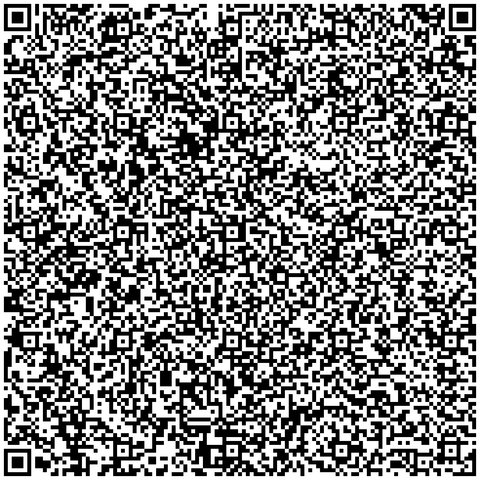
QR codes are a fun topic. They're just a machine-readable image with robust error correction that contains text, and can be flavoured stylistically for fun or branding.

The image on this post is a QR code containing all the text of a previous post in this thread. I guarantee that the phone you're reading this on is capable of reading this enormous graphic. They don't have to be tiny anymore, big ones are perfectly readable. Don't make QR codes with link shorteners, just put the full URL in it.

To create that QR code, by the way, I used free software. Specifically, this free software, made by @julian - https://fietkau.software/qr

You should bookmark it for later. You might want it, some day in the distant future. I did, today.

QRSVG

QRSVG is a small JavaScript project to render a two-dimensional bitmask (mostly assumed to be a QR code) to an SVG element as a collection of SVG paths with defined purposes.

Julian Fietkau

The last lesson on my mind is that while you are alive, while you exist as a functional entity, The Website is not the source of truth - you are. Maybe the URL is what gets cited in a publication, if you're lucky enough to make something useful to science, but it's still just your words, your stuff, what you made - and while you exist, The Website is not the last word on the topic.

If The Website goes down, it's not the end of the world - you choose another and put your stuff there instead.

There is nothing sacred about The Website. When you pay your Mastodon server a few bucks a month, you're not buying a lifestyle, or a parasocial relationship with other people you can @ there - you're buying a place in space-time where you put your words, and hope someone finds them useful or funny or insightful or inspiring. But eventually the space or the time runs out.

If Man is made in the image of God, He must be pretty damn temporary; and so it must be with data that We create.

And I think I'll end it there, clearly I need some lunch and maybe a lie-down.

Did you find this thread useful, funny, insightful, or inspiring? Boost some or all of it as you will. That's what keeps the ideas alive.

If you take one thing away from this thread, let it be this:

Tip your Mastodon server admin.

So going through my old Twitter accounts: I had one that is what this account used to be, one personal that I'd had since the beginning, and a handful of alt accounts.

My original personal account is gone without a trace, some time after 2022 (possibly I deactivated it myself but they don't appear to email you when you do that?). My alts were easy enough to find again and nuke. I have a short trail of threads to fully adapt to here, after which I'll nuke my last Twitter account.

I may have left it too late to fully separate from Twitter, my personal account is still visible but support insists there's no such account by that name anymore and I'm welcome to create a new one.

That email also says "Reply above this line", which is sortakinda standard for dated, inflexible CRM software, but also states "Please don't respond to this email, as replies are not monitored". That is no longer a fully functioning system of support. It's abandoned.

@timixretroplays insights like these are always helpful for aligning one’s internal views. So thanks for that :)
@timixretroplays all this thread is super important. Blogs or our own sites are the only thing that kinda might stick around, but even then, after we go, if no one maintains it, TLDs get resold, networks change or yank down stuff, etc etc.

@timixretroplays @julian

Ok but what weird legal situation resulted in this phrasing? "a two-dimensional bitmask (mostly assumed to be a QR code)"

@mattdm @timixretroplays @julian I assume the underlying SVG renderer supports arbitrary, non-QR-code bitmasks.
@mattdm @timixretroplays @julian The same page uses the term "QR code" without any qualifications in dozens of pages so I assume this is some technical pedantry rather than legal stuff.

@mattdm @timixretroplays Love this 🤣 Yes, as @ratsnakegames also guessed, it's just engineering pedantry.

I use someone else's library to generate the actual QR code. What my code does (in contrast to other QR code renderers) is trace the outlines of contiguous shapes in the SVG instead of simply outputting a grid of squares. It avoids a type of rendering glitch at pixel boundaries that you'd otherwise often see as you zoom in. The same principle would work with data matrix codes (etc) too.

@timixretroplays @julian stances of iOS aside from either of us - using Shortcuts you can actually create a shortcut that can create a dense QR code from any arbitrary text, removing the need for a website to do so. I imagine android would potentially have similar, but it also wouldn’t surprise me if it’s a third party app. Probably something you’re already aware of as well but it’s something I try to make awareness for that phones might already natively do it. As for desktop I assume people can share with an easier medium not constrained by the locked down nature of phones.

I use this whenever I’m at conferences(speaker or volunteer) to quickly make something I have quickly sharable without having to direct people elsewhere, while keeping my data within the device that generates the QR code

@timixretroplays Thank you for the shout out, I'm glad it's working well for you! 🙂
@julian you put useful stuff up on the internet for free, you're a good egg 😃
@timixretroplays
One lesson I wish people would learn more related to this:
QR codes are meant for machines to read, not humans. Putting *just* a QR code on something when you're intending it to be seen by humans is effectively anti-human, even URLs. I can remember a URL to visit later, I can't a QR code.
Treat them as a convenience feature, not a replacement.

To further poke and prod at Twitter, I'll point out it uses its own link shortener at t dot co. Visiting that page, you're greeted with the following message:

"X uses the t.co domain as part of a service to protect users from harmful activity, to provide value for the developer ecosystem, and as a quality signal for surfacing relevant, interesting posts."

The "Learn more" button leads to this article, where they're a little more verbose about it: https://help.x.com/en/using-x/url-shortener

X link shortener (t.co) and how it works | X Help

X automatically shortens links within posts or Direct Messages. Find FAQ surrounding t.co links.

The quality signal part - fair enough, it's crucial data for their core business, I get it. Reducing the character count for URLs is kind of a nothingburger - Mastodon solved this completely by counting any URL as a maximum of 23 characters, and (to my knowledge) most servers have much higher character limits on individual posts, so we're really not punished by websites with poorly constructed URLs. (Twitter's solution, I understand, is to charge a premium for features that are free elsewhere.)
The safety thing, though - they say they check every link against a list of malicious ones, and warn you if you click on a link they think is a bad egg. For that to work, though, the list must be constantly updated, and implicitly trusted; there's nothing stopping them making their own judgements on what websites are good or bad to show to their users, and by hiding URLs with a link shortener you also obfuscate the full fact of them from users, which IMHO makes it easier to go phishing.

This is the same thing Microsoft do with Safelinks - URLs in Teams chats are instead redirected to a "safelinks" system on office dot net and checked for malicious activity on demand.

The difference is that while the dot net TLD, like dot com, is administered by Verisign - an American company - the dot co TLD is managed by .CO Internet S.A.S. of Bogotá, Colombia. They themselves are US-owned, but to my understanding, Colombia could theoretically decide to rug-sweep and re-nationalise it.

That would have further-reaching implications than being a stake through Twitter's historical heart - Amazon, Google and a handful of other Large American Entities rely on Colombian domain names in one way or another. And in a more sensible parallel universe, the idea of Twitter becoming a political football wouldn't have been any sort of possibility. But it was super cool and trendy at the time, so a massive part of Twitter's infrastructure depends on another country playing nice in perpetuity.
@timixretroplays having built a roughly equivalent thing at another company before:

it's probably just the google safe browsing list. it's the bare minimum thing you can do to make the legal people happy

i did add some other domains from a particularly persistent phishing operation to the one i built though, which seemed to annoy them enough to go away once they realized they'd bought like $100 worth of domains so far and i could easily continue doing the same thing
Mike [SEC=OFFICIAL] (@[email protected])

Attached: 1 image Screenshotting this because oh my god it's so bad it's poetry.

Chinwag Social

@timixretroplays
Sub-lesson for Corporations:
If you publish a book with with text like "check out more of our stuff at blankity-black[dot]com" in the book and on the cover...
Do your damned best to control that domain, or get control of it (legally and ethically)

I was reading a graphic novel that was dropped in out free library to see if it was a good fit for the small humans. It was, I wanted to see about the the sequel so I checked the URL in the book:... Now it's an adult site/likely scam site offering "encounters in your area".
The book is an "imprint"of a major publisher.

@timixretroplays I wish we could just abandon the entire concept of TLDs. They ceased to mean anything decades ago, and are a remnant of a far more structured time.
@timixretroplays this is one of the first things I did with my server admin.