 Justified Ancient of Moomin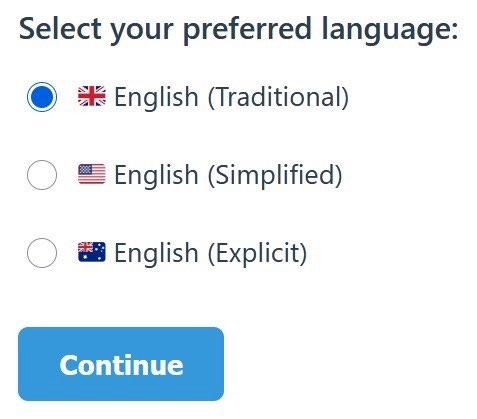
 Mikee
Mikee 四
四@ThermiteBeGiants @piepants The Trad/Simp joke will never grow old. I genuinely still find it funny :)
 David Nash
@yon @ThermiteBeGiants @piepants
Contemporary UK English *is* the simplified version. The “traditional” version, going back about 1000 years, is more precisely called “Ænglisc”. https://en.wikipedia.org/wiki/Old_English
 Otte Homan - remember Geordie
 Ken Scambler
@ThermiteBeGiants I am reliably informed by new Australians that English (Explicit) is a cunt of a dialect
 Anyia, refuelled 🏳️⚧️ girl
 Joscelyn Transpiring
@ThermiteBeGiants wait…so what’s Kiwi English?
 Birdhouse in Your [Redacted]
@JoscelynTransient @ThermiteBeGiants 🇳🇿English (wholesome)
@coolandnormal @ThermiteBeGiants sounds bout right to me, Kiwis always made me feel so welcome and kind
@JoscelynTransient @ThermiteBeGiants literally the only times I've been in New Zealand and people haven't been super lovely was when they were calling me out on my shit (and they were 100% right).
 Errol Cavit
@ThermiteBeGiants Watching Aussie dashcam videos is highly entertaining, did to the colourful responses from the cammers.
 unattributed 𓂃✍︎
@ThermiteBeGiants I would have said:
🇺🇸 English (Obfuscated)
 Richard Penner
@unattributed @ThermiteBeGiants
There are vast regions of the US where the names Don and Dawn are phonetically indistinguishable. Also: Marry / Merry / Mary; Pour / Poor / Paw; Cot / Caught ; and Stalk / Stock.
Non-alcoholic fizzy drinks may be called soda, pop, tonic, soda pop, or coke, which any cryptologist will tell you is an attempt to prevent decoding by introducing the noise of variants.

 D. G. Marshall
No fucking lies detected.
 Skeptiker
@ThermiteBeGiants Second Option should read English with lots of fucks
 Melroy van den Berg
@ThermiteBeGiants English (traditional America)
English (Noord America)
English (East America)
English (Australia)
English (Noord America)
English (East America)
English (Australia)
 WILLIAM B PECKHAM
@melroy @ThermiteBeGiants True English is only spoken in England, and I find it odd and interesting that it's not one of the choices.
 Tattered
@wpeckham @melroy @ThermiteBeGiants Given that “Gannen” is the original version of the verb “to go”, I am glad to learn that you accept Geordie as the true standard bearer of the English language.
Or perhaps this is not what you meant?
In my experience, English is only enhanced by its encounters with and adoption by other cultures. That the language of Shakespeare was preserved longer in New England than in old, and the language of Dickens is closer to Australian than to modern British variants is well-known. Some of the more elegant English speakers I have known have been Kenyan, Sri Lankan, and Jamaican. Its wealth is in its diversity, a common enough lesson.
 AlsoPaisleyCat 🇨🇦
@ThermiteBeGiants
🇨🇦 English (Politely and Quirkily Profane) & French (Bloody-minded)
🇨🇦 English (Politely and Quirkily Profane) & French (Bloody-minded)
 eena meena me
@ThermiteBeGiants i also speak 🇮🇪 English (explicit)!
@ThermiteBeGiants English, mangled.
 M Schommer
@ThermiteBeGiants
Thanks for the grin :)
Thanks for the grin :)
 Ni
Ni🔘 🇫🇷 English (For Sure)

 Luissen
@ThermiteBeGiants english (apologetic)
 Ring <3 Rootkitty
@ThermiteBeGiants the word "cunt" is one of utility here.
 👀
👀traditional: four yorkshiremen
simplified: why use many word when few do trick
explicit: a scot talking about trump
@ThermiteBeGiants (i fondly remember the word shitgibbon)
 untitled.enby :neocat_trans::neocat_flag_nb:
@ThermiteBeGiants 🇳🇱 English (WTF)
 Demokritus Jorik
@ThermiteBeGiants that's it! I'm going to call US English as Simplified English from now on.
 Eli the Bearded
 LisPi
LisPi