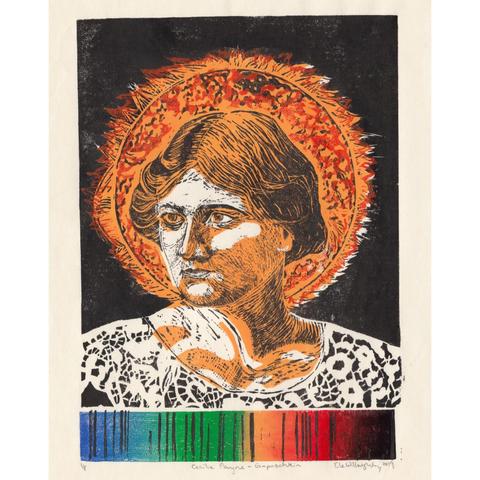
Happy birthday to astrophysicist Cecilia Payne-Gaposchkin (1900-1979), a trailblazer for women in #astronomy who discovered that hydrogen and helium are the most common elements in the universe.⁠

Born England, she won a scholarship to Newnham College at Cambridge in 1919 where she heard a lecture which changed her life. She wrote, “My world had been so shaken that I experienced something very like 🧵

https://minouette.etsy.com/listing/708302399

#linocut #physics #sciart printmaking #womenInSTEM #mastoArt
a nervous breakdown.” She had gone to hear Sir Arthur Eddington’s account of his 1919 expedition to the island of Principe to photograph stars with apparent positions near the sun during the solar eclipse. He had produced the first experimental evidence supporting Einstein’s General Theory of Relativity, which predicted that large masses like the sun would bend spacetime itself & that gravity would bend light changing apparent position of stars. 🧵2/
Payne’s imagination was captured by astronomy. Cambridge did not grant women degrees & her only option in the UK would be to become a teacher. She met Arthur Shapley, Director of the Harvard College Observatory & went to grad school in the US. With Shapley’s encouragement she became the first PhD in astronomy at Radcliffe College (now part of Harvard).⁠

Her 1925 thesis was “Stellar Atmospheres; a Contribution to the Observational Study of High 🧵3/
Temperature in the Reversing Layers of Stars.” Payne showed that variations in absorption lines were related to ionization state & temperature, rather than the various amounts of elements. She found the abundances of Si & C were just like on Earth, but H & He were vastly more abundant. H was a million times more abundant, the most abundant element in the universe! When defending her thesis, astronomer 🧵4/5
Henry Norris Russell, convinced her that this result was spurious. But she was right & they were wrong. Within a few years astronomer Otto Struve described her work as “the most brilliant PhD thesis ever written in astronomy” & Russell himself found independent evidence of her result. Russell published his result & though he acknowledged Payne he was often wrongly credited with this discovery.⁠ 🧵5/5
@minouette Fantastic! The composition is so good on so many levels.