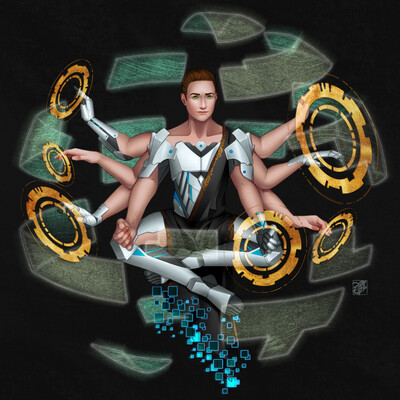
The word ‘queen’ is distantly related to the first part of ‘gynaecology’ and the second part of ‘misogyny’.

It’s also related to Norwegian ‘kone’ (wife) and ‘kvinne’ (woman), but they’re not full cognates.

While ‘queen’ comes from Proto-Germanic *kwēniz (wife), ‘kone’ and ‘kvinne’ stem from *kwenōn (woman). In English, this became the disparaging – and now archaic – word ‘quean’ (slʋt).

@yvanspijk altijd leuk om je toots te lezen en wat te leren, dank!
@ZuilenV Wat leuk om te horen! Dank je wel!
@yvanspijk wait, "queen" and "quean" were homophones? That seems like a dangerous ambiguity, but maybe some vowel shifts made it distinguishable?
@aburka Yes, they were indeed. The vowel shift that merged 'meet' and 'meat' turned them into homophones in most dialects.
@yvanspijk I think quean is a variation of spelling of quine, which in the Doric Scots of NE Scotland means young woman or girl. Quine is by no means disparaging, rather a simple description.
@geomannie Yes, that Scots word is also mentioned in the infographic. It branched off from English 'quean' in Middle English.

@yvanspijk in Doric Scots we say quine which means girl. So it's interesting to see the roots

https://dsl.ac.uk/entry/dost/quine_n_1

Dictionaries of the Scots Language:: DOST :: quine n 1

@onepict Yes, it's a sister word of 'quean' (included in the graphic). 😊
@yvanspijk I'd always wondered where it comes from. 😊
@yvanspijk Is “gynaecologia” Neo-Latin or Greek? The components are all Greek but it was possibly used in Latin, so the answer may be “both” 😅
@JensJot It was invented as a Latin word, but indeed, the components stem from Greek.
@yvanspijk I have a rather technical question: do you encode your diagrams as semantic knowledge graphs? Or do you make them directly as raw graphics?
@nojhan I'm afraid I don't understand your question. I export them as a png file in Microsoft PowerPoint.
@yvanspijk @nojhan @yvanspijk Well, that answers the (interesting) question, in a way :-)
I guess the point was to ask whether those diagrams were designed in a machine-readable format that would allow the underlying information to be used at a larger scale. The structure I see in there would perfectly match the data structure formats we (computer science researchers) call "SKG", or "ontologies". Such sets of "graphs" would ease asking questions like "what’s the common ancestor between those two words", for instance, a computer program being able to find the answer almost instantly. Of course, someone would have had to take care to create the machine-readable data first, which is the hard part.