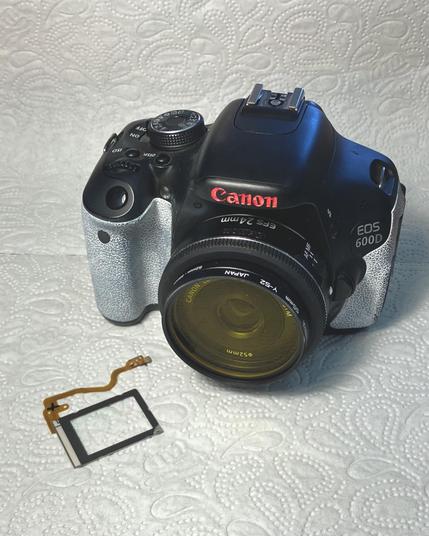
hahaa! Successfully removed all IR and UV filters from my old Canon EOS 600D, I can do full spectrum, UV and IR photography now!

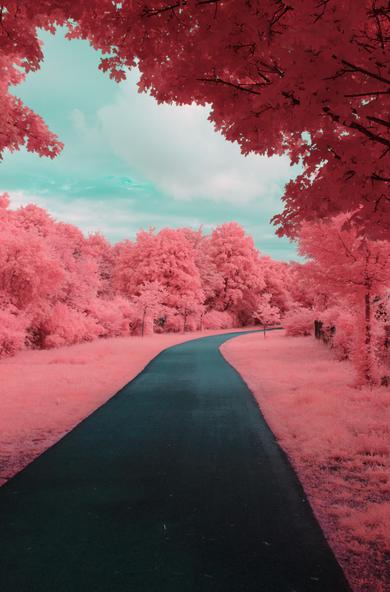
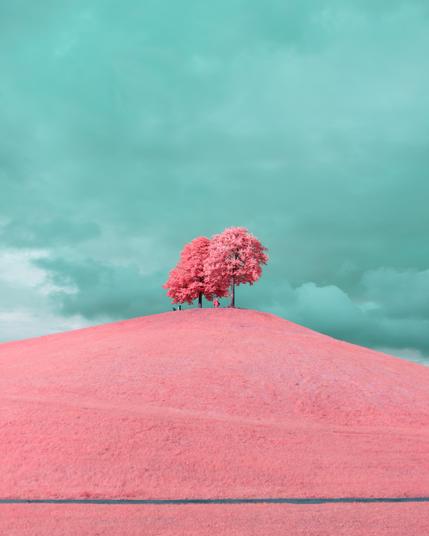
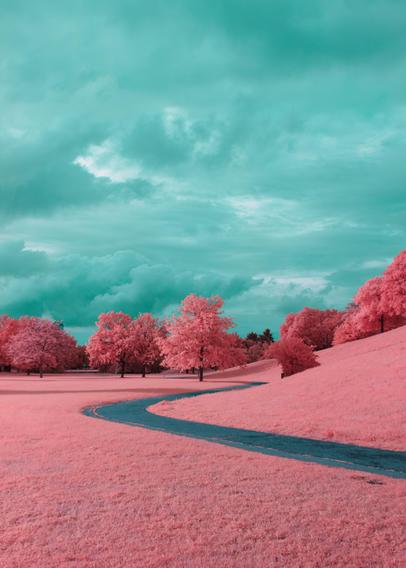
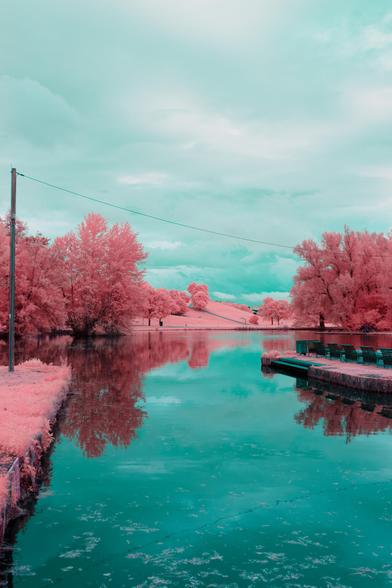
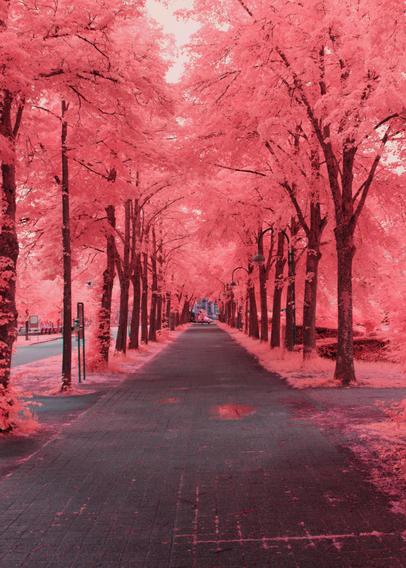
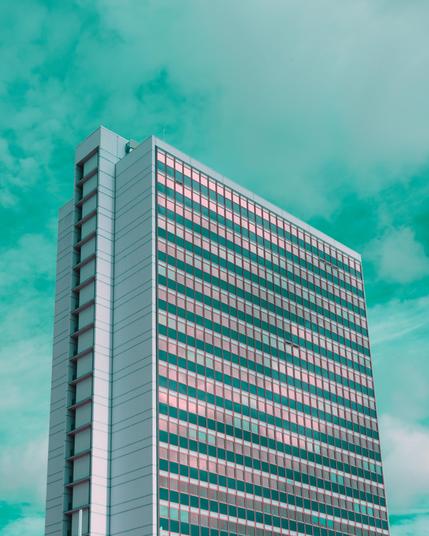
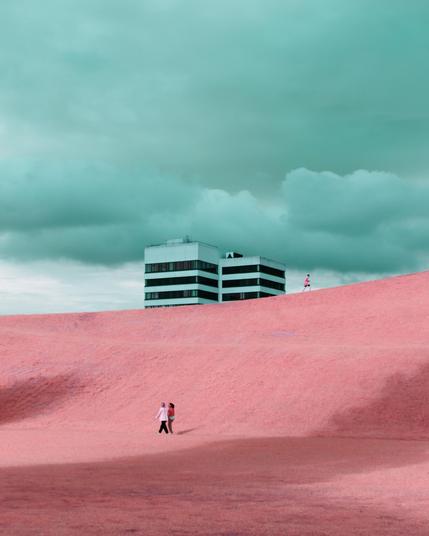
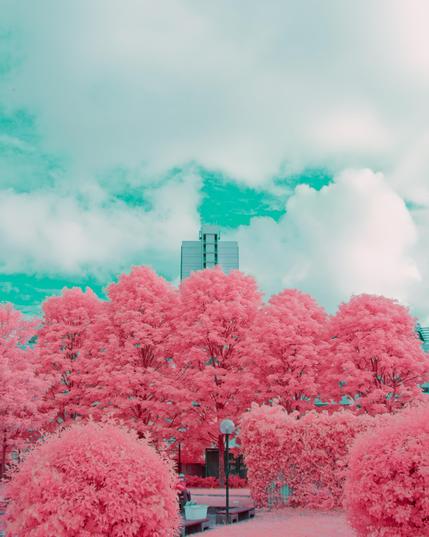
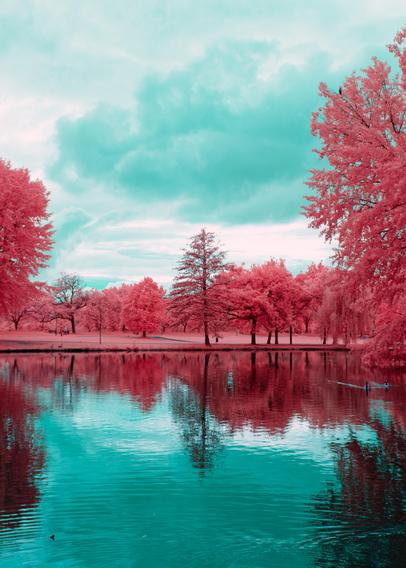
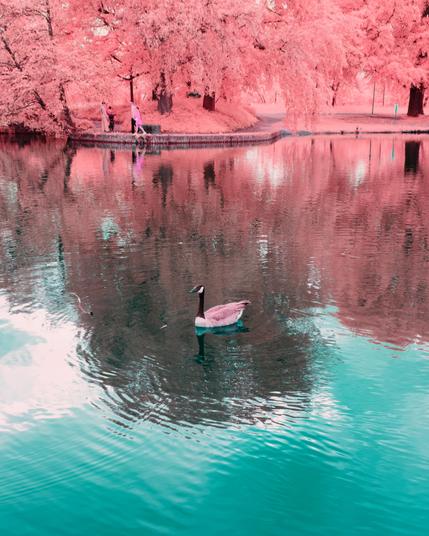
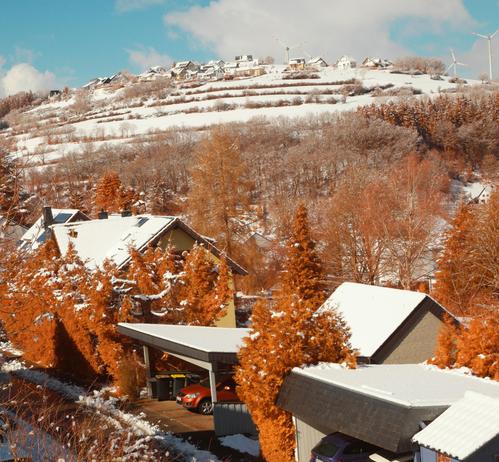
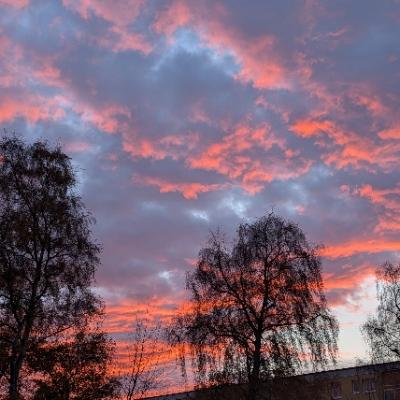
All of the following photos have been taken with a ~550nm+ lpf, meaning cutting everything under 550nm (blue, purple and uv) off. I love the vibrant pink foliage and dramatic turquoise skies #photography

this is so cool!! Taking photos with atypical spectra is a lot of fun, even with the rather old and bulky camera. The imaging technique used here emulates old Kodak Aerochrome film stock. It’s not available anymore, but used to be a colour IR film, which mapped the IR on the blue channel, while remapping red and green to get this pink-foliage look. I do the same here! Blue is solely IR and swapped with the red channel in post. #photography
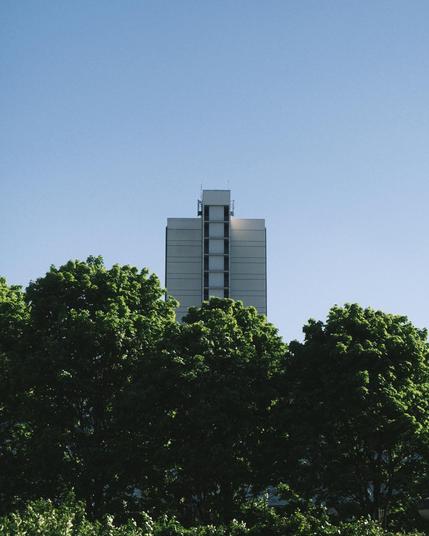
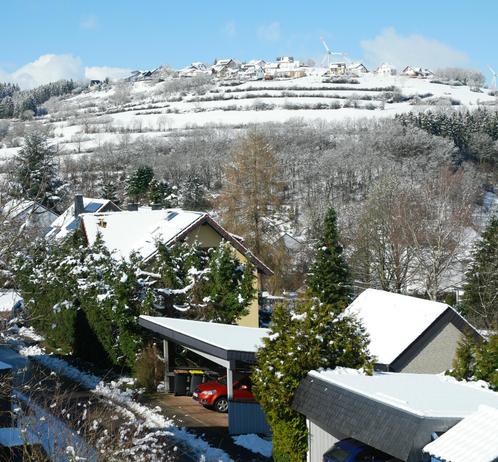
I also retook a few recent photos in this lovely Aerochrome-style IR! They actually look fantastic, not even sure which versions I like more now.. :D #photography

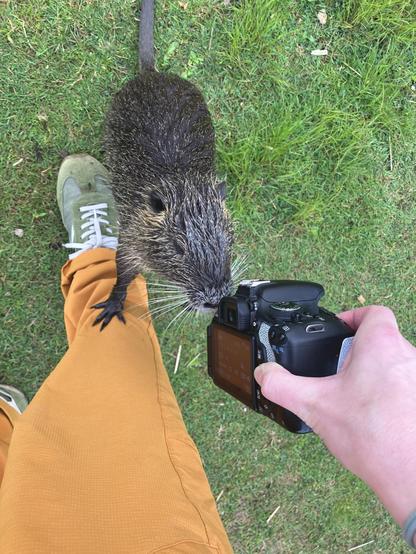
The camera also is already nutria approved!! Got sniffed and was found to be okay (I think..)

Also, man, water!! The turquoise is just fantastic! #photography

There are some hardships though, since the camera now sees a lot more light (the full IR spectrum), but the light-meter cannot process that properly, auto-exposing is off by about 2 steps. Even worse, with the missing filters and the phase-detect diodes not being in that path anyways, the auto-focus is now off by a tiny bit. You can get used to it, but at first, I was just way off with my focus and exposure.

The resulting images are also very much discoloured, this is because the red and blue channels have to be swapped, which given that I shoot raw becomes annoying. I don't think there is a command line tool to switch two channels in a canon raw-file (.cr2), imagemagick will just invoke darktable.

Using darktable for development would be great, but I sadly have a bunch of bugs with it and my tool of choice is anyways DxO PhotoLab... which cannot swap colour channels -.-

So my workflow right now is to demosaic all photos in DxO, export them as 16bit tif files, then run a batch imagemagick command to swap the red and blue channel on all photos, just to re-import them in DxO for final development. This actually not tedious, just time intensive...

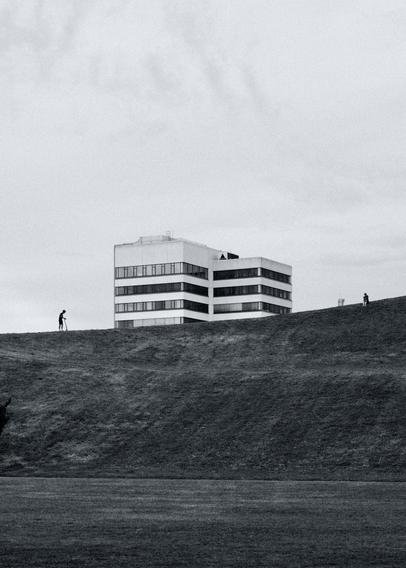
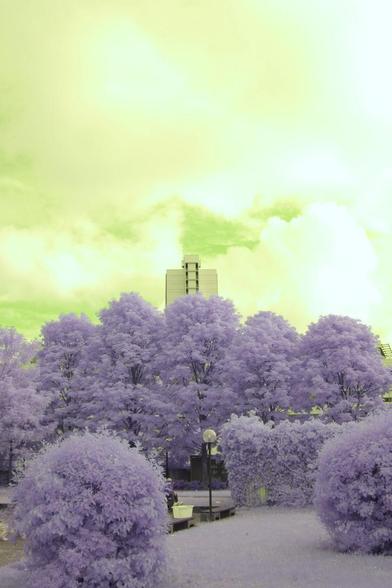
Anymeow, this is how a raw image without development actually looks like. The white-purple foliage is actually neat, maybe I will do something with it as well some time, but for now I enjoy the pink-turquoise style more
@janamarie Was about to ask… that‘s also one of the things one has to learn with aerochrome based analog photography… the focus point of the lens is in a different plane if the spectrum is shifted that much. Was not sure if electronic autofocus wouldn’t be able to compensate here.
@nblr oh, yea!! Forgot to mention that in my toot there. Also the specturm is much much wider now, I am pretty sure that you cannot have the full spectrum in focus now
@janamarie Dumb/Obvious question… How does the coloration work, btw? I mean, can't be luma… what's the optics/physics behind that? Where does the chroma information come from?
@nblr there's a low-pass filter on my lens, filtering out everything below 550nm (as in anything with more energy than 550nm). This means that no actual blue hits the sensor, IR is what is turned into the 'blue' colour. So chroma information contains IR (blue channel), G+IR and R+IR. from that you can get G and R back and do some channel swap to get the more common BGR, or rather IRGR colour sequence, which turns leaves pink and skies turquoise
@nblr I also want to get other lpfs, with 630nm, 720nm and 850nm, for different false-colour experiments. Getting a hpf to do some UV experiments would also be great, but such filters are much more uncommon and more expensive to get (already the IR filters are about 60€+ each in good quality)

@janamarie @nblr Welcome to the club! #Infrared is such a fascinating rabbit-hole! Kolari even created a dedicated "IR Chrome" filter that mimics the Aerochrome effect without requiring post-processing. Just set a custom WB when shooting and you get #Aerochrome JPEG out-of-camera!

Left: unmodified camera, OOC JPEG

Right: full-spectrum camera, IRchrome filter, OOC JPEG

@janamarie Oh! ok! The filter-part I got, but of course… But in my mind this turned the camera into a "luma only" device, which would be silly. Didn't expect the IR to expose on the blue filter though. Interesting! Thanks.
@nblr @janamarie my Nikon FE lenses had an extra dot (enamelled on the ring) which apparently was used to estimate focus on IR film. I never used it.

@drj @nblr ooh, right, I remember that!! I'm a bit sad that IR photography kind of went away, sure you _can_ buy IR cameras (like the X-T4) if you work in forensics, but why is there nothing like an Xpro3 camera where you can select to mechanically remove the IR filter and have a proper, artistic IR/full spectrum camera...

This used to be more of a thing with film, especially in B&W

@janamarie @drj @nblr
Regular film is poor for IR and originally poor for reds, hence eventually "Panchromatic" mono film.
Maxwell's original colour demo of tartan with red worked by accident as his red filter didn't block UV which was somewhat reflected by the red areas!
Mono paper remained insensitive hence a darkroom could use a red lamp, but Panchromatic film had to be developed in the dark (usually a tank with a spiral holder).
@nblr @janamarie The phase detection sensor will be inaccurate for IR, but the 600D can do live view with contrast-based autofocus using the main sensor. Mini view camera!

@nblr @janamarie I just remembered my 1Ds lets you adjust the phase detection autofocus with offsets. It’s mostly used for adjusting for slightly wonky lenses (like devignetting or warp mapping), but I bet it could let the phase detection sensor work well enough with visible light to focus for IR or UV.

Not sure if the 600D supports that kind of adjustment stock, but Magic Lantern might.

@bob_zim @nblr yip! Already checked, it does not and with that magic lantern also doesn’t. But it’s fine for me, I usually nail the focus
@janamarie Cool. I’m garbage at focusing by hand without some kind of rangefinder like a split prism. Even with one, the 1-series phase detection sensor is better than I can manage, especially with fast lenses.
@bob_zim ooh I love focussing on rangefinder cameras, one of my most used is a digital rangefinder (with a digital prism). They are the best cameras for me!

@janamarie I enjoy non-SLR rangefinders, but I also have a Nikon F (from before they had numbers) with a split prism center. I can focus decently enough with that, though nowhere near as well as with a Leica.

My freakish ability is accurately eyeballing exposure, including with manual, off-camera flash. Never tried with IR, though.

@bob_zim oh, haha, I am terrible at that! Team fixed-apeture-auto-shutter-speed here :'D

@janamarie

FWIW, here are some near-IR shots I've taken with a camera that has all UV/IR filters removed...and the Bayer color array...so it's a monochrome camera...a poor person's version of a Leica.

https://universeodon.com/@KrajciTom/115260438189271132

https://universeodon.com/@KrajciTom/115160280583258193

https://universeodon.com/@KrajciTom/114632825309966782

https://universeodon.com/@KrajciTom/115318736377132956

@KrajciTom oh, that’s very cool! Thanks for sharing!
@KrajciTom @janamarie
I bought a near IR filter (760 nm) for my regular Canon EOS-70D. Only useable with the electronic screen, bright day, changed EV stop by 2 and only manual focus.
Really good IR needs a dedicated camera.
I also have an IR LED array. A cheaper sort of phone camera or old vidicon "sees" with it easily. but almost useless for the Canon, which is good really.
The cheap phone "sees" the UV light very differently too!

@raymaccarthy @janamarie

Here are some options to get a dedicated IR (and even UV if you remove all the filters):

https://monochromeimaging.com/

https://kolarivision.com/product/full-spectrum-converted-panasonic-lumix-zs-point-and-shoot-camera/

Or find a discarded point-and-shoot at a flea market and hack into it yourself. You can find how-to vid's on YouTube.

I have experimented a bit with portraiture in various bands using a full-spectrum camera. In near-IR everyone has pasty white skin. Think of the scenes in Dune 2.
https://www.youtube.com/shorts/5UEGpAvaeEU

If you shoot in near-UV, every freckle or other dark skin mark looks like a blotch of india ink. Folks can look 20 years older in near-UV.

Monochrome conversion of Sony mirrorless cameras

Over 100 monochrome converisons and counting! Beautiful B&W images are not difficult using a converted Sony digital camera. All models, old or new, can be converted.

Monochrome Imaging Services
@KrajciTom @janamarie woah, these are cool
(how did you get rid of the Bayer filter o.o?)

@spacekatia @janamarie

Thanks for asking.

https://monochromeimaging.com/ did the conversion for me. I sent them a used Sony a6300 body.

They never told me how they did it, and I never asked...but my hunch is that they removed the sensor from the camera body and then heated it...just enough to soften the adhesive that held the Bayer filter in place, gently pried it off, and put the sensor back in the body with some spacers to change the sensor height. They had to do that because removing a glass filter out of the converging optical path shifts the resulting focal plane...so they set sensor height so that my manual lenses had the same focus setting...infinity focus setting remained the same after the conversion, give or take a few thousandths of an inch. Works for me. Your mileage may vary.

Monochrome conversion of Sony mirrorless cameras

Over 100 monochrome converisons and counting! Beautiful B&W images are not difficult using a converted Sony digital camera. All models, old or new, can be converted.

Monochrome Imaging Services

@KrajciTom @janamarie from my research into doing it myself, it looks like most manufacturers use dyed versions of the same kind of photoresist that's used when producing the silicon itself make the bayer filter

the correct way to removie it is to buy the dedicated hard-baked-photoresist remover from 3m, some horrbile concoction of solvents that you apply to the chip boiling hot

@spacekatia @KrajciTom I think there are easier means, but yea, generally chemically and with some mechanical abrasion
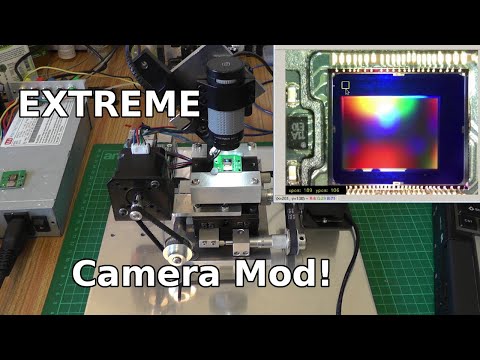
Bayer filter removal on a Pi Camera: Laser stripping, CFA removal, debayering, and UV conversion.

YouTube
@janamarie Idk if it would be a big improvement to your current workflow but at one point I had to write a python script to calculate the maximum and minimum of every pixel across hundreds of images.
I used rawpy for reading my CR2s and tiffile for output, which gave me about 1pic/s speed on an hdd (though I didn't have to save a tif for every picture).
Anyways, might be worth trying! 
@skylarmlem ooh, TIL rawpy! That sounds interesting, will look into that. Thanks!!!
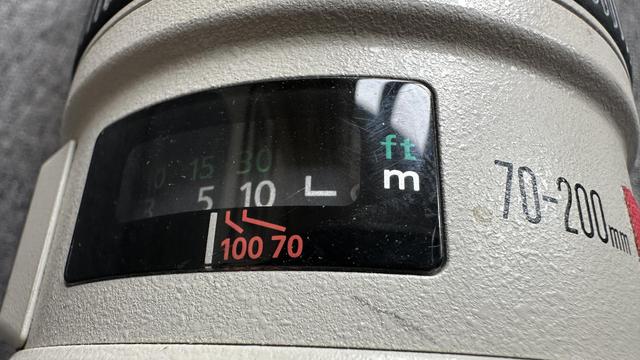
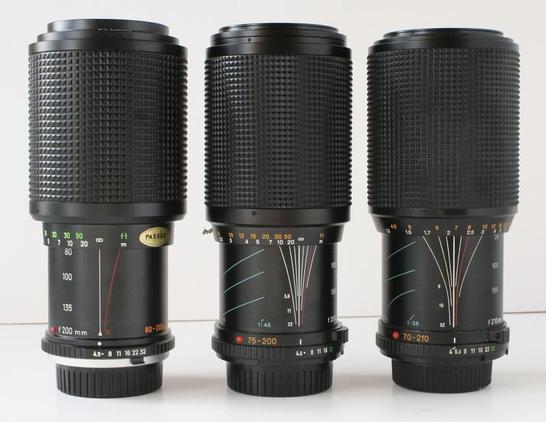
@janamarie some of my modern lenses still have the red IR index markers on them, although they are fairly crude compared to the more accurate diagrams on manual lenses I used decades ago for shooting infrared film.
@th ooh, very nice! such a weird artifact in a way
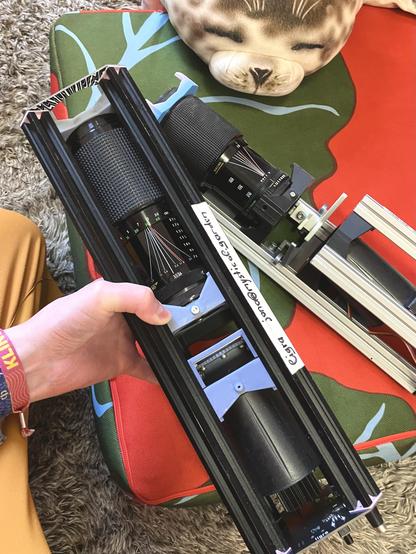
@janamarie I don't have them anymore, but they looked like these manual focus zoom lenses
@th aaaaah yes!! I have a bunch of these barrel type lenses, I just love the markings and interface, even if it is a bit annoying to use at times. Your three lenses are marvelous!
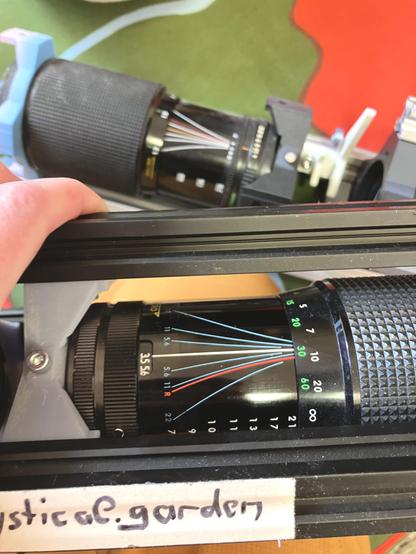
@th oh hey, look at that!! My ligras have them! Now I can do sharp IR projections :D
@janamarie @th
My (sadly no longer) Minolta Rokkor lens had an IR focus index mark.

@janamarie I'd imagine that it'd be trivially possible to swap to a different Bayer pattern in a DNG file. Converting from CR2 to DNG is quick and easy - and lossless. The file format is described openly, so maybe dig into that?

http://lasse.nerdcamp.net/static/dng-in-lightroom-ohne-demosaicing/index.html

DNG's in Lightroom ohne Demosaicing | preamp.org

@lasse yea, that would be interesting! I think my main issue with the colour swap is that I want to do demosaic/debayer in DxO, but it can’t swap channels. So I need to swap them before debayering, which is nothing you would usually do. But converting to dng would open up a bunch of tools! Thanks!
@janamarie I could try to come up with something for you, but it'd probably take me several days... Haven't done anything along those lines in years 🙈
@lasse hah, don’t worry! My current workflow works, I will see if I can optimize it, but it’s everything but urgent. I like it when doing art takes some time

@janamarie I still have to successfully do the color swapping, Lightroom also makes that hard to do, so your workflow is something to try.

I did manage to fix the autofocus on my Nikon D70, there is a tiny screw inside the mirror box to adjust it. Maybe there is something similar for your Canon.

@mifune yea! It has three screws for focus adjustment, but each adjustment requires full disassembly and re-assembly. This means I have to disconnect and reconnect a few board to board connectors with a life-cycle of ~10 matings. So I just fear that adjusting it will break a connector
@janamarie Ah, it took me like 3 to 4 tries to get it right for both close and infinity focus. I get that you wouldn't want to try that with the way you have to adjust it

@janamarie Hi Jana! Have you tried opening the cr2 files with Natron? It's an open source compositing software that uses nodes and supports 32bit color management.

I've just tried and it can read cr2 files directly. Then you can use a Shuffle node to swap channels and write out the image to a hdr, exr, tiff or whatever you need (I've tried writing out to raw formats again like cr2 or dng but it crashes. Maybe you have more luck)

Hope it helps!

@gsevillano ooh, never heard of natron! I will def try that. Thank you!
@janamarie first trans*-photography and now enby*-photograpy?   
@CIMB4 hehe, you're right! didn't see that until now 🥺

@janamarie I have an old Fuji X-E2 laying somewhere... it's very inspirational to give it a second life with such a project !

I will check if it can be converted now 😊 Do you have any pointers ?

Thank's for the details on your workflow ! I have been postponing my tests about DxO on Linux for months, this may be the motivation I needed.

@molusk oooh!!! I love the Fuji X-E2, I have one myself and I use it so so so much, almost more often than my X-T4, in fact every photo in this thread was shot on my X-E2 https://mystical.garden/@janamarie/114398828788760621.

Of course if you don't use yours as much, converting it could be a fun challenge. You can probably even get some good in-body rendered photos! Giving it a quick search, this seems like a good set of instructions https://www.lifepixel.com/tutorials/infrared-diy-tutorials/life-pixel-fujifilm-x-e2-diy-digital-infrared-conversion-tutorial

Be aware that this all in all can induce costs, e.g. if you want to replace the filter with glass slide to protect the sensor, it can easily cost 60€, the IR filters themselves cost a fair bit (e.g. the 550nm lpf I have was also about 60€) and of course there's a chance that the camera can get damaged during the modification

@janamarie thank's a lot !
I really loved the X-E2 but sadly almost never used it since I've got the X-E3. I also tried X-E4 but sold it quickly, never got any feeling with it. So X-E3 is the one I keep and X-E2... I couldn't sell it. It's a great camera and I don't know, it's special.
Last time it took pictures, a friend of mine was using it to teach photography in a highscool, 2 or 3 years ago... 😨

I don't think I would be able to invert channel in-camera but yes, all the custom preset may be great for IR photography !

@janamarie I haven't looked into the red-blue swapping, but is this something magic lantern would do? I run it on both my cameras but have barely touched all the features.

For normal shots, can you put an IR filter on the lens and get the camera to react normally again? I have a Ti4 and Ti5 I had considered doing this mod for astrophotography, but never got around to trying it, and I use both cameras for regular photography.

@Shdwdrgn I am actually not sure if ML can do this, I also run it on my camera.

In theory yea! You can get normal operation again by cutting out IR and UV

Has that camera had the filter removed off the sensor? The pink and turquoise tones are gorgeous.
I bet that’s a lot of fun. I just use an IR filter on my normal camera to get some cool B&W style photos SooC.
@FlashF1R3 @janamarie
Only the separate out-of-band filter layer. It still has the imperfect Bayer CFA with usuually
R G
G B
over 2 x 2 pixels, though there are other schemes.
Single tube vidicons had stripes.