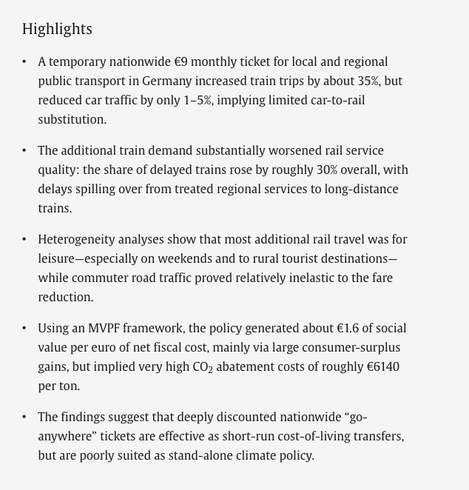
This is a great illustration highlighting transport systems need system- and networked thinking. Emergency measures are costly interventions, but can provide for learning opportunities (bar: narrative shadows), to inform broader system change. Could the paper have done "better"?
First, to say the obvious: the paper does MANY things expected from a high quality paper at the intersection of public finance/public policy etc and is a great piece of work. Yet, this paper may also develop a "narrative shadow", you may see in the future it is being "cited"...
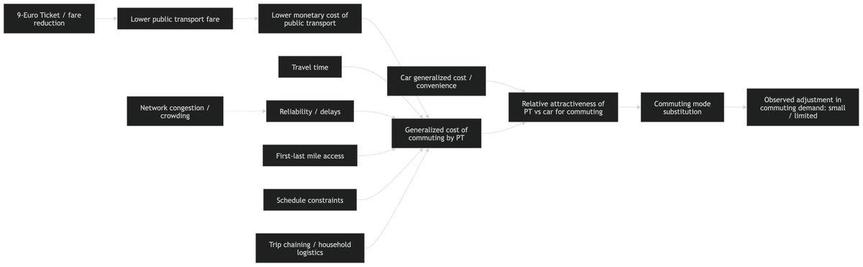
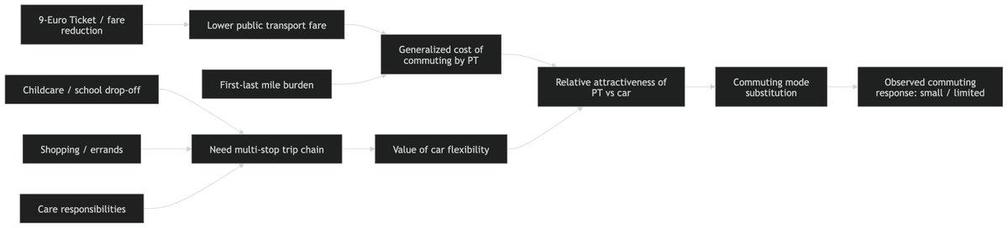
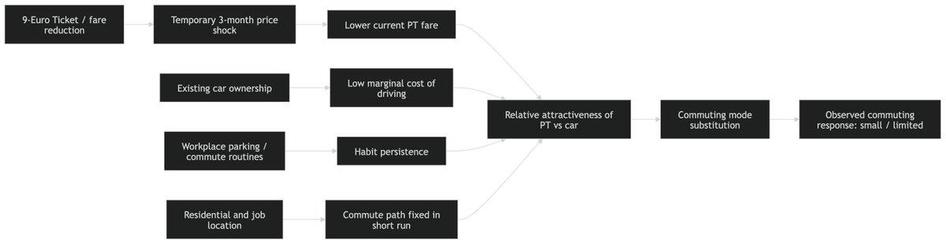
as evidence that public transportation subsidies "don't work" tackling things like the climate crisis. The authors rightly warn that this is not the correct interpretation of the results, but it is within the span of narratives. The main mechanism can be presented as this:

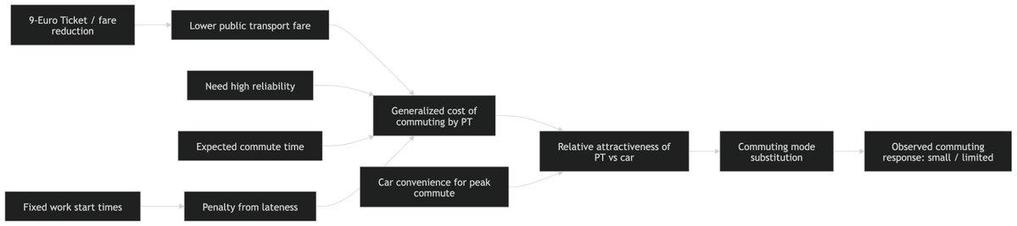
But we are missing a ton... the authors highlight each of these. For example, it could be that hard works schedules constrain commuting choice set.
Similarly, the policy induced demand shock may reduce the value of the fare cut.
Or it could be that informational boundaries strike. That we are unable to measure many of the more local adjustments that may capture large welfare gains. Revealed preference in favor of WFH suggests this may not be irrelevant.
It could be that transportation is bundling many tasks together that are difficult to unbundle with public transport in the absence of a local service sector economy that caters to said needs (trip chaining/bundling)
Similarly, the temporary fare shock may not overcome fixed commuting arrangements or these are costly to adjust to (think about how long it may take to cancel e.g. an arrangement for parking,...) people dont like to make adjustments if they perceive shocks to be transitory.
Further, the policy itself was blunted by the deployment of another correlated intervention: the fuel tax cut weakened the relative-price signal. Now this is important to ponder...
This paper is surely important and I am glad it was published so well, but what do we think is the narrative shadow this research may develop? It may be (ab)used by political operatives for their own narrow goals. This has happened to my own work so many times, which is why I...
so interested in finding ways to evidence anchor or validate narratives. But this is where invariably we will experience a clash of cultures. And I feel (most of) societies are not ready for this. The obvious "culture clash" is on freedom of speech versus shared responsibility.
@HenzeTimon @SarahNecker
@edenhofer_jacob
@ChFlachsland